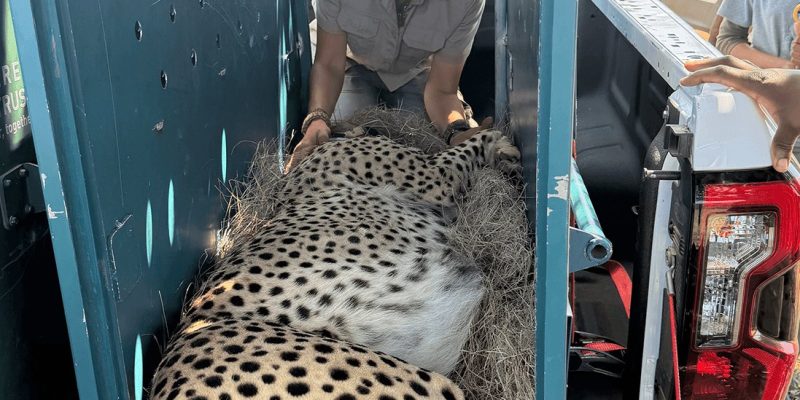
Pilanesberg National Park had two cheetahs, both female, and no male. It now has four, after the Endangered Wildlife Trust moved two adult males across from Madikwe Game Reserve and held them in a boma for three weeks before letting them loose.
The Trust described the operation on November 7. Its Cheetah Conservation Project facilitated the relocation on September 23, 2026, moving the two males from Madikwe to Pilanesberg, both reserves in South Africa’s North West Province. The two were released from the holding boma on October 13 and have been exploring the park since.
Why two males were the thing Pilanesberg needed
Because a population with no males is not a population. It is an endpoint. The two resident females had no breeding prospect in the park, and the arrival of the males balances the sex ratio, introduces genetic material from a different reserve, and makes future breeding possible where it previously was not.
That reasoning is not Pilanesberg’s alone. The move was made under South Africa’s managed Cheetah Metapopulation Project, which treats the country’s fenced reserves as one population on paper even though they are many populations on the ground, and moves animals between them to keep the genetics moving. Fenced reserves do not exchange animals by themselves. Somebody has to drive them.
The boma, and why they did not simply open the crate
Madikwe and Pilanesberg are close together, and that proximity is a problem rather than a convenience. A cheetah released near the place it came from may try to walk home.
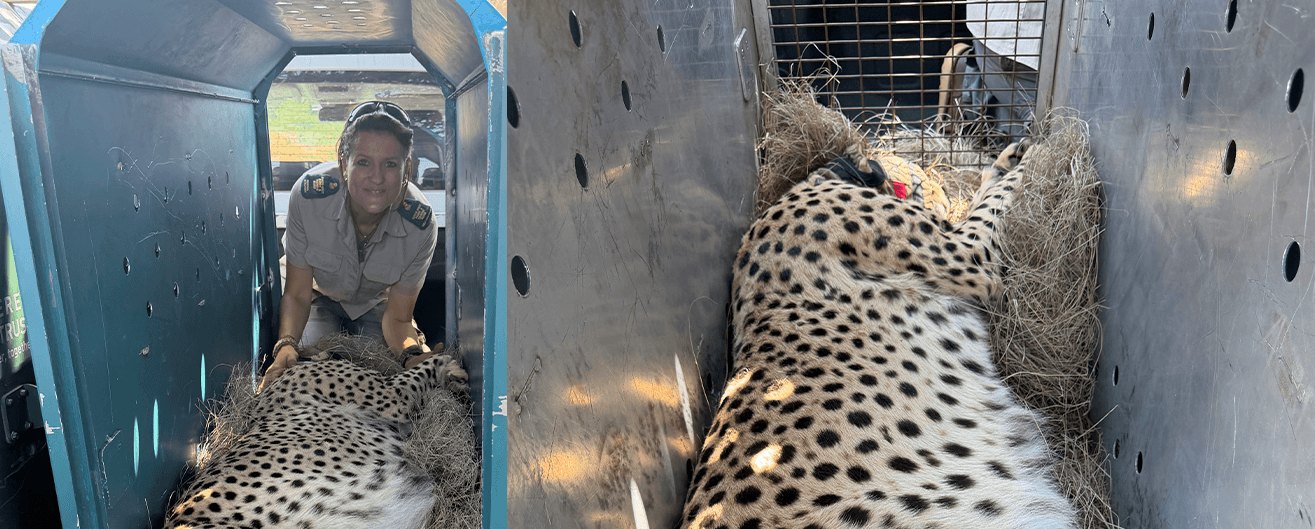
So the two males went into a temporary holding boma on arrival rather than straight into the park, a delay the Trust attributes directly to “the cheetah’s natural homing instinct,” and were given three weeks to settle before the gate was opened on October 13. The same instinct, in a much larger animal, is what undid an elephant translocation in Kenya that we wrote about three days ago, where two collared animals left their release area within one to seven weeks. Soft release is the cheap insurance against that outcome, and it is the step that gets cut when an operation is rushed.
The handling itself was routine and is worth spelling out because it is where translocations go wrong. Both males were immobilized, given health assessments and fitted with tracking collars before transport. The Trust credits the wildlife veterinarian Dr Zoe Glyphis with the clinical side and the management teams at Madikwe and Pilanesberg with the ground support, and is careful to describe its own role as facilitation: both reserves are government-managed, and the Trust coordinates rather than owns.
Which zoos or aquariums fund this
None, and in this case the organization says so itself rather than leaving us to find out. The Endangered Wildlife Trust states at the foot of the article that its Cheetah Conservation Project “is supported by the Ford Wildlife Foundation and MetroFibre.” Neither is a zoological institution: the first is the conservation arm of a motor company, the second a South African fiber network operator. We checked the zoos’ side as well, which is usually the side that publishes a gift, and found no accredited zoo or aquarium named in connection with this translocation or with the Trust’s cheetah work.
That is a real finding rather than a gap. Accredited institutions do fund cheetah conservation heavily, including the work of the Cheetah Conservation Fund in Namibia that we covered from Geneva this week, and the American Zoo and Aquarium Association reports its 235 accredited and certified facilities spent roughly $372.4 million on conservation across 139 countries in 2025. This particular operation was not one of them, and the honest version of that sentence is more useful than a forced connection.
What happens next is a monitoring question
Both males are collared, which means the thing that matters most about this move is measurable: whether they stay. The Trust has not reported on their movements since the November 7 article, and nothing published since suggests either animal has left the park or come to harm.
Pilanesberg is where the answer will show up, over seasons rather than weeks. A balanced sex ratio is an opportunity for cubs, not a guarantee of them, and a metapopulation only works if the animals moved into a reserve behave as residents of it.
Quick answers
- What happened at Pilanesberg National Park?
On 23 September 2026 the Endangered Wildlife Trust facilitated the relocation of two adult male cheetahs from Madikwe Game Reserve to Pilanesberg National Park, both in South Africa's North West Province. The park's only resident cheetahs were two females. The males were released from a holding boma on 13 October 2026.
- Why were the cheetahs held in a boma first?
Because of what the Trust calls the cheetah's natural homing instinct. Madikwe and Pilanesberg are close together, so an animal released directly into the park might set off back toward the reserve it came from. Three weeks in a temporary enclosure let the two males settle before the gate was opened.
- What is the Cheetah Metapopulation Project?
South Africa's managed program for coordinating cheetah movements between fenced reserves. Because the reserves cannot exchange animals on their own, the project moves individuals between them to balance sex ratios, maintain genetic diversity and support the long-term viability of the population as a whole.
- Which zoos or aquariums funded this translocation?
None that we could verify. The Endangered Wildlife Trust states that its Cheetah Conservation Project is supported by the Ford Wildlife Foundation and MetroFibre, neither of which is a zoological institution, and we found no accredited zoo or aquarium named in connection with this move.