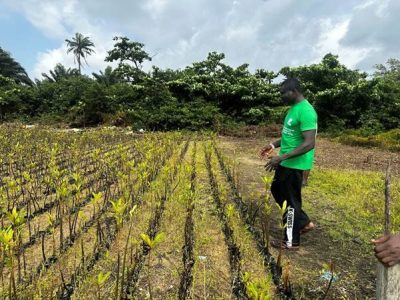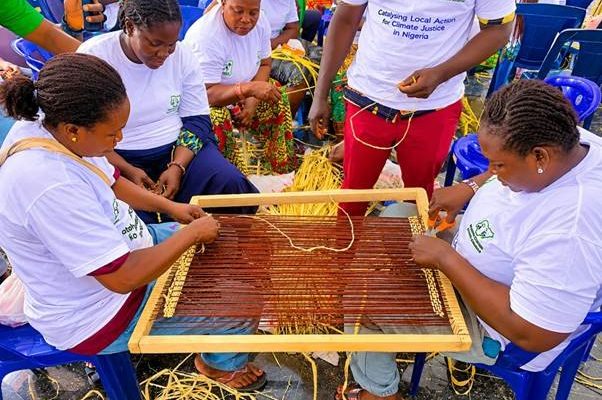
One hundred people in two Niger Delta communities have been trained to weave fiber from an invasive palm into bags, baskets, flower vases and book covers, and several of them are already selling the results. The plant they are working with is the same one conservationists in the region spend money pulling out of the mangroves.
The Nigerian Conservation Foundation described the training on November 19, under its Catalysing Local Action for Climate Justice in Nigeria project, which is supported by the Ford Foundation. Fifty participants came from each of two communities, one of them Ogulagha in Burutu Local Government Area, Delta State. Alongside the practical instruction in processing the fibers, the foundation supplied tools, starter materials, financial support and basic business and marketing guidance.
Why the palm is a problem in the first place
Nypa palm is not from the Niger Delta. The IUCN Invasive Species Specialist Group’s Global Invasive Species Database entry for Nypa fruticans records a native range running from Sri Lanka and the Ganges delta east to the western Pacific, taking in India, Myanmar, Thailand, Malaysia, Indonesia, the Philippines, Papua New Guinea, Australia and the island states beyond. It was intentionally introduced to Nigeria, the database says, and has since spread to Cameroon.
What it does there is the problem. The database records that the palm forms dense single-species stands that outcompete native mangroves, and that it “displaces native mangrove vegetation throughout the Niger Delta and in Cameroon.” It also notes a mechanism that makes the spread self-reinforcing: where red and white mangroves are cut for fuel wood, the mudflats left behind are readily colonized by nypa. Cut the mangrove, and the palm takes the ground.
That is why restoration work in the delta often starts with removal. We reported the other half of this ledger two days ago, when the same foundation replanted 23 hectares of mangrove across Rivers and Bayelsa states and had to clear nypa at Bodo and Baa before anything could go in the ground. The training described here is the same plant approached from the opposite end: not as vegetation to be removed at a cost, but as material with a price.
What the trainees say happened next
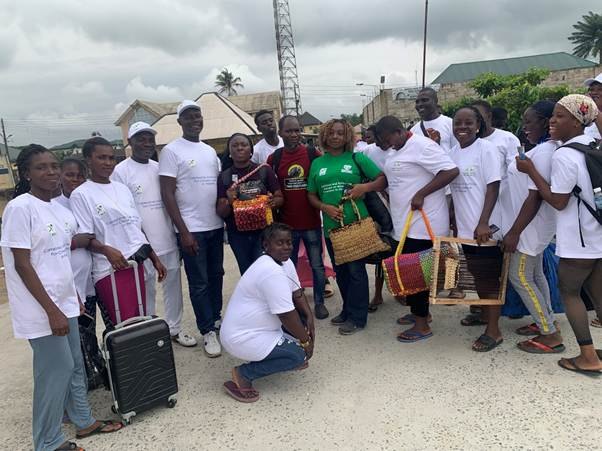
The foundation’s account carries three named participants, which is more than most project write-ups offer, and what they describe is sales rather than attendance.
Dobra Ogolobori of Ogulagha learned to work the fibers into household items and slippers. “After the training, I started making money from the products. People buy them and even come to learn from me. I use the money from the sales to support my husband and my family,” she said.
Ogolonpitan Npapa, financial secretary of Ogulagha community, described the effect on his household. “My wife participated in the training and learnt how to make these products. Today, people from neighbouring communities come to buy what she makes, and she can now help me with the family’s responsibilities.”
Raymond Blessing, another participant, pointed to a product the local market had not seen before. “We learnt how to make bags and sell them. Before now, we had not made this kind of bag here, but people are already buying them.”
Buyers arriving from neighboring communities, and non-trainees asking to be taught, are the two things that distinguish a skills workshop that took from one that did not. Both appear in the accounts above, within weeks rather than years.
The foundation is careful about what it claims
Read closely, the write-up promises very little. The foundation states plainly that the longer-term potential depends on consistent product quality, market demand, access to buyers, and whether participants can sustain production at all, and that early accounts from beneficiaries are “encouraging early signs” rather than an outcome. It frames continued support and market connections as work still to be done.
That is an unusually honest register for a project report, and it matters here, because the weak point of invasive-species-to-livelihood schemes is well known: the craft market saturates, the buyers who turned up for the launch stop coming, and the harvesting pressure on the invasive plant never reaches a scale that affects its spread. Nothing in the account claims that 100 trained weavers will clear nypa from the delta. The claim is narrower, and better supported: some households in Ogulagha have a second income they did not have, and it comes from a plant that was previously only a cost.
Which zoos or aquariums paid for this?
None that we can find. The funder named on the work is the Ford Foundation, through the Catalysing Local Action for Climate Justice in Nigeria project, and we went looking on the foundation’s side as well. The Nigerian Conservation Foundation’s own partnerships page names IUCN, WWF, the RSPB and BirdLife International as the global conservation organizations it works through. No zoo, aquarium or zoological society appears on it, and none of AZA, EAZA, WAZA or PAAZA is mentioned anywhere on the page.
We print that because the answer is sometimes yes. When we looked at the collapse of Nigeria’s vultures, the trail from the same foundation’s work led to a long list of accredited institutions. Here it does not, and inventing one would be worse than reporting the absence. The Association of Zoos and Aquariums reports that 235 accredited and certified facilities spent approximately 372.4 million dollars on conservation across 139 countries in 2025; no published breakdown isolates an African share, so there is no regional figure to weigh the Ford Foundation’s contribution against. What there is here is a named funder, an absent one, and a reason to keep checking both.
Quick answers
- What is nypa palm and why is it a problem in Nigeria?
Nypa fruticans is a mangrove palm native to a range running from Sri Lanka and the Ganges delta east to the western Pacific. The IUCN Invasive Species Specialist Group records that it was intentionally introduced to Nigeria, has since spread to Cameroon, forms dense single-species stands, and displaces native mangrove vegetation throughout the Niger Delta.
- How many people were trained, and where?
One hundred, 50 from each of two Niger Delta communities. The Nigerian Conservation Foundation names one of them as Ogulagha, in Burutu Local Government Area, Delta State.
- What do the trainees make from the palm?
Bags, baskets, flower vases, book covers and other household and decorative products. One participant also describes making slippers. Alongside the instruction, the foundation supplied tools, starter materials, financial support and basic business and marketing guidance.
- Which zoos or aquariums fund this work?
None that we could verify. The named funder is the Ford Foundation, through the Catalysing Local Action for Climate Justice in Nigeria project. The foundation's own partnerships page names IUCN, WWF, the RSPB and BirdLife International, and no zoo, aquarium or zoological society appears on it.