
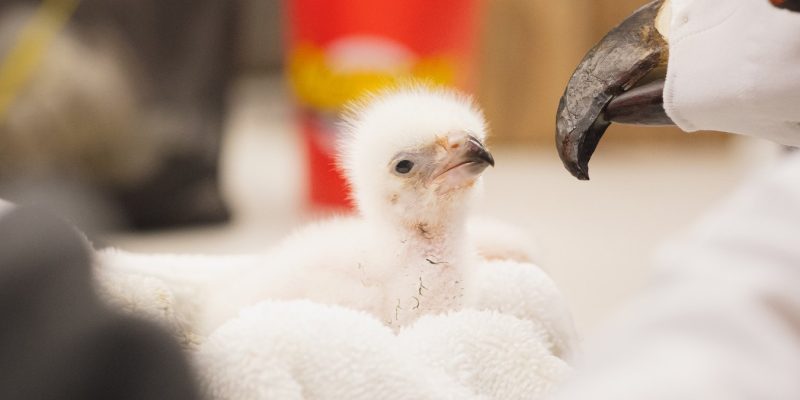
The Fort Worth Zoo has hatched an African fish eagle chick, the first eagle of any species to hatch there in the zoo’s 117-year history. It is also, the zoo says, the only institution accredited by the Association of Zoos and Aquariums to have hatched this species in the last several years.
The chick came out of the egg at 76.5 grams, roughly the size and weight of a tennis ball. Six weeks later it was close to full size: 25 to 30 inches tall and 5 to 8 pounds, though its adult plumage, the white head and chest against dark brown, was still weeks away.
Why the keepers dressed up as an eagle
The adults are first-time parents, so keepers made the call to hand-rear rather than leave the chick with them. That decision buys round-the-clock feeding and monitoring during the weeks when a raptor chick is most fragile, and it costs something too: a hand-reared bird can imprint on the people feeding it, fixing on humans as its own kind and losing the social behavior it will need later.
The workaround is theatrical and entirely standard in raptor care. Staff fed the chick wearing reflective shields and protective clothing, with an adult eagle puppet present at every feeding, so the thing the chick learned to associate with food was an eagle rather than a person. It is housed in a protected space inside its parents’ habitat, close enough to see and hear adults of its own species while keepers do the feeding.
In the wild, African fish eagle chicks begin to fly at around 70 to 75 days old and stay near their parents’ territory for another two or three months before striking out. The zoo’s chick will be fed and cared for by keepers until it is big enough to fledge.
What “rare in professional care” actually means here
The African fish eagle is not a rare bird. The IUCN Red List, in a 2020 assessment by BirdLife International, lists it as Least Concern, and it is one of the most recognizable sounds in sub-Saharan Africa. Its scarcity is on this side of the ocean: the Fort Worth Zoo is one of only five institutions on the continent that keep the species at all.
That is the gap this hatch addresses. Five facilities holding a species between them have five collections rather than a population, and collections age out. Establishing a self-sustaining group of African fish eagles in North American zoos means birds have to be produced here rather than imported, and until now essentially none were. One chick does not fix that arithmetic. It demonstrates that the arithmetic can be fixed.
This is also why the chick will not spend its life in Fort Worth. The zoo has said the young eagle remains behind the scenes and will likely be transferred to another accredited zoo once it matures, which is what a bird produced for a managed population is for.
The part that took years
Hatching is the visible end of a process that mostly is not. The zoo credits managed pairings, nest building, egg laying, incubation and hatching, each a step where the whole thing can quietly fail, and each requiring its own judgment calls by the animal care and veterinary teams. Notoriously difficult to breed is the phrase the zoo uses, and the count of institutions that have done it recently backs the phrase up.
Fort Worth has a record with difficult birds. It hatched seventeen lesser flamingo chicks in 2023, another species that is stubborn about reproducing under human care and another case where the answer was years of adjusting conditions rather than a single intervention.
Will visitors be able to see the chick?
Not for a while. It is in a protected space within the adults’ habitat while keepers finish raising it, and its longer-term home is expected to be a different accredited zoo. The adult African fish eagles remain at Fort Worth, and they are worth finding: a bird whose wingspan runs from about six and a half feet in males to nearly eight in females, with a call that carries across open water, is not a subtle exhibit animal.
Sources: Fort Worth Zoo, “‘The eagle has landed’: First hatching of African fish eagle chick,” March 19, 2026; BirdLife International species factsheet, Haliaeetus vocifer; Fort Worth Weekly, “New African Fish Eagle,” July 29, 2026, for the chick’s status since the hatch.
Quick answers
- Has the Fort Worth Zoo hatched an eagle before?
No. The African fish eagle chick announced in March 2026 is the first eagle of any species to hatch there in the zoo's 117-year history.
- Why was the chick hand-reared?
Its parents were breeding for the first time, so keepers hand-reared the chick to provide round-the-clock feeding and monitoring. They wore reflective shields and protective clothing and used an adult eagle puppet at feedings so the chick would not imprint on people.
- Is the African fish eagle endangered?
No. The IUCN Red List lists it as Least Concern, in a 2020 assessment by BirdLife International. It is rare in professional care rather than in the wild: the Fort Worth Zoo is one of only five institutions in North America that keep the species.
- Will the chick stay at the Fort Worth Zoo?
The zoo has said it remains behind the scenes for now and will likely be transferred to another accredited zoo once it matures.