A Seattle Aquarium research collaboration spent five months this year bringing sixgill sharks briefly to the surface of Puget Sound to find out who they are. The season closed in September with 20 sixgills and six spiny dogfish sampled across 15 expeditions, and the largest shark they handled measured 9.1 feet.
The sixgill that lives in Washington waters is the bluntnose sixgill, Hexanchus griseus, and the reason nobody knows much about it is that it usually lives too deep to study. The Washington Department of Fish and Wildlife, one of the project’s collaborators, calls it one of the most widespread sharks in the world on the strength of how much deep water it occupies. Divers in Puget Sound saw them in unusual numbers this year, which is the opening the research was built around.
What does six gill slits actually tell you?
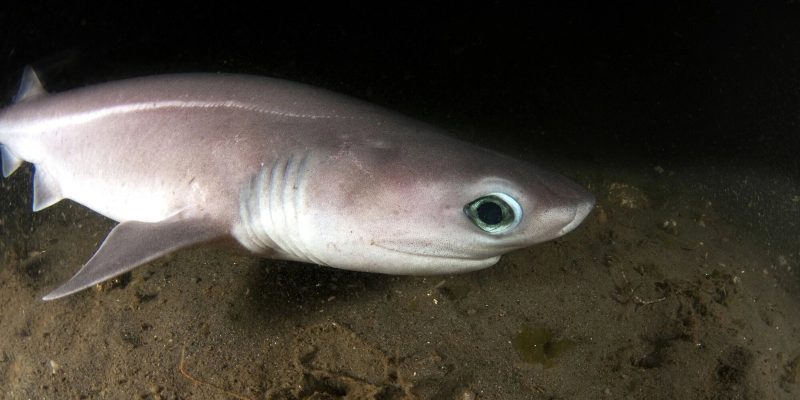
That the animal is from an older branch of the shark family tree. Nearly every shark alive has five gill slits on each side; the sixgill has six, which is where the common name comes from and which sets the hexanchiform sharks apart from the groups most people can picture. The bluntnose is also built differently from a reef shark: a heavy body, a broad head, a single dorsal fin set far back near the tail, and six rows of bladelike, comb-shaped teeth on each side of the lower jaw. The eyes are the detail people remember: small, and a luminous green-blue.
What did the team actually do?
Fifteen trips, five each at three sites: Elliott Bay, a site near Bainbridge Island, and one off Redondo Beach. At each, animals were brought briefly to the surface alongside the boat, worked on fast, and released.
From every sixgill the team took blood, muscle and fin samples and a cloacal swab, assessed the animal for parasites, measured it and photographed it. Two of the six dogfish were sampled the same way. A cloaca is the single opening that birds, reptiles, amphibians and some fish use for waste, urination and reproduction; swabbing it returns a species-level read on what the animal has recently eaten, on a shorter timescale than the other methods available, which is how you learn what a deep-water predator is hunting without following it down.
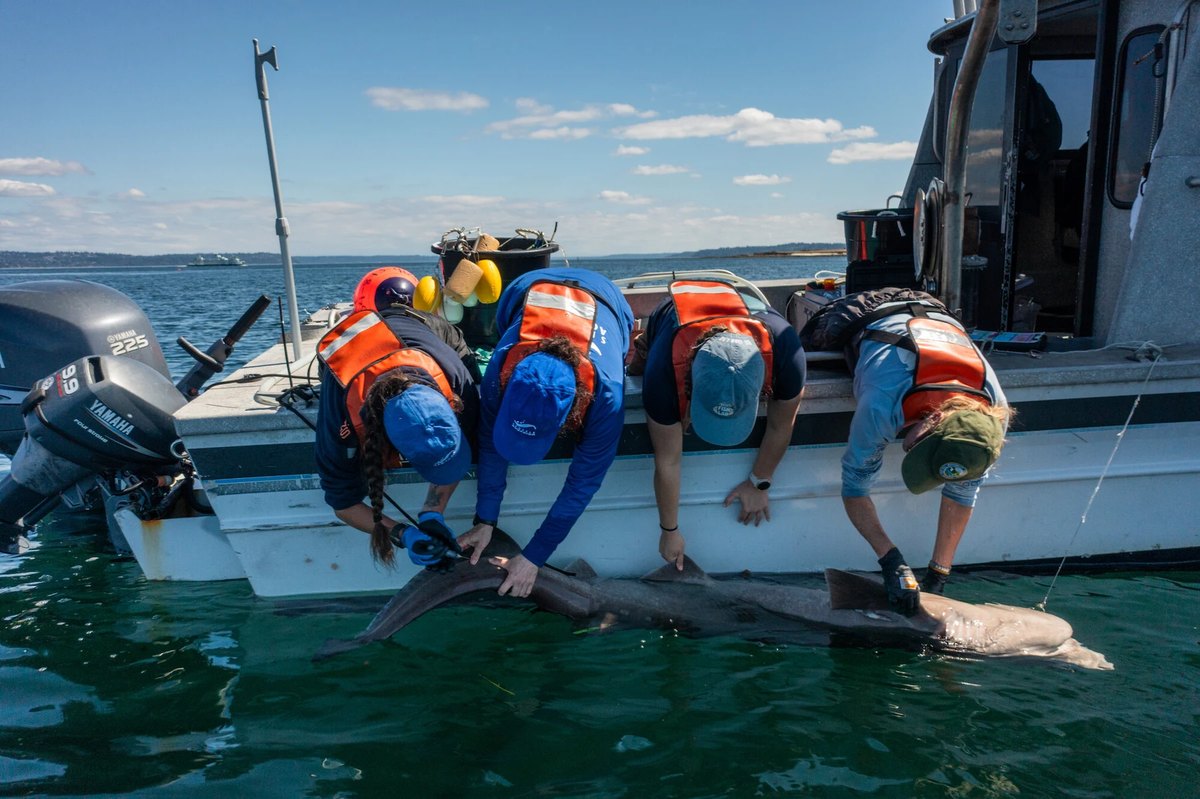
Every animal got an external Floy tag, the visible plastic marker a diver or a fisher can read without catching the animal again. Some also carried acoustic tags, which report movement and habitat use to listening stations rather than to a human eye. The two answer different questions: the Floy tag asks where an animal turns up, the acoustic tag asks where it has been.
The measurements give the first sense of the population’s shape. Across the 20 sixgills, the average was 7.6 feet, or 232 centimeters. The smallest was 5.8 feet, the largest 9.1 feet.
What are divers contributing?
A sightings report form the Aquarium launched alongside the fieldwork, open for tagged and untagged animals alike. It has produced reports on 22 individual sharks so far. One of them is an animal the team tagged, and it has now been spotted four separate times, which is the beginning of a movement record built by people who were in the water anyway. The Aquarium notes that it is illegal to fish for, retain or remove sixgill sharks from the water in Washington.
“The sixgill fieldwork season was a tremendous success,” said Seattle Aquarium Research Scientist Dr. Dani Escontrela. “Even though I knew sixgills were in the Sound, I still couldn’t believe it when we brought our first individual to the surface. Everything about them was thrilling to see in person, especially their huge, teal eyes.”
Is there really a shark under the Aquarium?
Yes, and the Aquarium went looking for it. The Elliott Bay site is directly below the Aquarium’s own Pier 59. The team made five baited dives there between May and September, each paired with time-lapse GoPro footage, and worked with the company MarineSitu to install an adaptable monitoring platform under the pier for continuous video. The bait was mostly fish heads left over from preparing food for the animals at the Seattle Aquarium and at Point Defiance Zoo & Aquarium, which would otherwise have been waste.
This is not the first time. The Aquarium studied sixgills under the same pier in the early 2000s after a run of local sightings, and ended that work in 2015 when the sightings dropped off. The animals came back; the research followed them.
What happens now?
Laboratory work. “For the rest of this year, we will be dedicating our efforts to processing the samples we collected, preparing for our next field season, continuing to develop our partner relationships, and starting to analyze the data we collected this year,” Escontrela said.
The stated goal is a long one. “To better understand this population, their behavior, feeding, physiology and more, to help shape their management needs,” said Director of Animal Health Dr. Caitlin Hadfield. “This is a long-term goal because of how little is currently known about them.”
The collaborators on the water were the Washington Department of Fish and Wildlife, the Big Fish Lab at Oregon State University and Point Defiance Zoo & Aquarium, with support from the Monterey Bay Aquarium, the Science and Math Institute in Tacoma, Seattle Central College, the University of Hawai’i at Manoa, Seattle University, Stanford University and the recreational diving community. The work ran under Washington Department of Fish and Wildlife scientific collections permit ESCONTRELA 26-131a.
The Aquarium’s own recap is here, and the state’s species page for the bluntnose sixgill is here. We covered the Aquarium’s other baseline research project, on sea otters in Oregon, here.
Quick answers
- What is a bluntnose sixgill shark?
Hexanchus griseus, a deep-water shark with six gill slits on each side where almost every other shark has five. It has a heavy body, a broad head and a single dorsal fin set far back near the tail. The Washington Department of Fish and Wildlife calls it one of the most widespread shark species in the world.
- How many sharks did the Seattle Aquarium team sample?
Twenty sixgill sharks and six spiny dogfish, across 15 field expeditions between May and September 2026.
- How big were they?
The 20 sixgills averaged 7.6 feet, or 232 centimeters. The smallest was 5.8 feet and the largest 9.1 feet.
- What did the researchers collect?
Blood, muscle and fin samples and a cloacal swab from every sixgill, plus parasite assessments, measurements and photographs. A cloacal swab gives a species-level read on what the animal has recently eaten.
- Where did the research take place?
Three Puget Sound sites, five expeditions each: Elliott Bay, a site near Bainbridge Island and one off Redondo Beach. The Elliott Bay site is directly below the Aquarium’s own Pier 59.
- Can divers report a sixgill sighting?
Yes. The Aquarium launched a sightings report form for tagged and untagged animals, and it has produced reports on 22 individual sharks so far. The Aquarium notes that it is illegal to fish for, retain or remove sixgill sharks from the water in Washington.