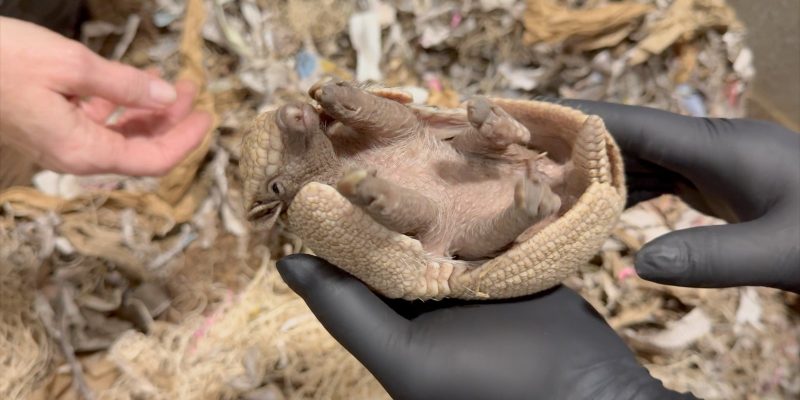
The Oregon Zoo has a new armadillo, named after a chess piece. Rook was born on September 28 to mother Max and father Toby, the pair’s third pup, and care staff only recently got a proper look during a routine health check.
The name is a joke with a point. A rook is the castle on a chessboard, and a three-banded armadillo is an animal that carries its own castle. Rook weighs 22 ounces. A full-grown three-banded armadillo weighs about three pounds, which puts the pup a little under half-size and, according to the people watching, climbing fast.
“Max is a great mom, so we haven’t needed to step in at all,” said Eliza Lee, who oversees the zoo’s armadillo family. “She keeps Rook nice and cozy in their nest.”
Max has been keeping the pup so thoroughly tucked away that nobody has yet confirmed whether Rook is male or female. That will come from the veterinary team at a future checkup. Until then the care team is taking a deliberately hands-off approach and letting the pair bond without interference, which is why mother and pup are still in a private maternity den behind the scenes rather than out on exhibit.
What makes a three-banded armadillo different?
It is the only kind that can roll all the way into a ball. Most armadillos are armored across the back and open underneath, so when something frightens them they dig. Three-banded armadillos cannot do that nearly as well, and they do not dig their own shelters at all: they move into burrows that anteaters have abandoned. What they have instead is the hinge. The three flexible bands across the middle of the shell let the animal fold head to tail until the armored plates meet and the soft parts disappear inside, leaving a sphere with no opening to work at.
That is also a nursery. The ball Max makes around herself is the safe, snug space the zoo describes her keeping Rook in.
Three-banded armadillos are among the smallest of the roughly twenty armadillo species, and they live in the dry grasslands and scrub of eastern Bolivia, southwestern Brazil, Paraguay and Argentina. Their numbers are falling, pushed down by habitat loss, hunting and the illegal pet trade.
How threatened are they?
The southern three-banded armadillo, Tolypeutes matacus, is listed as Near Threatened on the IUCN Red List, under criterion A2cd, with a decreasing population trend. That assessment was made on August 9, 2024 and published in 2025, so it is recent, and the zoo’s description of the species matches it on both the category and the range countries.
Rook, Max and Toby are part of the Association of Zoos and Aquariums’ Species Survival Plan for three-banded armadillos. An SSP is a breeding program run across many accredited institutions at once: a studbook keeper tracks who is related to whom, and recommendations about which animals should be paired are made for the population as a whole rather than one zoo at a time. The object is a group of animals that stays genetically diverse enough to sustain itself for the long run. A third pup from an established pair is exactly what that program is for.
For now Rook stays behind the scenes with Max. “Rook is getting bigger every day,” Lee said. “Mom is still staying close by for now, but pretty soon the pup will start venturing out a bit and exploring.”
The Oregon Zoo has had a notable few weeks: it has also been helping map the state’s deadliest roads for wildlife. This one is smaller and rounder.
Quick answers
- When was the Oregon Zoo's armadillo pup born?
On September 28, 2026, to mother Max and father Toby. Rook is the pair's third pup. Care staff got their first close look during a routine health check in November.
- Is Rook male or female?
Not yet confirmed. Max has kept the pup tucked away in the nest, and the veterinary team expects to determine the sex at a future checkup.
- Why can three-banded armadillos roll into a ball?
The three flexible bands across the middle of the shell act as a hinge, letting the animal fold head to tail until the armored plates meet and the soft underside disappears inside. They are the only armadillos that can close up completely, which is also why they do not dig their own burrows and instead use ones anteaters have abandoned.
- How threatened is the southern three-banded armadillo?
The IUCN Red List lists Tolypeutes matacus as Near Threatened under criterion A2cd, with a decreasing population, in an assessment made on August 9, 2024 and published in 2025. Habitat loss, hunting and the illegal pet trade are the pressures named.