
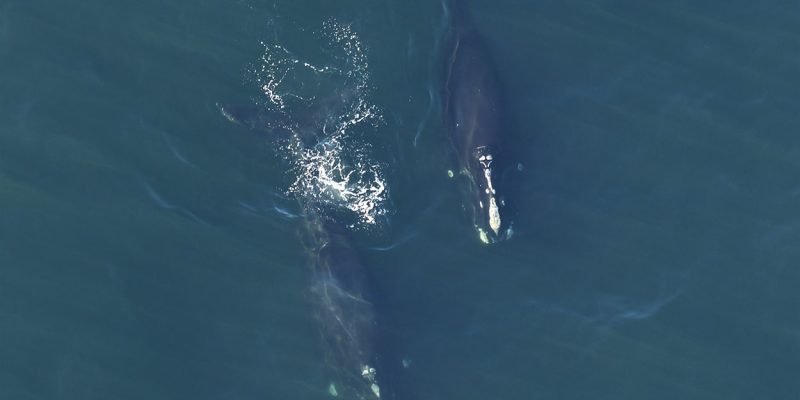
The question was whether protecting North Atlantic right whales and building offshore wind had to be a choice. A New England Aquarium scientist decided to find out, and the answer published in Nature Climate Change is no.
The study, “Balancing marine species conservation with cost-effective renewable energy development,” comes from Dr. Laura Ganley, a research scientist at the Aquarium’s Anderson Cabot Center for Ocean Life, with collaborators at the Anderson Cabot Center, Cornell University, LAUTEC US and NOAA. The Aquarium described it on August 13, 2026.
“I wasn’t satisfied with the idea that we have to choose between developing wind energy to fight climate change and protecting endangered species.”
Dr. Laura Ganley, New England Aquarium
The problem is noise, and it moved
The specific risk here is not ship strikes or fishing gear. It is piledriving, the process of hammering turbine foundations into the seabed, which is loud enough to affect marine life over a wide area.
What makes it a right whale problem is a change nobody planned for. More than fifteen years ago, when wind development was first slated for the water south of Martha’s Vineyard and Nantucket, scientists believed right whales did not use that habitat in summer. Climate change moved their food. Surveys then showed the whales increasing in New England waters in exactly the summer months when construction was scheduled.
The permitting assumption and the animal had quietly stopped matching.
Ten years of flying over the water
The method is the reason this works. The Aquarium has flown aerial surveys over southern New England roughly twice a month for more than a decade, and that archive let the team estimate right whale numbers in and around the Rhode Island and Massachusetts wind energy areas across the whole year.
“We were able to map predictions of whale occurrences in eight-day time periods. So, you could approximate week by week how many right whales were going to be in the area and how that was going to overlap with construction.”
Dr. Laura Ganley
Eight-day resolution is what turns a conservation objection into a construction schedule.
What the paper recommends
- Bubble curtains around piledriving to dampen the noise
- Construction scheduled for periods when the animals are not there
- Restrictions focused on the highest-risk area nearest the piledriving
- A prototype app developers could use during project planning
The finding is that these measures can greatly reduce the number of right whales affected at minimal cost to developers. Not zero cost. Minimal.
“It’s complicated, it takes a lot of time and a lot of collaborators. But, collectively, we can do it. It doesn’t have to be all or nothing.”
Dr. Laura Ganley
Why an aquarium is the one holding this data
A decade of twice-monthly aerial surveys is not a research project. It is an institutional commitment nobody funds on a grant cycle, and it exists because the New England Aquarium kept flying when there was no specific paper at the end of it.
That is the same logic behind long-run monitoring elsewhere in our coverage, including the cetacean distribution surveys behind the Macaronesia sanctuary proposal. Baseline data has no news value until the day somebody needs it, and then it is the only thing that settles the argument.
The North Atlantic right whale is critically endangered. Photographs of the species are made under NMFS permit.
Source: New England Aquarium; Nature Climate Change.