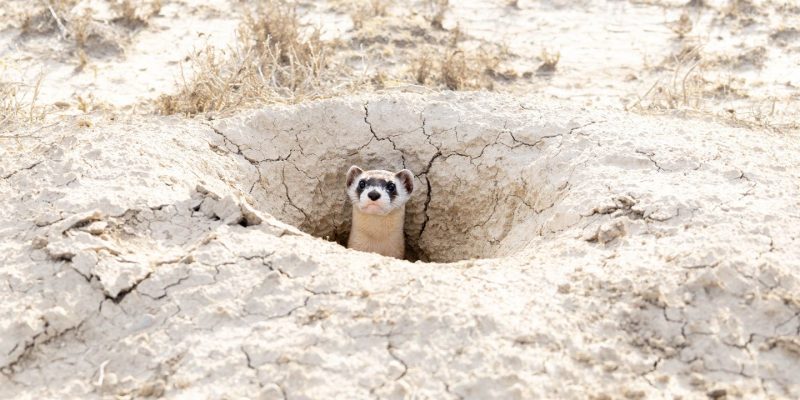
Five breeding facilities produced 470 black-footed ferret kits this year, and the five numbers add up exactly: 246 at the US Fish and Wildlife Service’s National Black-footed Ferret Breeding Center, 74 at the Smithsonian’s National Zoo and Conservation Biology Institute, 60 at the Louisville Zoo, 53 at Cheyenne Mountain Zoo and 37 at the Phoenix Zoo. Cheyenne Mountain published the tally on October 29, in a staff account written by Jeff Baughman, the zoo’s conservation manager for black-footed ferrets and Wyoming toads and the program leader for the Association of Zoos and Aquariums SAFE black-footed ferret effort.
It lands on an anniversary that is really two anniversaries. This year is 45 years since the species was rediscovered near Meeteetse, Wyoming, and the 40th year of breeding black-footed ferrets in human care.
Why a rediscovery, and not a discovery?
Because the black-footed ferret had already been written off once. The US Fish and Wildlife Service listed it as endangered in 1967 and again in 1970, and it was carried into the Endangered Species Act when that law took effect in 1973. By the late 1950s it was presumed gone across its entire range. A small population turned up in Mellette County, South Dakota, in 1964; the captive breeding attempt built around it failed, and that wild population died out in 1974. The animal was gone a second time.
Then came Meeteetse in 1981. Every black-footed ferret alive today traces back to the handful of animals taken into care from that population, and every known wild population is the result of a deliberate reintroduction rather than a remnant that survived on its own.
What a whelping season actually looks like
Gestation in a black-footed ferret runs 42 days, and a litter is due inside a three-day window, usually somewhere between April and July. Twelve females were potential mothers at Cheyenne Mountain this season, which Baughman counts as thirty-six mornings of waiting. Whelping is the term for the birth itself, and a newborn is a kit, about the size of a little finger.
Because the adults and the kits are candidates for release into the wild, the people who look after them deliberately stay away. The breeding center runs cameras on the nest boxes instead, and when a sleeping position blocks the view, staff go in quietly to listen for squeaks or wait for feeding time to get a look. The restraint is the point: a ferret that grows up comfortable around people is a ferret that is harder to put back on a prairie.
Preconditioning: the step between the nest box and the prairie
Most of this year’s kits will not go straight from a breeding center to open country. They go through preconditioning first, which means living in outdoor pens that contain real burrow systems and live prairie dogs. A black-footed ferret hunts prairie dogs and lives in prairie dog burrows, so the pen is not a training exercise in the abstract: it is the animal’s actual future, at a scale where a mistake is survivable. Kits that come through it are released at reintroduction sites, thirteen of them this year. Around 90 stay behind in human care across the partner facilities, as the breeding stock for the next generation.
The release program began in Wyoming in 1991 and now runs through eight states and three countries, with 35 locations having received ferrets: Wyoming, South Dakota, Montana, Arizona, Colorado, Utah, Kansas and New Mexico, plus Canada and Mexico. It works through state and federal agencies alongside Native American tribes, private landowners, non-profits and zoos. The Fish and Wildlife Service names sylvatic plague as the single largest obstacle to keeping those populations resilient, because the disease hits ferrets and the prairie dogs they depend on at the same time.
The prairie dog Jenga game
Cheyenne Mountain marked the rediscovery anniversary with a Rediscovery Day on the last weekend of September, and the activity worth describing is a modified Jenga tower in which each block stands for a prairie species. Pull out too many prairie dogs and the tower falls. That is a fair model of the real thing, and it is a more honest way of explaining a keystone species to a ten-year-old than most sentences would be. There was also a scavenger hunt for the prairie animals living at the zoo.
This is the species recovery template that several of our recent stories have circled. The Smithsonian’s cloned ferret litters, from one of the same five breeding facilities, are here, and the Phoenix Zoo’s Mexican wolf program, another animal rebuilt from a tiny founder group, is here.
Baughman’s account is on the zoo’s site here, and the Fish and Wildlife Service’s species profile, with the listing history and the recovery record, is here. Next whelping season starts in April.
Quick answers
- How many black-footed ferret kits were born in 2026?
470 across the five breeding facilities in the AZA SAFE black-footed ferret program: 246 at the US Fish and Wildlife Service National Black-footed Ferret Breeding Center, 74 at the Smithsonian National Zoo and Conservation Biology Institute, 60 at the Louisville Zoo, 53 at Cheyenne Mountain Zoo and 37 at the Phoenix Zoo.
- What happened at Meeteetse?
Black-footed ferrets were rediscovered near Meeteetse, Wyoming in 1981, 45 years ago, after the species had been presumed extinct across its range. Every black-footed ferret alive today descends from the animals taken into care from that population.
- What is preconditioning?
The step between a breeding center and a release site. Kits live in outdoor pens containing real burrow systems and live prairie dogs, so they learn to hunt and shelter the way a wild ferret does before they are released.
- Where have black-footed ferrets been released?
Reintroduction began in Wyoming in 1991 and now covers eight states and three countries, with 35 locations having received ferrets: Wyoming, South Dakota, Montana, Arizona, Colorado, Utah, Kansas and New Mexico, plus Canada and Mexico. Thirteen sites received kits this year.
- Is the black-footed ferret still endangered?
Yes. The US Fish and Wildlife Service listed it as endangered in 1967 and again in 1970, and it was carried into the Endangered Species Act in 1973. The Service says every known wild population is the result of a deliberate reintroduction rather than a surviving remnant.
- What is the biggest threat to the species now?
Sylvatic plague, which the US Fish and Wildlife Service names as the single largest obstacle to population resilience. It affects both the ferrets and the prairie dogs they hunt and shelter among.