
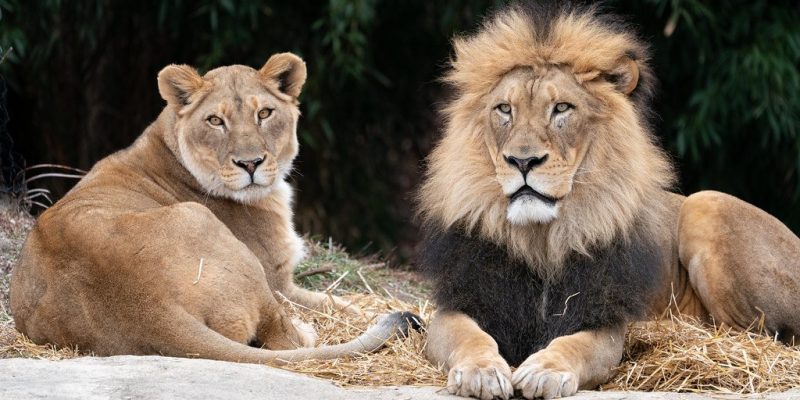
The Cincinnati Zoo & Botanical Garden is home to the first veterinarian at an AZA-accredited institution to earn board certification in theriogenology, the veterinary specialty of animal reproduction, and she is using it to solve fertility cases in African lions that nobody else could.
Thirty years of cat science, scaled up
For three decades the Imperiled Cat Signature Project at the zoo’s Center for Conservation and Research of Endangered Wildlife (CREW) has worked on small wild cats using assisted reproductive technologies. In recent years that expertise has been extended to big cats, African lions among them.
Dr. Julie Barnes, a veterinarian and researcher with the project, serves as Reproductive Advisor for the Lion Species Survival Plan, the AZA partnership that coordinates breeding across accredited zoos to keep the lion population genetically healthy. She completed specialty training in theriogenology and earned that board certification in 2025. She now works with zoos across North America diagnosing fertility problems and building reproductive management strategies.
Two lionesses, two different problems
The work is easier to grasp through the cases.
One female would not accept natural breeding at all. The team attempted artificial insemination across two consecutive breeding seasons, timing each procedure to her natural cycle. No pregnancy resulted. But when she later underwent a planned preventive spay, the Imperiled Cat Signature Project performed a successful gamete rescue: eggs collected from her ovaries, fertilized through in vitro fertilization, producing four embryos now cryopreserved for future breeding.
That is the detail worth sitting with. A lioness who could not reproduce in her own lifetime may still contribute her genetics to the population decades from now.
A second female had bred repeatedly without conceiving. She was enrolled in CREW’s natural reproductive cycle monitoring study, where Barnes and the team are combining fecal hormone metabolites, blood and salivary hormones, vaginal cytology, behavior and vocalizations to find real-time indicators of estrus, because knowing precisely when a lioness is in season is most of what determines whether an insemination works.
The bigger gap they are filling
There is no standardized way to evaluate reproductive health in cats, which means fertility problems routinely go undetected until breeding has already failed or disease has advanced. CREW is collecting data across the entire Lion SSP to establish benchmarks, identify causes of infertility, and measure how contraception affects long-term reproductive health.
Each evaluation folds ultrasound, endoscopy, hormone monitoring, microbiome analysis and tissue evaluation into one assessment. The work currently covers African lions, jaguars and Amur leopards, and the tools coming out of it could change reproductive medicine for wild cats generally.
Males matter too. Since 2023 the team has performed full reproductive evaluations and semen collections on seven genetically valuable male African lions, with samples cryopreserved in CREW’s CryoBioBank.
Lions are a busy beat this year on the habitat side too, from Busch Gardens Tampa’s Lion and Hyena Ridge to a cub debut in Pittsburgh.
What this means for a visit
None of this happens in front of guests, which is exactly why it is worth knowing about. The lions you can stand and watch at Cincinnati are the visible end of a research program that is quietly rewriting how the whole continent manages its lion population, and admission is what pays for the building it happens in.
Quick answers
- What is theriogenology?
It is the veterinary specialty of animal reproduction. Dr. Julie Barnes of the Cincinnati Zoo and Botanical Garden earned board certification in it in 2025, the first veterinarian at an AZA-accredited institution to do so.
- What is CREW?
The Cincinnati Zoo's Center for Conservation and Research of Endangered Wildlife. Its Imperiled Cat Signature Project has worked on small wild cats using assisted reproductive technologies for three decades, and in recent years has extended that expertise to big cats including African lions.
- What does a Lion Species Survival Plan Reproductive Advisor do?
The Species Survival Plan is the AZA partnership that coordinates lion breeding across accredited zoos to keep the population genetically healthy. As its Reproductive Advisor, Barnes works with zoos across North America diagnosing fertility problems and building reproductive management strategies.