
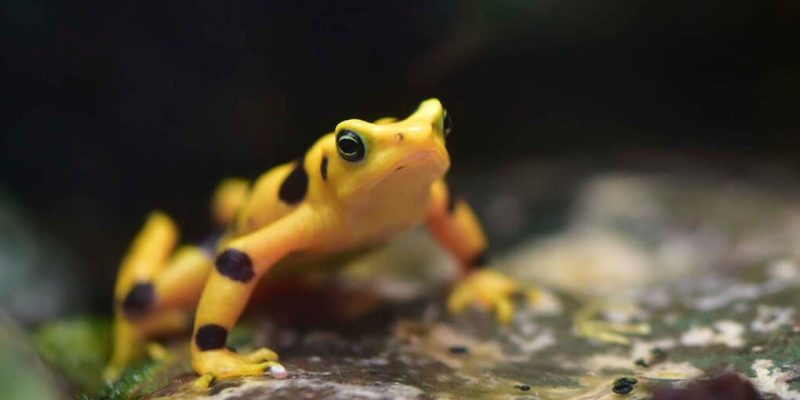
Panamanian golden frogs have not been seen in the wild since 2009. This summer, for the first time since the early 2000s, some of them are outside again.
Conservationists at El Valle de Antón in Panama have moved captive-bred frogs from indoor holding into carefully monitored open-air enclosures, a step the Maryland Zoo announced on July 27, 2026. The move is research, not release, but it is the last stage before one.
What the study is measuring
The work compares growth rates of captive-bred Atelopus zeteki and Atelopus varius raised in semi-natural conditions against those raised in controlled ones. The frogs are tracked from the tadpole stage through morphlets, the small first-stage froglets, and on into juveniles.
“This is the first time since the early 2000s that golden frogs have been allowed to experience the natural elements of El Valle,” said Heid Ross, project manager at the EVACC Foundation. “We’re carefully monitoring how variables like temperature, rainfall, and UV exposure affect their development, information that could be vital for reintroduction efforts.”
The enclosures are shaded and screened. The caution is the point, because of what drove the species indoors in the first place.
Twenty years indoors
Chytrid fungus, Batrachochytrium dendrobatidis, was close to wiping out the wild population before conservationists rescued a small group. Since then the yellow-and-black Atelopus zeteki, the national symbol of Panama, has lived exclusively in secure indoor facilities across several countries to keep it away from the fungus.
“It is incredibly exciting to see the efforts we have made over the past two decades to keep this species healthy in both North America and Panama now moving closer to a day when they are back in the wild in the El Valle de Anton region,” said Ellen Bronson, senior director of animal health, conservation and research at the Maryland Zoo.
Who is behind it
The study is led by local conservation teams at the EVACC Foundation with support from the Maryland Zoo, Fort Worth Zoo, Detroit Zoo, Zoo Atlanta, Seneca Park Zoo and Project Golden Frog, which is the Association of Zoos and Aquariums Species Survival Plan for the species. Hotel Campestre and the Hincapié family provided the land.
“This wouldn’t be possible without two decades of dedication from our partners,” Ross said. “It’s a shared success, one rooted in science, persistence, and deep respect for this extraordinary amphibian.”