
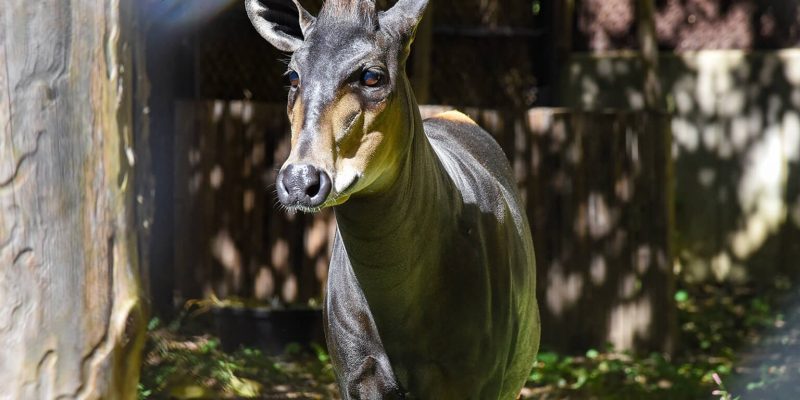
The Maryland Zoo in Baltimore has added a species it has never held before. Astrid, a female yellow-backed duiker, is now on view at the zoo’s Giraffe House, and in time she will share a yard with Askari, the zoo’s okapi.
Astrid arrived from the Dallas Zoo in June and spent a standard quarantine period before being introduced to Askari. She is nine years and eight months old. When she arrived she weighed a little over 180 pounds.
“Yellow-backed duikers and okapis share habitat in the wild and these different species have similar temperaments so we expect this pair to do well together,” said Erin Cantwell Grimm, mammal curator at the Maryland Zoo. “At first, you might look at them and think they’re a related species but, physiologically, they’re quite different.”
What is a duiker?
A duiker is a small to mid-sized forest antelope, and the name is a description of what one does when startled: it comes from the Afrikaans for diver, because a duiker’s instinct is to dive for cover rather than run in the open. There are a lot of them, roughly twenty species across Africa, and the yellow-backed is the largest of the lot.
The yellow back is literal. Adults carry a wedge of marigold-colored hair across the rump, set into an otherwise dark, near-charcoal coat, and on a forest animal built to be hard to see it is the one part that is easy to see. Astrid also has the short, backswept horns and the pale markings around the jaw that the species carries.
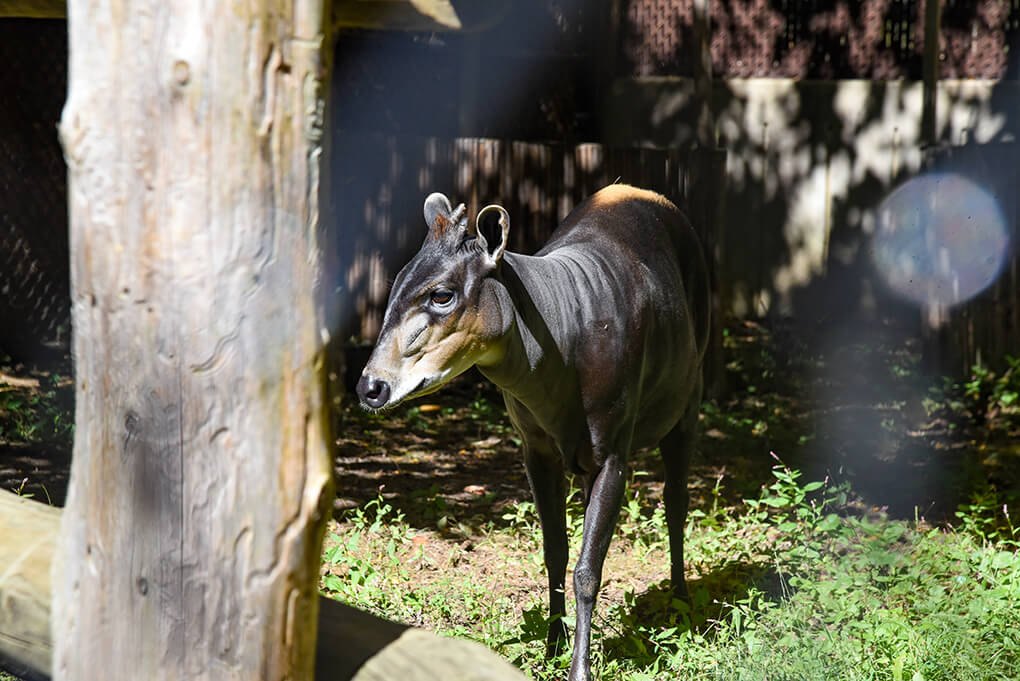
Two forest animals, one yard
Sharing a yard with an okapi is not a novelty pairing. Yellow-backed duikers and okapi overlap in the forests of central Africa, and a mixed-species yard that puts two animals together who would meet anyway is a bigger, more interesting space for both of them than two smaller single-species yards would be. The zoo is taking it in stages: Astrid and Askari have been introduced, and the plan is for the two to share the same yard frequently.
The size contrast in the zoo’s own collection makes the point about how wide the duiker family is. The Maryland Zoo already keeps blue duikers, which can be seen seasonally in the African aviary. An average adult female blue duiker weighs somewhere between 8 and 16 pounds. Astrid arrived at more than 180.
How threatened are yellow-backed duikers?
The IUCN Red List assesses the yellow-backed duiker as Near Threatened with a decreasing population, which matches the category the zoo gave it. The pressure is hunting, which is what the zoo pointed to as well. Duikers are taken for bushmeat across their range, and being the largest of them makes the yellow-backed a bigger prize than its relatives.
Astrid is the second new species the Maryland Zoo has introduced in four months, after a pair of red pandas. For a zoo that has spent recent years on long-running conservation work, including the return of Panamanian golden frogs to the outdoors after twenty years and the birth of a Coquerel’s sifaka, a new hoofstock species on view is a straightforward pleasure. Go and find the Giraffe House, and look for the one with the gold patch on its back.