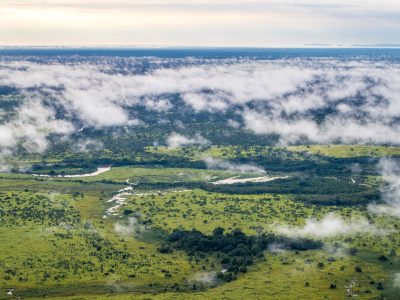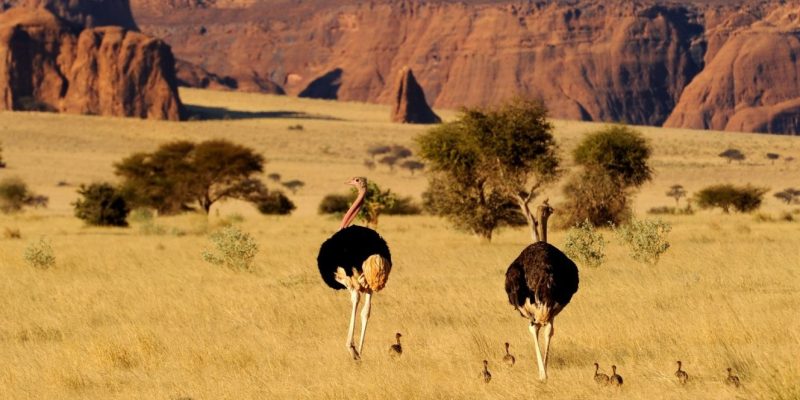
In the Ennedi Natural and Cultural Reserve, in the far northeast of Chad, people have known what an ostrich looks like for several thousand years without ever having seen one. The birds are engraved in the region’s sandstone, in rock art that outlasted the animals themselves. They were gone from the landscape, and the pictures were the only record.
Eleven birds were released into Ennedi five years ago. By June 2026, monitoring teams counted 103 red-necked ostriches moving freely across the reserve: 22 adults, 50 juveniles and 31 chicks. African Parks, which manages Ennedi in partnership with the Chadian government, published the count on October 13.
Where the birds came from
The reintroduction did not start with an egg in an incubator. It started with a convoy. In 2020, 30 ostrich chicks were moved from Zakouma National Park, in southeastern Chad, to a purpose-built facility at Fada inside the Ennedi reserve. Fifteen more followed in 2021. At Fada the young birds were raised and taken through a managed acclimatization process, which is the step that separates a reintroduction from a release.
The first eleven went out at a site called Aloba and became the nucleus of the new wild population. The arithmetic since then is the whole story: eleven birds released, and five years later a hundred and three, with chicks hatching across the reserve rather than in one corner of it. A population with 22 adults, 50 juveniles and 31 chicks in it is not a holding population. It is a breeding one.
What is actually being counted
The monitoring is done largely by people who live in the reserve. Community members work alongside the reserve teams as eco-monitors and nest guardians: they report sightings and new nests, record movements, and watch nesting sites from a distance. When somebody finds a nest and reports it, they may be taken on to monitor that nest and raise the alarm if anything threatens it.
The method is written down in the reserve’s own terms. “We pay particular attention to the breeding cycle, from egg-laying to hatching, strictly respecting the necessary distances so as not to disturb the adults,” the account runs. “When a community member discovers a nest and reports it, they become the nest guardian, responsible for monitoring it from a distance and reporting any danger, without ever handling the eggs.” African Parks publishes that passage without naming the speaker, and we are not going to attach a name to it.
The same account carries a second unattributed remark, from a resident of the reserve: “We grew up seeing ostriches drawn on the rocks, but we had never seen live ones. Today, seeing them run again across our plains is a great source of pride for us.”
Least Concern, and locally gone
This is a case where the Red List category and the situation on the ground point in opposite directions, and saying so is the honest version.
The common ostrich, Struthio camelus, is assessed by the IUCN Red List as Least Concern. The current assessment was made on May 27, 2025 and published the same year, the population trend is recorded as decreasing, and the number of mature individuals is given as unknown. Chad and Niger are both on the list of countries where the species is extant. Libya is listed as Extinct.
What the Red List does not do is assess the North African subspecies separately. Struthio camelus camelus, the red-necked ostrich, is the largest of the recognized ostrich subspecies and once ranged across the Sahel and Sahara from Ethiopia and Sudan west to Senegal and Mauritania. It is now reduced to small, fragmented populations. The Red List is silent on it as a unit, and where the Red List is silent we say so rather than reach for a number from somewhere else. A species can be Least Concern globally and functionally absent from a subcontinent at the same time, and this is what that looks like.
Which zoos are paying for this?
Here the chain holds, and it runs through Sahara Conservation.
African Parks names three partners in the Ennedi work alongside the communities: Chad’s Ministry of Environment, Fisheries and Sustainable Development, Sahara Conservation, and itself. Sahara Conservation is the one that supplied the breeding and reintroduction expertise, and Sahara Conservation’s own account of its North African ostrich program records where that expertise came from. The program was launched in 2007 by Sahara Conservation together with the Saint Louis Zoo, the AZA Struthioniformes Taxon Advisory Group and the Nigerien NGO CERNK, after the species disappeared from the wild in Niger in 2004. The breeding facilities it built in Niger were constructed to Association of Zoos and Aquariums enclosure standards, and the organization credits that, along with an adapted diet, with the improvement in survival and breeding success.
Sahara Conservation also describes the Chad side plainly: an initiative launched in 2020 with African Parks that moved young wild ostriches from Zakouma into both the Ouadi Rime-Ouadi Achim Faunal Reserve and Ennedi. So the Ennedi birds are wild-sourced rather than zoo-bred, and no published document we could find shows a zoo paying for the Fada facility or the transfers themselves. What is documented is that the organization holding the ostrich expertise in this region was built around a zoo program, and that the zoo in question is Saint Louis, which also paid Sahara Conservation’s start-up costs in 2004 and hosted its United States headquarters.
For the sector-wide figure: the Association of Zoos and Aquariums reports that in 2025 its 235 accredited and certified facilities spent approximately $372.4 million on conservation across 139 countries. No published breakdown isolates the African share, so we are not going to estimate one.
Two countries, two methods, one bird
The Ennedi count lands two months after the other half of the same program produced its own first result. On September 2, 2026, eight North African ostriches walked out of an enclosure in Niger’s Gadabedji Biosphere Reserve, the first of the species in the wild in that country since 2004. We wrote that one up here: eight ostriches walked back into Niger.
The two sites are doing the same job by different routes. Niger’s birds came out of captive breeding centers at Kellé and Mainé-Soroa and are a founder group being watched to see whether they settle. Chad’s came from a surviving wild population at Zakouma and are already breeding unaided. Put side by side they are a useful demonstration that neither method is the method: what the Sahel needs is both, and a count that goes up.
African Parks is careful not to call it finished. The population still needs monitoring, breeding-site management and long-term support before it can be described as established. But a reserve where the only ostriches were the ones carved into the rock now has a hundred of them walking around underneath, and the people reporting the nests are the people who grew up looking at the carvings.
Source: African Parks, “The return of the red-necked ostrich to Ennedi,” October 13, 2026.
Quick answers
- How many red-necked ostriches are in Ennedi now?
Monitoring teams counted 103 by June 2026: 22 adults, 50 juveniles and 31 chicks. Eleven birds were released five years earlier.
- Where did the Ennedi ostriches come from?
Thirty chicks were moved from Zakouma National Park in southeastern Chad to a purpose-built facility at Fada in 2020, and fifteen more followed in 2021. The first eleven were released at a site called Aloba.
- Is the red-necked ostrich endangered?
The IUCN Red List assesses the common ostrich, Struthio camelus, as Least Concern on an assessment dated 27 May 2025, with a decreasing trend. It does not assess the North African subspecies separately, although that subspecies has disappeared from most of its range.
- Who monitors the nests?
Community members working as eco-monitors and nest guardians. Someone who finds and reports a nest may be taken on to watch it from a distance and report any danger, without ever handling the eggs.
- Which zoo is behind this work?
Sahara Conservation supplied the breeding and reintroduction expertise, and its North African ostrich programme was launched in 2007 with Saint Louis Zoo, the AZA Struthioniformes Taxon Advisory Group and the Nigerien NGO CERNK. No published record shows a zoo paying for the Ennedi transfers themselves.
- How does this relate to the ostrich release in Niger?
They are two halves of the same programme. Niger's birds came from captive breeding centers and eight were released into the Gadabedji Biosphere Reserve on 2 September 2026. Chad's came from a surviving wild population at Zakouma.