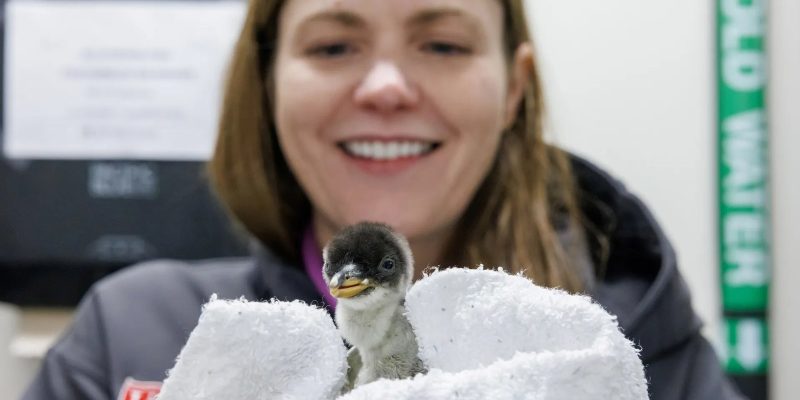
The Tennessee Aquarium hatched two gentoo penguin chicks in the summer of 2026, twenty-two days apart, and the second one would not have lived without a week of round-the-clock hand-feeding.
The first hatched on June 25 to Nipper and Pebbles, a veteran pair in the Penguins’ Rock gallery who had already raised a chick together and others with different partners. The second hatched on July 17 to Blue and Flower, who hatched the gallery resident Carla in 2021.
The chick that could not lift its head
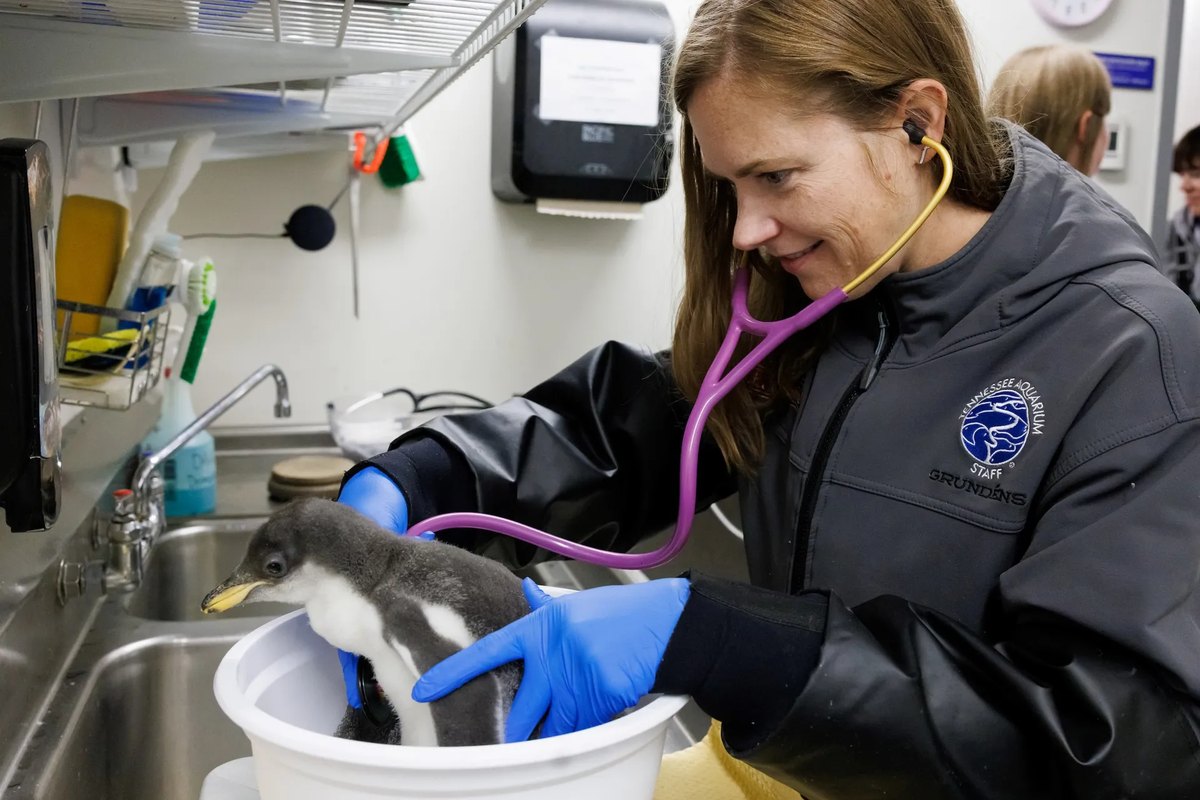
A penguin chick feeds by pushing its head deep into a parent’s mouth to take regurgitated fish. The second chick could not do it.
“We don’t know exactly why, but it seemed to have a hard time holding up its head and getting far enough into mom and dad’s mouth to feed,” said Loribeth Lee, the Aquarium’s assistant curator of forests.
This is the kind of problem that is lethal on a schedule. A gentoo chick is supposed to be gaining weight fast from the day it hatches, and the margin is measured in days rather than weeks. Even a two-day stall is serious. The animal care and veterinary teams took over, feeding the chick around the clock for close to a week until it could feed itself from its parents.
“Without intervention, the chick would not have made it,” Lee said. “Mom and dad were trying their hardest, but there’s only so much they can do. It feels really good to see the chick doing so well thanks to our efforts.”
That is the argument for a zoological facility in four sentences, made by someone who was in the room. The parents were competent. The problem was mechanical and the parents could not solve it. A team that could feed the chick itself, hour after hour, for as long as it took, could.
The growth numbers are the point
Penguins grow at a rate that is difficult to picture, so the Aquarium did the arithmetic. The first chick weighed 122 grams the day after it hatched, a little less than a D battery, and had passed two kilograms within a month, an increase of about 1,700 percent. The second chick weighed 101 grams a day old, roughly a bar of soap, and reached 2.73 kilograms at its one-month weigh-in, up about 2,700 percent.
Scaled to a human infant, the Aquarium noted, a baby born at seven and a half pounds would weigh more than 200 pounds a month later.
That speed is not a quirk. Gentoos breed on sub-Antarctic islands and the Antarctic Peninsula, where the window between a survivable spring and the return of winter is short, and a chick that is not close to adult size and waterproof by the end of it does not get a second season. Everything about the species is organized around compressing that growth.
“Its growth rate isn’t unprecedented, but it’s in keeping with the chicks that have done the very best out of all the chicks we’ve raised,” said Dr. Chris Keller, the Aquarium’s director of animal health. “The parents have done a fantastic job. When they’re providing as much food as they have been, a chick is just going to thrive in that environment.”
Why both chicks were kept out of sight
Past chicks in Penguins’ Rock grew up in front of the public. These two did not. Both families were moved to holding rooms in the gallery’s back-of-house space for the season.
The reason is nesting season itself, which runs from early April into early summer and is the most aggressive stretch of the colony’s year. Once birds pair off they defend their nests, infighting rises across the whole group, and a chick that gets caught in somebody else’s argument is fragile enough to be hurt by it. Separating the two families was a decision about the chicks rather than about visitors.
Getting back into the gallery requires passing a swim test at around seventy days old. The chick has to float and, more to the point, get itself out of the water unaided. A penguin that cannot exit a pool is not safe in one.
One term worth keeping
Staff heard the first chick before they could see any sign of it. “This little bird, we heard it before we even saw the pip in the egg,” senior animal care specialist Holly Gibson said. “It’s definitely a very vocal penguin.”
The pip is the first crack, the hole a chick makes from the inside with the egg tooth on the tip of its bill. It can take a day or more between the pip and the hatch, which is why keepers watch for it, and why a chick calling from inside an intact egg is something a person standing in the room can actually hear.
The species is, unusually, fine
The gentoo penguin, Pygoscelis papua, is listed by the IUCN Red List as Least Concern, in an assessment carried out on August 28, 2019 and published in 2020, with about 774,000 mature individuals and a population trend described as stable. Among penguins that is close to a best case, and it is worth saying plainly rather than reaching for a decline that is not there. Gentoos have actually expanded their range south along the Antarctic Peninsula as the ice has retreated, which has made them one of the few polar species that reads as a beneficiary rather than a casualty so far.
One caveat for anyone checking: the single-species treatment is under argument. Researchers have proposed splitting Pygoscelis papua into several species, and the Red List has not adopted that, so the Least Concern category applies to the broad species as currently assessed and not necessarily to each population inside it.
Where things stand
The Aquarium said in September that the first chick is a male and the second a female, and it auctioned naming rights to both in its annual online fundraiser, which opened on September 15. It has not published the names. The Aquarium runs a live stream of Penguins’ Rock, and its new veterinary program is the department that ran the rescue described above. The IUCN Red List entry has the assessment in full.
Sources: Tennessee Aquarium, July 24, August 20 and September 14, 2026.
Quick answers
- When did the Tennessee Aquarium penguin chicks hatch?
The first hatched on June 25, 2026 to Nipper and Pebbles. The second hatched on July 17, 2026 to Blue and Flower.
- What was wrong with the second penguin chick?
It could not hold its head up far enough to reach into its parents’ mouths to feed. The aquarium’s animal care and veterinary teams fed it around the clock for close to a week until it could feed itself. Assistant curator Loribeth Lee said that without intervention it would not have survived.
- How fast do gentoo penguin chicks grow?
Very fast. One chick went from 122 grams the day after hatching to more than two kilograms within a month, an increase of about 1,700 percent. The other went from 101 grams to 2.73 kilograms, about 2,700 percent.
- Why were the chicks kept off exhibit?
Nesting season raises aggression across a penguin colony, and infighting between nesting adults can injure a fragile chick. Both families were moved to holding rooms in the gallery’s back-of-house space.
- What is a swim test?
The check a chick has to pass at around 70 days old before it joins the colony. It must float and, more importantly, be able to get itself out of the water without help.
- Is the gentoo penguin endangered?
No. The IUCN Red List lists the gentoo penguin as Least Concern, in an assessment carried out on August 28, 2019 and published in 2020, with about 774,000 mature individuals and a stable population trend.
- What are the chicks called?
The aquarium auctioned naming rights to both chicks in its annual online fundraiser beginning September 15, 2026, and has not published the names. It did confirm in September that the first chick is male and the second female.