
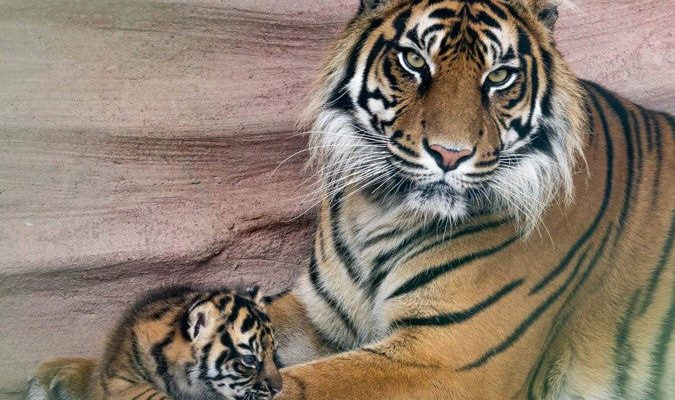
Two Sumatran tiger cubs were born at Fota Wildlife Park in County Cork on June 16, 2026, to a mother named Jambi and a father named Batak. It is the first time more than one cub has arrived in a single litter at the park.
Fota announced the birth on July 22, alongside three Asiatic lion cubs born on July 1 to nine-year-old Arya and ten-year-old Yali, Arya’s second litter with him.
Why do two cubs matter more than one?
Sumatran tigers are Critically Endangered, the highest category on the IUCN Red List before extinction in the wild, and Fota puts the remaining wild population at fewer than 350 animals. At that size, the managed population in zoos is not a nice supplement to the wild one. It is a second copy of the species.
A single cub keeps a bloodline going. A litter of two, from a first-time pairing that worked, gives the European breeding program something it can actually place: two animals, two sets of options, and a mother who has demonstrated she can raise more than one at a time. That is the difference between a birth and a breeding result.
“We’re absolutely thrilled to announce the birth of both sets of cubs. I have to pinch myself when I think about the fact that we’re announcing both Sumatran tiger and Asian lion cubs this summer.”
John Leahy, Lead Ranger, Fota Wildlife Park
The island tiger
The Sumatran tiger is the last of Indonesia’s tigers. Bali had its own subspecies and lost it in the 1930s. Java had one and lost it within living memory. Sumatra’s is what remains, and it is a smaller, darker, more heavily striped animal than the tigers of the Asian mainland, shaped by a life in dense island forest.
What is squeezing it is not mysterious: forest cleared for plantation agriculture, tigers and people ending up in the same place, and snaring. Fota names habitat loss, human-wildlife conflict and poaching, and those three cover almost all of it.
The Asiatic lion cubs are a good story too, though a different one. Their species is Endangered rather than Critically Endangered and survives as a single wild population in India’s Gir Forest, last counted at 891 animals in 2025. One population in one forest is a species with no margin for a bad year.
A busy year in Cork
Fota has had a run of births: the tiger and lion cubs, two European bison calves, a François’ langur infant, six meerkat pups, and earlier this summer a Critically Endangered Nubian giraffe calf, the third generation of that herd born at the park.
Sumatran tigers have been moving between European collections this year as the program places animals where the genetics work. Loro Parque took in two from British zoos in July. Cubs in Cork are the other end of the same machinery.
Source: Fota Wildlife Park. The wild population figures are the park’s.