
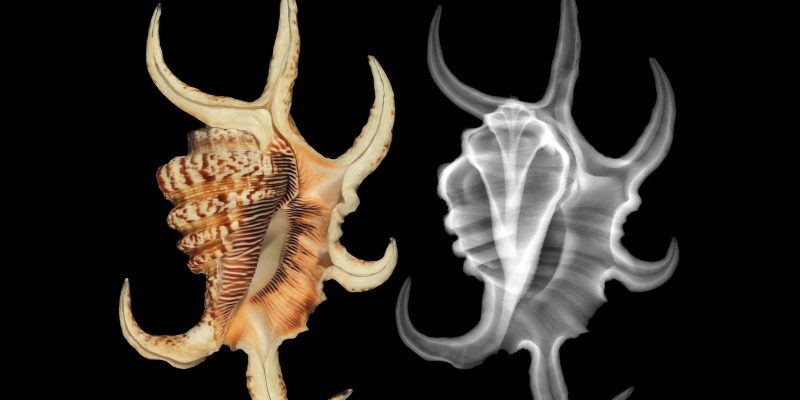
National Geographic ran a photograph of a shell as its Photo of the Day on August 31, and the shell came from an exhibit that has not opened yet. The image is one of Jim Wehtje’s X-ray composites of an arthritic spider conch, and the exhibit built around that body of work is on the Bailey-Matthews National Shell Museum & Aquarium’s schedule of temporary shows for the 2026-27 season on Sanibel Island, Florida.
What an X-ray does to a shell
Wehtje’s method puts an X-ray of a shell beside a color photograph of the same specimen, so the viewer sees the object and its interior at once. A shell is an unusually good subject for the technique. It is a solid carbonate structure built in layers around spaces nobody can see from outside, and radiography is the only way to look into one without destroying it.
Writing on the museum’s blog, Jose H. Leal used a bubble marginella from the coast of eastern Brazil to show what turns up. Running down the inside of that shell is a set of columellar folds: raised threads along the columella, which is the central pillar a snail’s shell is coiled around. In the X-ray they read as pale twisting lines. They are not decoration. They are anchoring surfaces for the columellar muscle, and when the animal contracts that muscle it hauls its soft body back inside the shell. The fold is the reason the retreat is fast enough to be worth having.
A photograph of that shell shows a glossy cream oval. The X-ray beside it shows the ridges the animal pulls against, and the reason a marginella can vanish into its own shell faster than a bird can take it.
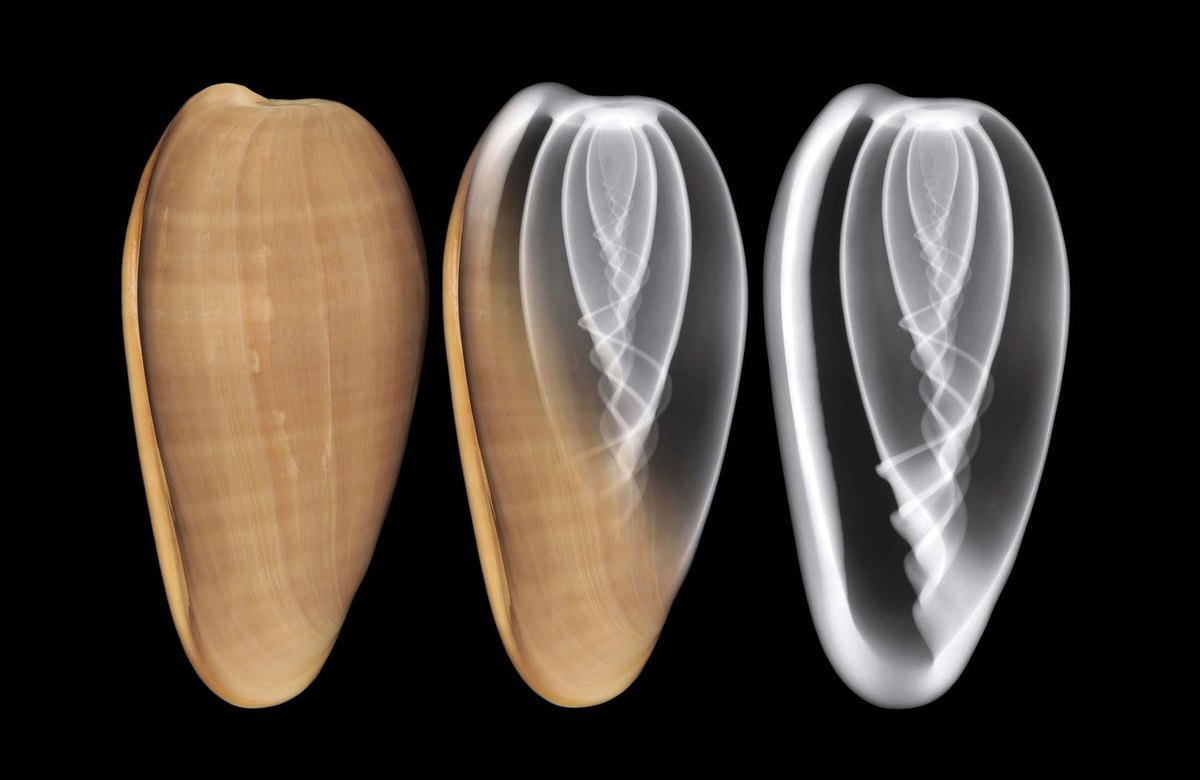
The conch on the National Geographic homepage
The specimen that ran on August 31 is Harpago arthriticus, the arthritic spider conch, whose outer lip grows into a set of long curved projections. Photographed and X-rayed side by side, the projections come out as solid in one frame and translucent in the other, and the spiral inside the body whorl shows through as a fan of bright ribs. National Geographic’s post linked back to the museum’s own writing on the series.
What is still unknown
The museum has not announced an opening date, a title or a run length for the exhibit. What it has said is that the Wehtje show is among the temporary exhibits planned for the 2026-27 season, and that more images from the series are coming. Anyone planning a trip around it should watch the museum’s listings rather than book on the strength of this.
The Bailey-Matthews National Shell Museum & Aquarium describes itself as the only accredited museum in the United States devoted primarily to shells, mollusks and their ecosystems, and it runs live aquarium galleries beside the shell collection, which is why a visitor can see a living mollusk and the architecture of its shell in the same hour. The museum’s posts on the X-ray series and on the National Geographic feature carry the images discussed here. For another aquarium building a gallery around a single idea, see the Texas State Aquarium’s Ocean Odyssey.
Quick answers
- What was on the National Geographic homepage?
An X-ray composite of an arthritic spider conch by Jim Wehtje, run as Photo of the Day on August 31, 2026. The post linked back to the Bailey-Matthews National Shell Museum and Aquarium's own writing on the series.
- When does the exhibit open?
No opening date, title or run length has been announced. The museum has said only that the Wehtje show is among the temporary exhibits planned for its 2026-27 season on Sanibel Island, Florida.
- What is a columellar fold?
A raised thread running along the columella, the central pillar a snail's shell is coiled around. The folds are anchoring surfaces for the columellar muscle, which the animal contracts to pull its soft body back inside the shell.
- Why X-ray a shell?
A shell is a solid structure built in layers around spaces that cannot be seen from outside. Radiography is the only way to look into one without destroying it, and Wehtje places the X-ray beside a color photograph of the same specimen.
- Where is the National Shell Museum?
On Sanibel Island, Florida. It describes itself as the only accredited museum in the United States devoted primarily to shells, mollusks and their ecosystems, and it runs live aquarium galleries alongside the shell collection.