
Six wild cat species live in the Tsavo Conservation Area: lion, leopard, cheetah, serval, caracal and African wildcat. Tsavo Trust, which flies and drives the ecosystem for a living, has documented all six. It has reliable landscape-wide population baselines for three of them, and for the other three it has essentially nothing.
That split is the most interesting thing in the Trust’s own account of its cats, published September 18, and it is not a criticism of anybody. It is a description of how carnivore research money actually gets spent.
The three that got counted
The best landscape-wide numbers for Tsavo’s large cats still come from a spoor survey run across Tsavo East and Tsavo West in 2013 and published in 2020. Reading tracks along roughly 1,500 kilometers of road, it converted the frequency of encounters into density estimates:
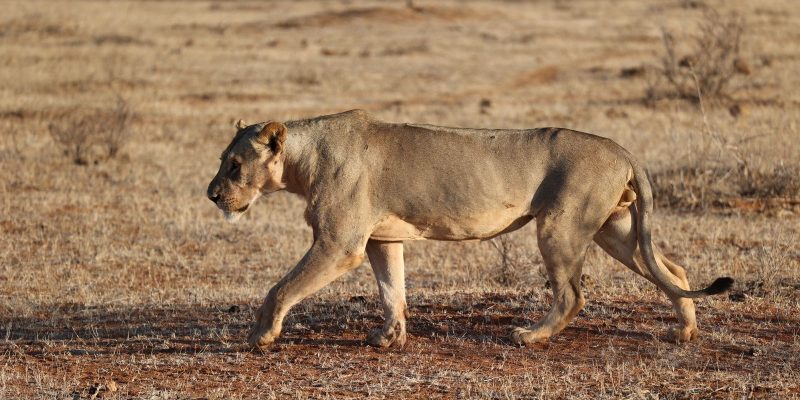
- Lion, roughly 706 animals, give or take about 201, at around 3.39 per 100 square kilometers. At the time the study concluded Tsavo held Kenya’s largest remaining lion population.
- Leopard, roughly 472, give or take about 98, at around 2.27 per 100 square kilometers, with occupancy higher in the denser country of northern Tsavo West and northwestern Tsavo East.
- Cheetah, roughly 154, give or take about 74, at around 0.74 per 100 square kilometers, and distributed far more patchily than the lions.
Those error bars are wide, and the Trust is careful to say why they should be read as a 2013 baseline rather than a 2026 census: carnivore populations move, different survey methods have different blind spots, and the study itself emphasized that detecting long-term trends would need complementary monitoring. We have not opened the 2020 paper, so every figure above is as Tsavo Trust reports it.
Work has continued. The Tsavo Simba Research Project now combines GPS and satellite collars, individual identification, camera traps and direct observation to study how lions move, hunt and associate in a semi-arid landscape where prey, water and vegetation are spread unevenly across an enormous area. The Tsavo Cheetah Project uses photographs, spoor, sightings and camera traps to identify individual cheetahs and track their movement between the protected area and the community land around it, which matters because a cheetah that leaves the park can meet livestock and then meet a retaliatory snare.
The three that did not
For the serval, the caracal and the African wildcat there is no comparable published estimate for Tsavo at all.
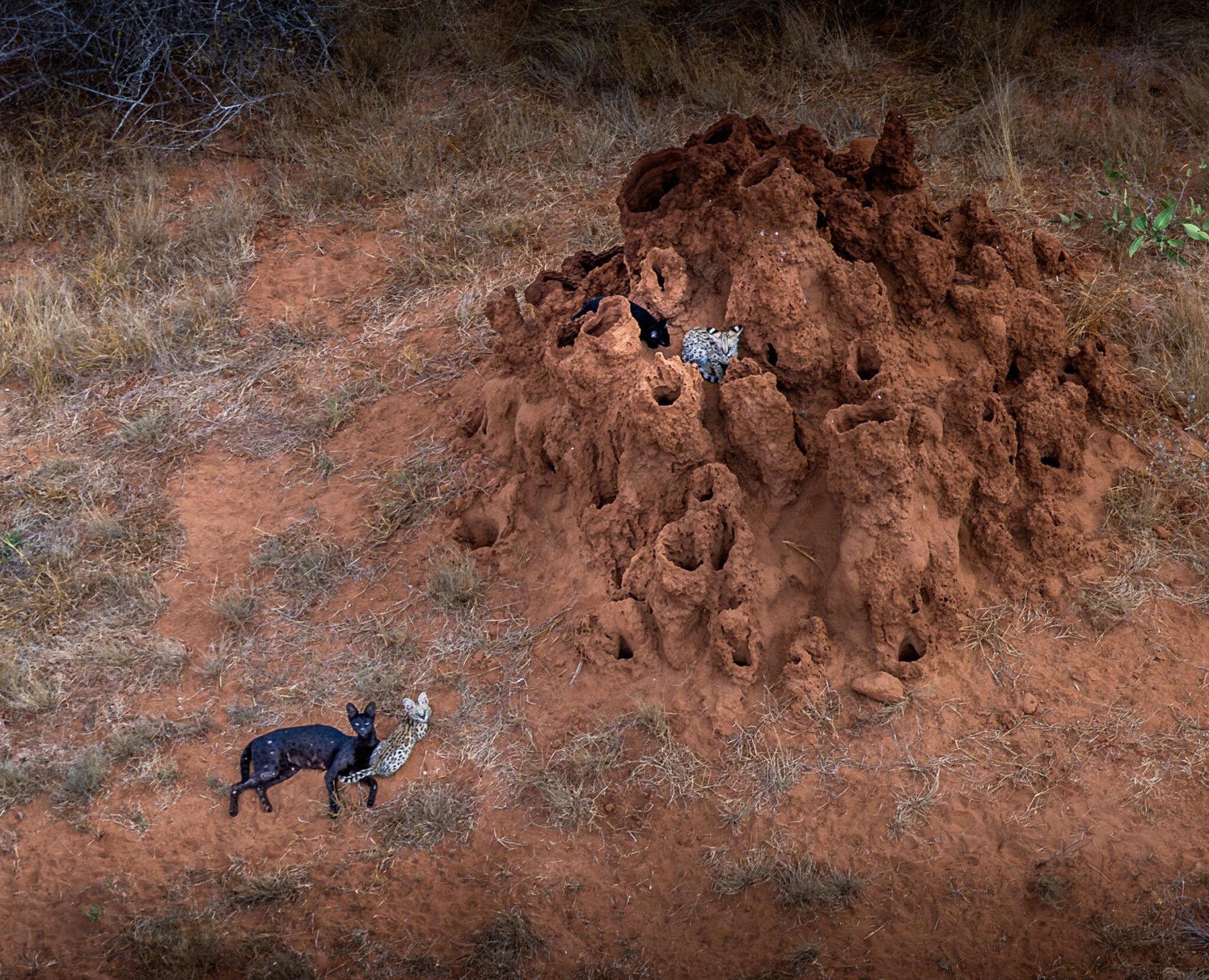
This is not because they are unimportant or absent. The serval is a specialist of a kind the big cats are not: disproportionately long legs, enormous ears, and the ability to locate a rodent by sound through dense grass and take it with a high vertical pounce. Tsavo also holds records of melanistic servals, animals whose coats can look almost entirely black while the underlying spots remain faintly visible, and the Trust reports both normally colored and melanistic individuals within the conservation area.
The caracal is built the other way: compact, heavily muscled, reddish, with the black ear tufts, suited to dry scrub and semi-arid savanna, hunting by stalk and short explosive rush, and capable of taking prey surprisingly large for its size. The leap into the air after a bird, which is the thing it is famous for, is a side effect of that hunting style rather than its main ecological job.
The African wildcat sits at the far end of the scale from the lion, hunting rodents, birds, reptiles and insects, and it is the animal every domestic cat descends from. That ancestry is also its conservation problem: African wildcats can interbreed with free-ranging domestic cats, and Tsavo Trust has flagged hybridization as a concern for the species’ genetic distinctiveness.
The Trust names the pattern directly. Smaller and more elusive carnivores get considerably less population-level monitoring than their larger relatives. They are nocturnal, they sit at low densities, they range widely, and they are hard to see, so they are hard to fund.
How six predators fit in one landscape
Ecologists call the mechanism niche partitioning, and Tsavo is a clean demonstration of it. Prey size divides the community first: a lion that can kill a buffalo is not competing with a wildcat that eats mice. Habitat divides it again, with leopards using dense cover, cheetahs favoring open ground where prey can be seen and run down, servals tied to grass and wetter patches, caracals to dry scrub. Hunting method divides it further still, and species can also separate in time, with smaller carnivores shifting when and where they hunt to stay out of the way of larger ones.
None of that eliminates competition. Lions, leopards and cheetahs take some of the same prey, lions will steal a cheetah’s kill and will kill the cheetah, and a specialist built for speed cannot defend what it catches. What the differences do is stop every predator in the system depending on exactly the same resource at exactly the same time. The result, as the Trust puts it, is not six separate niches but one overlapping community of predators responding continuously to prey, water, vegetation and each other.
Which zoo pays for this
Tsavo Trust has a substantial accredited zoo funder, and it is Cheyenne Mountain Zoo in Colorado Springs. The partnership dates to 2016, and in October 2024 the zoo announced it had passed $1 million donated to the Trust, raised through its Quarters for Conservation program and through daily elephant and rhino feeding experiences that bring in around $75,000 a year, with support from the Kratt Family Fund.
What that million bought is specific. By the zoo’s own account: protection for African elephants, including Tsavo’s super tuskers, and for eastern black rhinos; maintenance of anti-poaching aircraft and ground vehicles; an anti-poaching helicopter; an aircraft hangar; boreholes and sand dams; staff housing and a guest house; and staff salaries, pilot hours and operating costs.
“Modern accredited zoos, like Cheyenne Mountain Zoo, are invaluable partners in our mission to protect elephants and rhinos in their natural habitats,” Tsavo Trust chief executive Richard Moller said in that announcement.
Elephants and rhinos. Nowhere in the zoo’s description of what it funds does lion, leopard or cheetah work appear, and neither the Simba project nor the Cheetah project is named. We looked for accredited zoo or aquarium funding attached to Tsavo’s cat research specifically and did not find any.
The honest qualification is that the line is not perfectly clean, and the zoo’s own conservation manager, Nicole Chaney, drew it wider herself: “We’re providing millions of miles of anti-poaching surveillance for African elephants, black rhinos and the wildlife and communities that share that part of Kenya.” An aircraft flying anti-poaching patrols does not stop seeing a lion because a lion is not what it was paid to find, and a snare removed from an elephant corridor is a snare a leopard will not walk into. Aerial surveillance is a general good in a landscape this size.
But money attached to elephants and rhinos is still money attached to elephants and rhinos. Cheyenne Mountain Zoo is a funder of Tsavo Trust and is not, on any published account we can find, a funder of the lion, leopard or cheetah research described above, and we are not going to blur the two to make a tidier story. The zoo’s work in this ecosystem is real and is documented elsewhere, including in the expansion of Kenya’s rhino sanctuary in Tsavo West.
For scale, the Association of Zoos and Aquariums reports that in 2025 its 235 accredited and certified facilities spent approximately $372.4 million on conservation across 139 countries. No published breakdown isolates the African share of that, so we are not going to invent one.
What the Red List says about the six
Tsavo Trust states no conservation categories in its piece, so here they are. On the IUCN Red List, the lion (Panthera leo), the leopard (Panthera pardus) and the cheetah (Acinonyx jubatus) are all assessed as Vulnerable. The serval (Leptailurus serval), the caracal (Caracal caracal) and the African wildcat (Felis lybica) are all Least Concern.
Those categories are worth putting beside the counting gap rather than on top of it. The three Vulnerable cats are the three with landscape-wide baselines, and the three Least Concern cats are the three with none. A category of Least Concern is a statement about a species across its global range, not a statement that anybody knows how many live in Tsavo. For three of these six, nobody does.
Written from Tsavo Trust’s own account, published September 18, 2026: The wild cats of Tsavo: How Africa’s felines share one landscape. Funding figures are from Cheyenne Mountain Zoo’s October 2024 announcement. Red List categories were read from the GBIF mirror of the Red List.
Quick answers
- How many wild cat species live in Tsavo?
Six, all documented by Tsavo Trust within the Tsavo Conservation Area: lion, leopard, cheetah, serval, caracal and African wildcat.
- How many of them have been counted?
Three. A spoor survey run across Tsavo East and Tsavo West in 2013 and published in 2020 read tracks along roughly 1,500 kilometers of road and estimated about 706 lions, about 472 leopards and about 154 cheetahs, with wide error bars on each. There is no comparable landscape-wide published estimate for the serval, the caracal or the African wildcat.
- Why have the three smaller cats not been counted?
Tsavo Trust names the reason directly: smaller and more elusive carnivores get far less population-level monitoring than their larger relatives. They are nocturnal, they occur at low densities, they range widely and they are hard to see, which makes them hard to survey and hard to fund.
- Should the 2013 numbers be treated as current?
No, and Tsavo Trust says so itself. They are a baseline, not a 2026 census. Carnivore populations change, survey methods have different blind spots, and the study emphasized that detecting long-term trends would need complementary monitoring. We did not open the 2020 paper, so every figure here is as the Trust reports it.
- What are melanistic servals?
Servals whose coats carry extra dark pigment, so the animal can look almost entirely black while the underlying spotting stays faintly visible. Tsavo is notable for records of them, and the Trust has documented both melanistic and normally colored servals inside the conservation area.
- Which zoo funds Tsavo Trust?
Cheyenne Mountain Zoo in Colorado Springs, which announced in October 2024 that it had passed $1 million donated to the Trust since the partnership began in 2016, raised through its Quarters for Conservation program and daily elephant and rhino feeding experiences. By the zoo's own account that money funds elephant and rhino protection, anti-poaching aircraft and a helicopter, a hangar, boreholes and sand dams, staff housing and operating costs. We could not find accredited zoo or aquarium funding attached to the lion, leopard or cheetah research specifically.