
When Transnet’s dock master called the Two Oceans Aquarium in early August, what he described was not yet a problem. A few Cape fur seals had slipped into the Sturrock Dry Dock in Cape Town while it was flooded, and they were working their way through a large shoal of mullet.
The difficulty is what a dry dock is for. A vessel comes in, the main gates close, and the water is pumped out into the harbor so the hull can be worked on. Anything swimming around in there when the gates shut stays in there. For a seal, the walls are 14 meters high and the only way up is a flight of stairs.
By the time the aquarium’s Marine Wildlife Management Programme was alerted, the dock had already taken a ship and begun draining. Four seals were inside.
The first decision was to do nothing
The dock was still full of mullet, which meant the seals had a dependable food source, and the aquarium’s veterinary team advised that a healthy seal can go about a week without eating before its condition starts to suffer. That assessment bought the rescuers the thing they rarely get, which is room to be patient.
Then the seals moved somewhere worse. As maintenance work started in the emptied dock, staff reported that all four had gone into the service tunnel running along the side of it, away from the noise. During the day, when a rescue could safely be attempted, the animals were out of reach. In the quiet hours before dawn, when nobody could work, they came out to feed.
On August 17, with the dock dry, the aquarium sent a party in to find them: Martine Viljoen, Abdullah Abrahams and Ayanda Cimani from the Marine Wildlife Management Programme, with veterinary nurse Ashley and Wehan and Ashlea from the aquarium’s dive school. They went in with torches, seal boards and hard hats. About 200 meters along, where the tunnel turned a corner and began to climb, they found all four animals together, their calls echoing off the walls.
Finding them settled nothing. The tunnel sloped, the floor was slippery, the space was cramped and it was effectively dark. A capture in there could not be made safe for the seals or for the people attempting it, so the team backed out and tried to bring the animals to them instead. They played recordings of Cape fur seal calls, and the seals answered enthusiastically and stayed where they were. Transnet then ran a low-pressure stream of water through the tunnel for about fifteen minutes, in the hope the current would draw them out. The seals stayed where they were.
“Working with wildlife means accepting that nature sets the pace. Our role is to observe, adapt, and respond, drawing on the combined knowledge of everyone involved,” Viljoen said.
Out one at a time
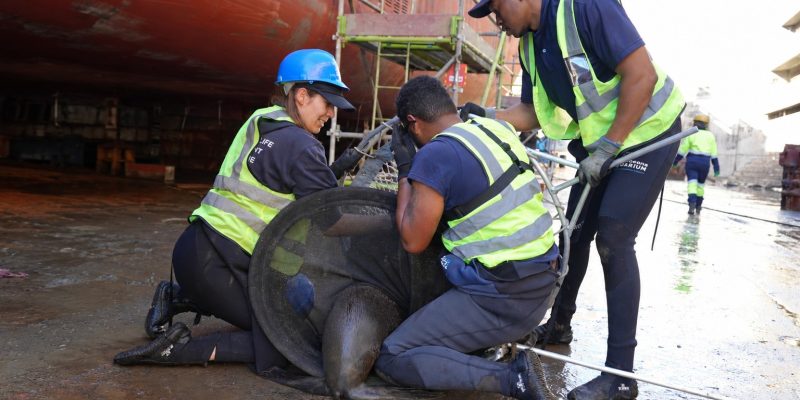
The first seal left the tunnel on its own on August 19. Cimani went in under the vessel and got it into a purpose-made net, Viljoen and Abrahams brought it into the open, and it went out on a stretcher, carried up several flights of stairs and about 150 meters past the dock wall by the aquarium team and the dock crew together. They picked a spot where it could slide straight back into the harbor. It went in, splashed about, and groomed itself.
The second came out on August 22 and was found playing in standing water on the dock floor, which made that capture straightforward. Two out, two to go, and the pair still inside were the largest of the group, which meant more hands and more risk for everyone involved. With the dock due to be refilled within days, the team decided to wait and let the animals swim out under observation rather than force it.
One of them did not wait. On September 2, dock staff noticed that seal resting on a lower flight of stairs, and then watched it climb all four flights and put itself back in the harbor.
“Watching one of the larger animals make its own way up the dry dock stairs and out of the dock was a fantastic moment, and another reminder never to underestimate the adaptability and resourcefulness of our marine wildlife,” Viljoen said.
The dock began refilling the next day. The fourth seal swam in the rising water until the level reached about 10 meters, climbed the last few stairs, and was guided around to the far side and back into the harbor. All four were out. None was sedated and none spent a day in a holding facility.
The outcome the unit is actually interested in
It is not the four releases. “The most valuable outcome is not only that all four seals were safely released, but that the incident has given us a much clearer understanding of how seals move through the dry dock system,” Viljoen said. “We can now use those lessons to explore practical preventative measures and hopefully reduce the likelihood of similar situations in future.”
That is the part worth holding onto. A working harbor is not going to stop taking ships, and the Sturrock Dry Dock will flood and drain again. A response that ends with a map of how animals get into the tunnel is worth more than one that ends with four animals on a stretcher.
The aquarium credits Johan Coetzee of the Transnet National Ports Authority and his team at the dock, along with Southey Contracting’s marine division, whose knowledge of the infrastructure it says was essential throughout. The Marine Wildlife Management Programme sits inside the Two Oceans Aquarium Foundation, the aquarium’s own conservation arm, which also runs the Turtle Conservation Centre behind the satellite tracking of the turtles Kai and Nori.
Which zoo paid for this
This one needs no tracing, which makes it unusual on this beat. Most rescue and release work in this region is done by field organizations and sanctuaries, and the useful question is always which zoo or aquarium is behind them. Here the aquarium is the responder. The Two Oceans Aquarium Foundation employs the staff who went into the tunnel and operates the unit that answered the call, and the aquarium names no outside funder for the response, because there was not one to name.
For scale on the wider pattern, the Association of Zoos and Aquariums reports that in 2025 its 235 accredited and certified facilities spent approximately $372.4 million on conservation work across 139 countries. No published breakdown isolates what share of that reached Africa, so we are not going to estimate one.
One note on the listing
Rescue stories carry an assumption that the animal in them is rare. This one is not. The IUCN Red List lists Arctocephalus pusillus, the Cape or South African fur seal, as Least Concern, and the breeding population along the South African and Namibian coast is substantial.
The aquarium never suggests otherwise, and nothing in its account leans on scarcity. It is worth stating anyway, because it is the honest frame for the work: a stranding and entrapment unit went into a dark tunnel repeatedly over three weeks for four animals of a species in no danger of disappearing. That is what such a unit is for. The case for it was never going to rest on the Red List category of whatever happens to swim through an open dock gate.
Written from the Two Oceans Aquarium’s own account, published September 18, 2026 by Laura du Toit: How four Cape fur seals were rescued from Sturrock Dry Dock in Cape Town.
Quick answers
- How did four seals end up in a dry dock?
They swam in while it was flooded, chasing a large shoal of mullet. A dry dock takes a vessel in, closes its main gates and pumps the water out into the harbor so the hull can be worked on, and anything swimming around when the gates shut stays inside. The walls are 14 meters high and the only route up is a staircase.
- Why did the rescue take three weeks?
Because the seals went into a service tunnel along the side of the dock, which is sloped, slippery, cramped and dark, and a capture in there could not be made safe for the animals or the people. The team waited for each seal to come out onto the open dock floor instead. The seals were feeding on mullet throughout and the aquarium's veterinary staff advised a healthy seal can go about a week without food before its condition suffers, which is what made waiting the safer option.
- What happened to all four?
All four went back into the harbor alive. One was netted and stretchered out on August 19 and a second on August 22. A third climbed all four flights of dock stairs by itself on September 2. The fourth swam up as the dock refilled the following day and walked out the last few steps. None was sedated and none spent a day in a holding facility.
- Who carried out the rescue?
The Two Oceans Aquarium's Marine Wildlife Management Programme, which sits inside the Two Oceans Aquarium Foundation. Martine Viljoen, Abdullah Abrahams and Ayanda Cimani led the operation with veterinary nurse Ashley and two of the aquarium's dive school staff. Johan Coetzee of the Transnet National Ports Authority and his dock team, and Southey Contracting's marine division, assisted throughout.
- Are Cape fur seals endangered?
No. The IUCN Red List assesses Arctocephalus pusillus as Least Concern and the breeding population along the South African and Namibian coast is substantial. The aquarium does not claim otherwise. A stranding and entrapment unit responds to the animal in front of it rather than to its Red List category.
- What did the aquarium say it learned?
How seals move through the dry dock system. Martine Viljoen called that the most valuable outcome, above the four releases themselves, because it lets the team look at practical preventative measures. The dock will flood and drain again.