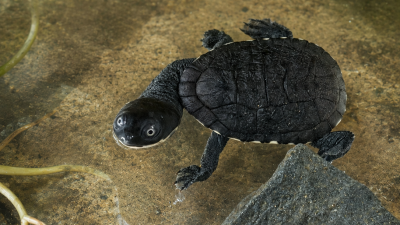

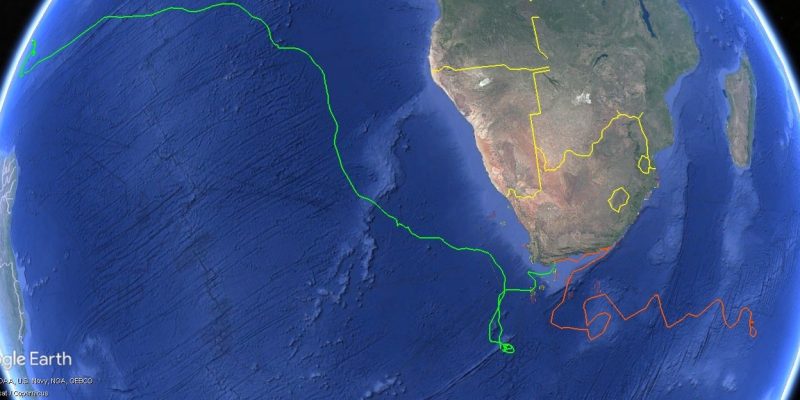
Two sea turtles rehabilitated and released by the Two Oceans Aquarium Foundation’s Turtle Conservation Centre in Cape Town are still transmitting, and between them they have now covered a little over 19,000 kilometers of open ocean. Kai, a juvenile loggerhead, has crossed an underwater mountain range in the Indian Ocean. Nori, a subadult green turtle, has spent nearly ten months working her way up the Atlantic and is currently closest to Cape Verde. The aquarium published its latest tracking update on September 23, 2026.
Kai: 6,879 kilometers in 129 days
Kai spent nearly six years in rehabilitation before being released into the De Hoop Marine Protected Area in May 2026. As of the aquarium’s update he is 129 days into his journey and has covered 6,879 kilometers, averaging roughly 53 kilometers a day.
Part of that pace was not his. The Agulhas Current, the warm fast-flowing current that runs south down Africa’s east coast before turning back into the Indian Ocean, carried him for an early stretch of the trip. Sea turtles use it as a migratory corridor, and a young loggerhead riding it is doing what the species does.
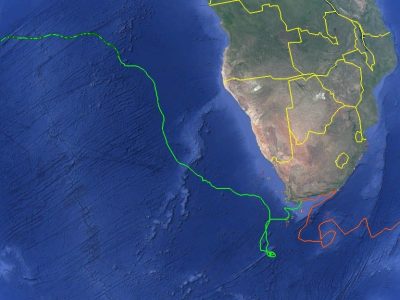
More recently he crossed the Southwest Indian Ridge, a mid-ocean mountain range of ridges, valleys and seamounts thrown up by tectonic activity on the floor of the Indian Ocean. It is thousands of meters beneath him and he will never see it, but the aquarium notes that its green turtle Bheni turned deliberately north when she reached the same ridge on her own track. Kai did not. He carried straight on, and where he is going is not known.
Nori: 12,190 kilometers in 299 days
Nori was released into the same marine protected area and has been at sea for 299 days, covering 12,190 kilometers at an average of about 40.8 kilometers a day. For most of that she ran steadily north through the Atlantic along the west coast of Africa. Then she turned right, put in a few of the loops the aquarium calls characteristic turtle squiggles, and is now heading almost due north.
Her current position puts her closest to Cape Verde, which matters for a reason beyond the map. The islands’ coastal waters hold juvenile green and hawksbill turtles, leatherbacks migrate through the wider region, and Cape Verde supports one of the world’s significant loggerhead nesting populations. It sits inside the Canary Current Large Marine Ecosystem, where currents and upwelling concentrate prey along ocean fronts. Research on loggerheads in that region has shown turtles exploiting exactly those fronts, which is the answer to why a turtle would slow down in what looks from a boat like empty water.
What the tags are for
Not sentiment, although the aquarium is open about enjoying the weekly check-in. Each satellite tag feeds the global database that turtle researchers use to work out where rehabilitated animals actually go, which is the question that decides whether rehabilitation is conservation or just veterinary care. A turtle that is released and then vanishes tells you nothing. A turtle that crosses an ocean ridge on a known heading tells you where the protection needs to be.
What the Red List says
The loggerhead, Caretta caretta, is listed as Vulnerable on the IUCN Red List in an assessment published on August 23, 2015, with regional subpopulations assessed separately and to different categories.
The green turtle is the one worth pausing on, because the widely repeated answer is out of date. Chelonia mydas was reassessed by Wallace and Broderick on December 9, 2024 and published in 2025, and it is now Least Concern with an increasing population trend. For decades it was Endangered, and a great deal of published material, ours included, still says so. The reassessment is not a claim that green turtles are fine. It is a finding that decades of nest protection, fishery bycatch measures and rehabilitation work of the kind Nori came through have moved the global population in the right direction far enough to change the category.
Both categories describe the species worldwide rather than the South African animals specifically, and the aquarium attaches no category to either turtle, so there is nothing here to correct in its account. Nori is simply a good illustration of why the green turtle’s category moved.
The aquarium has published nothing further about either animal since this update, and its newest item of any kind as of this writing is the update itself, dated September 23, 2026. Both turtles were transmitting when it was written.
We have followed the Turtle Conservation Centre’s work on Pearl, a loggerhead admitted in serious condition earlier this year. Kai’s six years in rehabilitation is what the far end of that process looks like when it works.
Quick answers
- Who are Kai and Nori?
Two sea turtles rehabilitated and released by the Two Oceans Aquarium Foundation's Turtle Conservation Centre in Cape Town, both fitted with satellite tags. Kai is a juvenile loggerhead who spent nearly six years in rehabilitation before his release into the De Hoop Marine Protected Area in May 2026. Nori is a subadult green turtle released into the same protected area.
- How far have they travelled?
As of the aquarium's September 23, 2026 update, Kai had covered 6,879 kilometers in 129 days, averaging about 53 kilometers a day, and Nori had covered 12,190 kilometers in 299 days at about 40.8 kilometers a day. A little over 19,000 kilometers between them.
- Where are they now?
Kai has crossed the Southwest Indian Ridge, a mid-ocean mountain range on the floor of the Indian Ocean, and carried straight on rather than turning north along it as the aquarium's green turtle Bheni did. Where he is heading is not known. Nori is closest to Cape Verde after turning north through the Atlantic.
- What are the satellite tags actually for?
They feed the global database researchers use to work out where rehabilitated animals go after release, which is the question that decides whether rehabilitation counts as conservation or only as veterinary care. A turtle that is released and then vanishes tells you nothing.
- What does the IUCN Red List say about these species?
The loggerhead, Caretta caretta, is Vulnerable in an assessment published August 23, 2015, with regional subpopulations assessed separately. The green turtle, Chelonia mydas, was reassessed by Wallace and Broderick on December 9, 2024 and published in 2025 and is now Least Concern with an increasing trend, having previously been Endangered for decades.
- Are both turtles still transmitting?
They were when the aquarium published this update on September 23, 2026, which remains its newest item of any kind. Nothing further has been published about either animal since.