
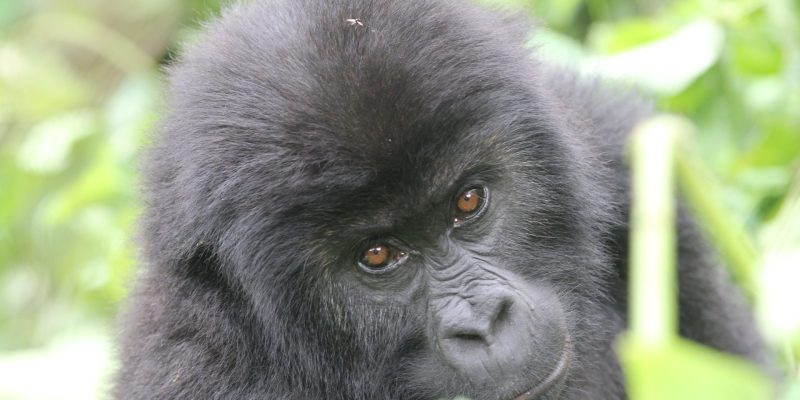
On World Gorilla Day, September 24, 2026, the Dian Fossey Gorilla Fund announced that the Democratic Republic of the Congo has granted formal legal recognition to another 445 square kilometers of community-managed forest inside the Nkuba Conservation Area. With the Mohoo concession recognized, 91 percent of the 2,400-square-kilometer Nkuba landscape now sits under formal community title, in a part of eastern DRC that holds the largest remaining subpopulation of Grauer’s gorillas.
What was actually granted?
A CFCL, a Concession Forestiere des Communautes Locales, which is a local community forest concession under Congolese law. It gives a community perpetual legal rights to forest it already regards as its own, in exchange for a commitment to manage that forest sustainably. People keep using the water and the medicinal plants they have always used. What changes is that the title is now written down and enforceable, which is what stops the land being allocated to somebody else.
This is not a national park, and the distinction is the whole point. Nkuba was established in 2012 by the Fossey Fund together with local landowners, and it is built on communities retaining their land rather than being moved off it. Mohoo is the third CFCL recognized in the area this year.
Why Grauer’s gorillas need this and mountain gorillas do not
Because most Grauer’s gorillas do not live in national parks. Mountain gorillas are concentrated in a small network of protected areas, which is a large part of why intensive protection has worked for them. Grauer’s gorillas, Gorilla beringei graueri, are spread across eastern DRC largely outside formal protected areas, so a strategy that only defends park boundaries defends the minority of the population.
The numbers behind that are stark. The Fossey Fund puts the Grauer’s gorilla decline at roughly 60 percent in recent decades, driven by armed conflict, habitat loss, illegal mining and bushmeat hunting, and the subspecies was recently added to the IUCN’s list of the world’s 25 most endangered primates. The first IUCN Green Status of Species assessment for eastern gorillas, published in August 2026, classified Grauer’s gorillas as Critically Depleted, one step from Extinct in the Wild on that framework.
What the Green Status is, and what it is not
The IUCN Red List, which assesses Gorilla beringei ssp. graueri as Critically Endangered under criterion A4bcd, measures how close a species is to extinction. The Green Status of Species measures something different: how close it is to full ecological recovery across its historical range, and how much of its current condition is owed to conservation that is already happening. The two run in parallel and answer different questions, which is why a subspecies can be Critically Endangered on one and Critically Depleted on the other without either being a revision of the other.
Mountain gorillas came out of the same assessment as Largely Depleted, which is the better of the two results and still a long way from recovered. Both subspecies were classed as conservation-dependent, meaning that the gains reverse if the work stops.
The assessment carries one finding that bears directly on Mohoo. Nkuba and the surrounding community forests, together with Kahuzi-Biega National Park, hold the largest remaining subpopulation of Grauer’s gorillas. Inside Nkuba, the Fossey Fund reports the number has held steady over the last decade. In Kahuzi-Biega, a national park, it has fallen by 77 percent since the mid-1990s.
Which zoos are behind this?
Named ones, and they are named by the Fossey Fund itself. The Rainforest Trust is credited with the financial support for the expansion of legal protections in Nkuba. Additional funding is credited to the Arcus Foundation, the Daniel K. Thorne Foundation, the Disney Conservation Fund, Planet Women, the Weeden Foundation, and AZA Gorilla SAFE members including Cleveland Metroparks Zoo, the Detroit Zoo and the Houston Zoo.
SAFE, Saving Animals From Extinction, is the Association of Zoos and Aquariums program that pools member institutions behind a single species recovery plan rather than leaving each zoo to fund its own projects. The gorilla program is led in part from Cleveland Metroparks Zoo, whose director of conservation and science, Kristen Lukas, is one of its program leaders, and from the North Carolina Zoo. The Dian Fossey Gorilla Fund is both a SAFE member and a recipient of SAFE funding.
For scale, the AZA reports that its 235 accredited and certified members spent approximately $372.4 million on conservation across 139 countries in 2025. No published breakdown isolates the African share of that, and we are not going to invent one. What is documented here is narrower and more useful: three named American zoos are among the funders of the legal work that put 445 square kilometers of Congolese forest under community title.
Conservation in the middle of an Ebola epidemic
The eastern DRC is carrying the largest recorded Ebola outbreak in the country’s history at the same time. The Fossey Fund cites World Health Organization figures for September 2026 of more than 7,600 confirmed cases and more than 3,700 deaths across seven provinces. The United Nations reported on September 23 that the outbreak, caused by Bundibugyo virus, had passed 3,700 deaths, with case numbers falling in Ituri and Haut-Uele and rising sharply in North Kivu. That is on top of the armed conflict, displacement and infrastructure failure the region was already dealing with.
“Conservation does not happen under ideal circumstances,” said Dr. Tara Stoinski, the Fossey Fund’s president, CEO and chief scientific officer. “It happens because people continue to show up for their forests, their communities and the wildlife that depends on them, even when conditions are extraordinarily difficult.”
What the model has produced so far
Since the Fossey Fund began working in Nkuba, the organization reports that the killing of gorillas there has stopped, and that forest elephants which had been locally wiped out by poaching have started to return. Nkuba is recognized as a Key Biodiversity Area and is under consideration as an Other Effective Conservation Measure, a designation for places that conserve biodiversity effectively without being formal protected areas.
“The recognition of Mohoo is an important step forward for the people and wildlife of Nkuba, and it demonstrates what is possible when conservation and local land rights work together,” Stoinski said.
Urbain Ngobobo, the fund’s DRC country director, put the mechanism more plainly. “Formal recognition gives communities the legal foundation to protect their land while also creating opportunities for sustainable livelihoods,” he said. “It is conservation that can endure because it is built around the people who call Nkuba home.”
The Fossey Fund has published nothing further about Mohoo since the announcement; its newest items of any kind as of this writing are dated September 29, 2026, and neither concerns Nkuba.
We have covered the other end of the Fossey Fund’s range before, in the first wild birth to a GRACE-released Grauer’s gorilla. Nkuba is where the habitat side of the same problem gets solved, one concession at a time.
Quick answers
- What was granted in the Nkuba Conservation Area?
The Democratic Republic of the Congo granted formal legal recognition to the Mohoo concession, another 445 square kilometers of community-managed forest. With it recognized, 91 percent of the 2,400-square-kilometer Nkuba landscape sits under formal community title. The Dian Fossey Gorilla Fund announced it on World Gorilla Day, September 24, 2026.
- What is a CFCL?
A Concession Forestiere des Communautes Locales, a local community forest concession under Congolese law. It gives a community perpetual legal rights to forest it already regards as its own in exchange for a commitment to manage it sustainably. People keep using the water and medicinal plants they always have; what changes is that the title is written down and enforceable.
- Why does this matter more for Grauer's gorillas than for mountain gorillas?
Because most Grauer's gorillas do not live in national parks. Mountain gorillas are concentrated in a small network of protected areas. Grauer's gorillas are spread across eastern DRC largely outside formal protection, so defending park boundaries defends the minority of the population.
- Which zoos funded this?
The Fossey Fund credits the Rainforest Trust with the financial support for the expansion of legal protections in Nkuba, with additional funding from the Arcus Foundation, the Daniel K. Thorne Foundation, the Disney Conservation Fund, Planet Women, the Weeden Foundation and AZA Gorilla SAFE members including Cleveland Metroparks Zoo, the Detroit Zoo and the Houston Zoo.
- What is the Green Status assessment?
It measures how close a species is to full ecological recovery across its historical range, rather than how close it is to extinction. The first Green Status assessment for eastern gorillas, published in August 2026, classified Grauer's gorillas as Critically Depleted and mountain gorillas as Largely Depleted. Both were classed as conservation-dependent, meaning the gains reverse if the work stops.
- Has the model worked?
Inside Nkuba the Fossey Fund reports that the killing of gorillas has stopped, that forest elephants locally wiped out by poaching have started to return, and that gorilla numbers have held steady over the last decade. In Kahuzi-Biega National Park, a formal protected area nearby, the subpopulation has fallen by 77 percent since the mid-1990s.