
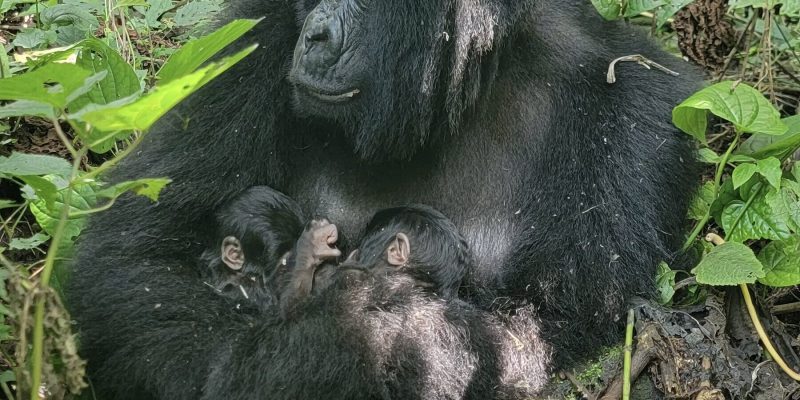
Mafuko had twins in 2016. They died a week later. On January 3, 2026, at twenty-two, she had twins again.
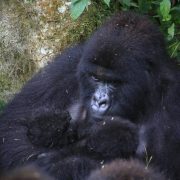
Community trackers found the two male infants in the Bageni family in Virunga National Park, the largest gorilla group in the park at 59 individuals. It was the first birth recorded in Virunga in 2026, and by the end of March there had been nine in the habituated population in three months.
Who Mafuko is
The park’s own account of her is not a gentle one. She was born into the Kabirizi family on May 23, 2003. Virunga states it plainly: following the assassination of her mother by armed individuals on June 8, 2007, she stayed with the Kabirizi family alongside her sister Tumaini. She joined the Bageni family in January 2013.
She has given birth seven times.
Uzima and Urithi
At two months the twins were named, and the names were chosen to say something. Uzima, a symbol of life, survival and biological continuity. Urithi, a symbol of heritage and the legacy passed to future generations.
Reaching two months was itself a first in the park’s history. The park’s description of how their mother manages the load is worth quoting exactly: during longer journeys, she adapts her posture, one infant on her back while the other remains clinging to her chest.
An adult blackback male has been observed staying beside Mafuko continuously, which Virunga describes as remarkable protective and solidarity behavior.
Why twins are so hard for this species
A mountain gorilla infant is carried constantly for its first months. It cannot cling and travel on its own, and the mother has to move with the group across steep, forested terrain. Two infants means two sets of hands that are not free, in an animal that walks on its knuckles.
Virunga puts twin births in mountain gorillas at fewer than one percent, most likely resulting from hyper-ovulation, and notes that observations in the park suggest such events may occur when females are in particularly good physical condition, without any causal relationship being established.
Good physical condition in a wild gorilla is not luck. It is the downstream result of protection, and the mountain gorilla is one of very few species ever downlisted from Critically Endangered to Endangered, which happened in 2018.
What it took
An enhanced monitoring team was deployed for the twins’ first four months, present with the family every day.
The rangers doing that work are doing it in eastern Congo, which is not a stable place, and the park does not pretend otherwise. Coverage of the second twin birth this year quotes the head of gorilla monitoring on exactly that point.
Virunga states that the continued protection of mountain gorillas in the park is made possible by the support of the European Union and UNESCO. It names no zoo. But the veterinary care at its orphan facility is another matter entirely.
Source: Virunga National Park.