
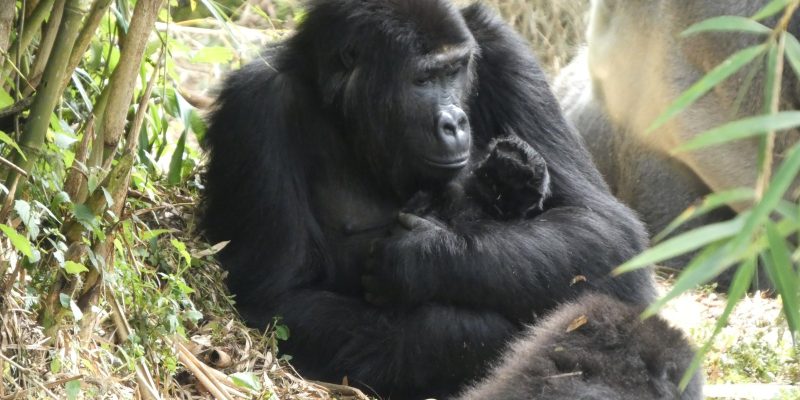
A Grauer’s gorilla who was taken from her family by wildlife traffickers as an 18-month-old infant has given birth in the forest she was returned to. Lulingu, one of four females released onto Mt. Tshiaberimu in Virunga National Park in December 2024, delivered a healthy infant on May 21, 2026. She is among the first Grauer’s gorillas ever returned to the wild successfully, and hers is the first birth to come out of that effort.
The father is Mwasa, a wild silverback who has lived on the mountain for years. That detail is the whole point: a rewilded female has not merely survived in the forest, she has been accepted into a wild family group and bred within it.
Who is Lulingu?
She arrived at the Gorilla Rehabilitation and Conservation Education Center, known as GRACE, in 2016. The Institut Congolais pour la Conservation de la Nature and the veterinary group Gorilla Doctors had rescued her after she was taken from her family and sold into the illegal wildlife trade. At 18 months she was the youngest gorilla GRACE had ever taken in, and GRACE, in Kasugho in eastern Democratic Republic of the Congo, remains the only sanctuary in the world for rescued Grauer’s gorillas.
Two caregivers, Devotte Kavira Kihira and Kambale Muviri, fed and settled her around the clock until she was stable. Then the sanctuary did the thing that makes its model unusual: it handed her to another gorilla. Pinga, an experienced female already living at GRACE, took the infant on as a surrogate and brought her into the sanctuary’s gorilla family. That family included Mapendo, Ndjingala and Isangi, the three females who would eventually walk back into the forest beside her.
All four had been rescued from the illegal trade as infants. All four were selected for release on behavior, reproductive health and overall health, following the International Union for Conservation of Nature’s published best-practice guidelines for reintroducing great apes. On December 3, 2024 they left the rewilding facility on Mt. Tshiaberimu on their own feet and followed Mwasa into the forest.
Why does a single birth count as a conservation result?
Mt. Tshiaberimu holds one of the smallest and most isolated Grauer’s gorilla populations anywhere. A population viability analysis found a high probability that it would go extinct within 50 years unless new breeding females were added. The release was designed to answer that arithmetic directly, by putting reproductive females into a gene pool that had run short of them. An infant fathered by a resident wild silverback is the first evidence that the design works.
It is worth being precise about how the monitoring team saw it coming. Virunga’s gorilla trackers have followed the group since the release, watched the females mating with Mwasa, recorded what they were eating, and collected urine non-invasively from leaves, which they tested with ordinary human pregnancy tests to pick up the hormone levels that signal a pregnancy.
“None of the four females have required veterinary treatment for illness or injury since being rewilded, the outcome we always hope for,” said Dr. Cedric Kibengo, a Gorilla Doctors field veterinarian who has monitored the eastern lowland gorillas on Mt. Tshiaberimu since 2024. “With the arrival of Lulingu’s infant, we now have one more patient under our care, and both mother and infant are healthy and doing well.”
Benoit Ishaba, who heads gorilla monitoring on the mountain as a Virunga National Park ranger, described what the team is seeing. “Lulingu is doing a great job taking care of the baby and is central to the family group,” he said. “We have seen her nursing, cradling, and playing with the baby. The other young gorilla in her group has shown interest in the baby, and Lulingu has been very patient with him.”
Jackson Kabuyaya Mbeke, GRACE’s country director in DR Congo, has been with the project since it began. “I watched her arrive as our youngest orphan at 18 months old, grow up in a surrogate gorilla family, return to the wild, and now become a mother for the first time,” he said.
The part nobody can promise yet
None of the four rewilded females has raised an infant before, although all of them spent time around young gorillas at GRACE. No one has studied Grauer’s gorilla infant mortality in the wild; in the closely related mountain gorilla, roughly 35 percent of infants do not survive. The monitoring team’s working hope is that the four learn alongside one another as they begin raising young. Gorilla pregnancies run eight to nine months, and at least one of the other three females may also be pregnant.
Where does the zoo money sit in this?
We look for the accredited zoos and aquariums behind field conservation work, because the connection is usually real and almost never stated. Here it is real, and it sits one step back from the forest.
The reintroduction was led by GRACE, Virunga National Park and local communities, with support from Gorilla Doctors and Re:wild. When the four females were released, the partners named the funders of the translocation: the European Union, the Arcus Foundation, the Disney Conservation Fund, Explore.org, the Margot Marsh Biodiversity Fund, the QATO Foundation and the Frankfurt Zoological Society. Two of those seven are zoo-world money. The Disney Conservation Fund is run out of the Animals, Science and Environment team at Disney’s Animal Kingdom. The Frankfurt Zoological Society is a conservation organization founded by a zoo director rather than a zoo itself, which is why it earns a mention here and not a facility page.
GRACE separately lists six accredited zoological institutions among the partner organizations that, in its own words, provide significant advisory or technical support in addition to funding for its programs: Dallas Zoo, Detroit Zoo, Disney’s Animal Kingdom, Houston Zoo, the Los Angeles Zoo and Botanical Gardens, and Nashville Zoo at Grassmere. Dallas supplies expertise to GRACE’s Animal Care and Welfare Advisory Group; Detroit provides veterinary support and expertise to its Education Advisory Group. Jacksonville Zoo and Gardens lists GRACE among its own conservation partners. None of those institutions is named as a funder of this particular reintroduction, so we name them as GRACE’s supporters and stop there.
For scale on the category: AZA reported that in 2025, 235 accredited and certified facilities spent approximately $372.4 million on conservation across 139 countries. No published breakdown isolates an African share, so we do not print one. The pattern this story fits is the one we found in the funding behind Gorilla Doctors: North American zoos underwrite veterinary and sanctuary infrastructure, and the field organizations do the work on the ground.
How endangered is a Grauer’s gorilla?
The IUCN Red List assesses Gorilla beringei ssp. graueri as Critically Endangered under criterion A4bcd. The assessment is by Plumptre and colleagues, dated March 1, 2016, and it records the population as decreasing, severely fragmented, and still declining in mature individuals. The Red List publishes no global figure for mature Grauer’s gorillas, so widely quoted population numbers are secondary-source estimates and are best read as such. The subspecies is found only in the Democratic Republic of the Congo, between 600 and 2,900 meters, and its generation length is put at 20 years.
One line in that 2016 assessment is worth reading twice. Under conservation actions in place, beside “successfully reintroduced or introduced benignly,” the Red List records: No. Lulingu, Isangi, Mapendo, Ndjingala and a newborn on Mt. Tshiaberimu are what it looks like when a line like that goes out of date.
Quick answers
- Who is Lulingu?
A Grauer's gorilla rescued at 18 months old by ICCN and Gorilla Doctors after traffickers took her from her family. She was raised at the GRACE sanctuary in Kasugho, DR Congo, and released into Virunga National Park in December 2024.
- When did she give birth?
On May 21, 2026, on Mt. Tshiaberimu in Virunga National Park. The father is Mwasa, a wild silverback whose family group she joined after her release.
- Why does this birth matter?
A population viability analysis found the isolated Mt. Tshiaberimu gorillas had a high probability of extinction within 50 years without new breeding females. Lulingu was one of four released to address that, and hers is the first birth to come out of it.
- How endangered is the Grauer's gorilla?
The IUCN Red List assesses Gorilla beringei ssp. graueri as Critically Endangered under criterion A4bcd, assessed on March 1, 2016, with a decreasing and severely fragmented population. The Red List publishes no global figure for mature individuals.
- Do any accredited zoos fund this work?
Yes, indirectly. The Disney Conservation Fund, run out of Disney's Animal Kingdom, is named among the funders of the 2024 translocation, alongside the Frankfurt Zoological Society. GRACE separately lists Dallas, Detroit, Disney's Animal Kingdom, Houston, Los Angeles and Nashville zoos as partner organizations that fund and advise its programs.