
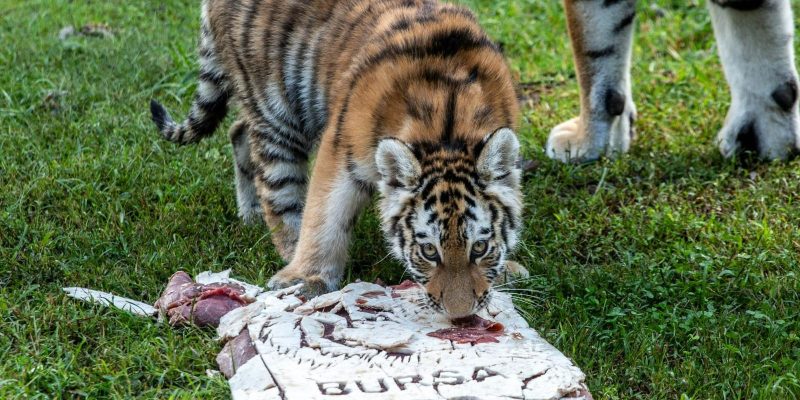
Bursa Zoo marked the hundredth day of an Amur tiger cub called Victoria on September 21, 2026, with a meat cake laid out on the grass of the tiger habitat. She is the only Amur tiger ever born in Turkey, and she got to the hundred-day mark by way of a broken leg and a course of treatment run jointly by the zoo’s veterinarians and the veterinary faculty of Bursa Uludag University.
Victoria was born to Victor and Zeya at the Bursa Metropolitan Municipality’s zoo, under the breeding program the zoo runs for the subspecies. Counting back from the celebration puts her birth in the second week of June 2026.
The fracture, and why it is in the announcement at all
The zoo’s own bulletin does not bury the accident. Victoria broke a leg while playing, specialists from the zoo and from Bursa Uludag University’s veterinary faculty treated her without delay, and the recovery was monitored closely enough that the hundredth day was worth a cake. Mustafa Omer Ukum, a veterinarian at the zoo, said the necessary clinical treatment was carried out after the accident and that Victoria is the only Siberian tiger born in Turkey under the species conservation program.
Erdem Saker, a former mayor of Bursa Metropolitan Municipality who now coordinates the zoo, said the arrival of an Amur tiger cub was a source of happiness for the zoo and that the veterinarians had worked meticulously on her development.

What an Amur tiger birth in Bursa is worth
Amur tigers are the northern end of the tiger’s range, and they are not numerous. Since the 2017 revision of tiger taxonomy the Red List no longer treats the Amur tiger as a species or subspecies of its own, folding it into the continental subspecies Panthera tigris tigris. The WildCats Conservation Alliance, which funds field work across the Amur region, reports that the most recent IUCN Red List assessment, published in 2022, put the Amur population at 265 to 486 in the Russian Far East, with a further small number crossing the border into China.
For scale on the other end of that century: the same alliance records that in the 1940s the Amur tiger was down to fewer than 50 animals in the wild, and that Russia became the first country in the world to ban tiger hunting outright, in 1947.
Against a wild population of a few hundred, the managed population in zoos is not a sideshow. Amur tigers are covered by a Global Species Management Plan convened through WAZA, the World Association of Zoos and Aquariums, which brings four regional zoo association programs into one framework: AZA in North America, EAZA in Europe, EARAZA across the former Soviet states and JAZA in Japan. WAZA’s own description of the purpose is blunt, and worth quoting because it is the argument for breeding tigers in zoos at all: the plan exists to keep the managed population going “as a genetic lifeboat for their wild counterparts.”
Bursa Zoo says it is a member of EAZA, and the municipality’s bulletin puts the membership at the top of the announcement. We were not able to confirm the listing in EAZA’s own member directory, so that one detail stands on the zoo’s word rather than ours.
The zoo itself
Bursa Zoo has been open since 1998. It covers 206,000 square meters, holds roughly a thousand animals across 123 species and takes in something like 800,000 visitors a year, Turkish and foreign. For a municipal zoo that is a substantial operation, and it is the most consistent self-publisher of animal news of any zoo in Turkey.
The hundred-day cake is the sort of thing that can read as a stunt, and the Bursa staff mostly avoided that by putting the vets in the announcement rather than only the cake. A cub with a healed fracture eating frozen meat off the grass is a more informative picture than a cub simply existing, because it says the animal is weight-bearing and competing at a shared feed.
Turkey’s zoos do not often reach an English-language audience, which is a gap we have been working at: earlier this week we covered the white-handed gibbons and siamangs arriving at Izmir Wildlife Park. For the wider picture of how Amur tigers move between institutions on the studbook’s instructions, see our report on Sarang’s transfer from Seoul to Columbus.
Who pays for the wild ones
We trace the zoological money behind conservation stories in this region as a matter of course, and it is worth saying where it runs and where it does not. The WildCats Conservation Alliance, the body whose Amur figures are quoted above, describes itself as an initiative between the Dreamworld Wildlife Foundation and the Zoological Society of London, and it channels zoo fundraising into anti-poaching, monitoring and human-tiger conflict work in the Russian Far East. That is accredited zoological institutions paying for wild tiger conservation, plainly and on the record.
It is not, however, Bursa’s story. Nothing we found connects the Bursa Metropolitan Municipality’s breeding program to the alliance or to ZSL, and naming them alongside Victoria would imply a link that does not exist. They are here as context for what the managed population is for, and for no other reason.
A note on the name
The cub is Victoria. The Turkish-language announcement from Bursa Metropolitan Municipality uses that name throughout, as does the Turkish press coverage; at least one English write-up of the same bulletin rendered it as Virginia. We have gone with the name the municipality published.
Quick answers
- Who is Victoria?
An Amur tiger cub born at Bursa Zoo, the Bursa Metropolitan Municipality's zoo in northwest Turkey, to parents Victor and Zeya. Her hundredth day was marked on September 21, 2026, putting her birth in the second week of June. The zoo says she is the only Amur tiger ever born in Turkey.
- What happened to her leg?
She fractured a leg while playing. Veterinarians at the zoo treated her together with specialists from the veterinary faculty of Bursa Uludag University, and she responded to the treatment. She was eating at a shared feed by her hundredth day.
- How many Amur tigers are left in the wild?
The WildCats Conservation Alliance reports that the 2022 IUCN Red List assessment put the Amur population at 265 to 486 in the Russian Far East, with a small number crossing into China. In the 1940s the figure was under 50.
- Are Amur tigers a separate subspecies?
Not on the current Red List. The 2017 revision of tiger taxonomy folded the Amur tiger into the continental subspecies Panthera tigris tigris, so it is now treated as a subpopulation rather than a subspecies of its own.
- How do zoos coordinate Amur tiger breeding?
Through a Global Species Management Plan convened by WAZA, which brings the regional programs of AZA, EAZA, EARAZA and JAZA into one framework. WAZA describes the managed population as a genetic lifeboat for the wild one.