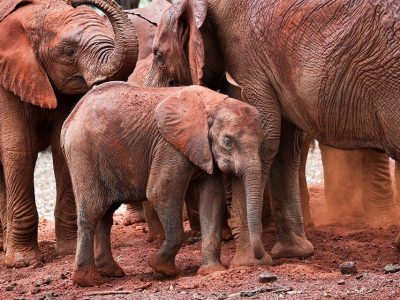

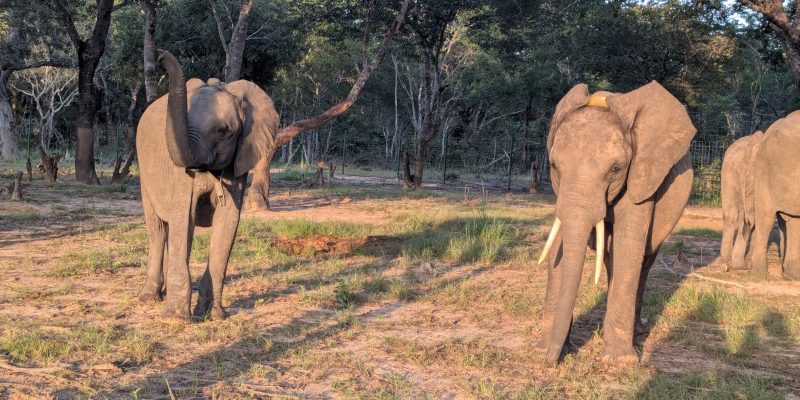
Muchichili was found alone on an island in the Lower Zambezi in January 2016, eighteen months old, dehydrated and in shock, with mouth ulcers that made feeding difficult. In March 2023 he walked away with wild elephants.
Game Rangers International published the full arc in February 2025, and it is the clearest account available of what an elephant orphan program actually involves.
The rescue
Teams watched him for days before intervening, because the first question is always whether a herd is coming back. None did. He was darted, taken off the island by boat, and driven four hours to the nursery, in an operation involving Zambia’s Department of National Parks and Wildlife, Conservation Lower Zambezi and Kanyemba Lodge.
In November 2016 he moved to the Kafue Release Facility alongside another orphan, Nkala. They were met by Chamilandu, the matriarch of the release herd.
The part that takes seven years
An orphaned elephant cannot simply be let go. It has no herd, no learned knowledge of where water is in a bad year, and no social standing. The release herd substitutes for all of that, and the animal leaves when it decides to.
Muchichili left in March 2023 with six other orphans, in the company of wild elephants.
Nkala took longer. In March 2026, aged thirteen, he chose for the first time to spend nights outside the predator-proof enclosure, moving from stage three to stage four in GRI’s monitoring framework. Thirteen years from rescue to sleeping outside by choice.
Chamilandu, and why the herd matters
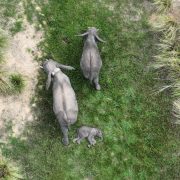
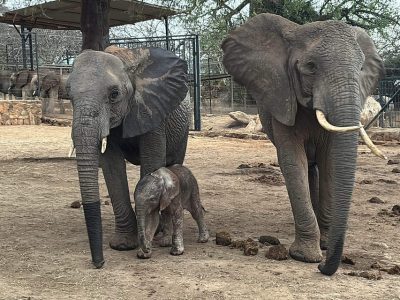
Chamilandu was orphaned to poachers roughly nineteen years ago. In November 2025 she gave birth in the wild near Nkala Pools in southern Kafue, her second calf and the first born with no human assistance. Her first, Mutaanzi David in 2019, was delivered inside the release facility boma.
The team found her by chance on a routine drive and watched from a distance. Present at the birth were two unknown wild females, Mutaanzi David himself, now six, and the orphans Kavala and Mosi.
That is what the program is for. Not the rescue, which is the photogenic part, but a wild-born calf to a wild-living female who was herself an orphan, in a herd that mixes hand-reared and wild animals and no longer needs anyone’s help to function.
An unusual note in GRI’s own copy
Under a 2013 photograph in the Nkala story, GRI added an editor’s note stating that its elephant welfare and rehabilitation practices have evolved since, and that some aspects shown in the historic image do not reflect current welfare protocols.
Organizations do not usually flag their own older photographs that way. It is a small thing and it is the right thing.
The Elephant Orphanage Project was established in 2008 with funding from the David Shepherd Wildlife Foundation, and is supported by, among others, Colchester Zoological Society, which has funded it since 2010.
Source: Game Rangers International.