
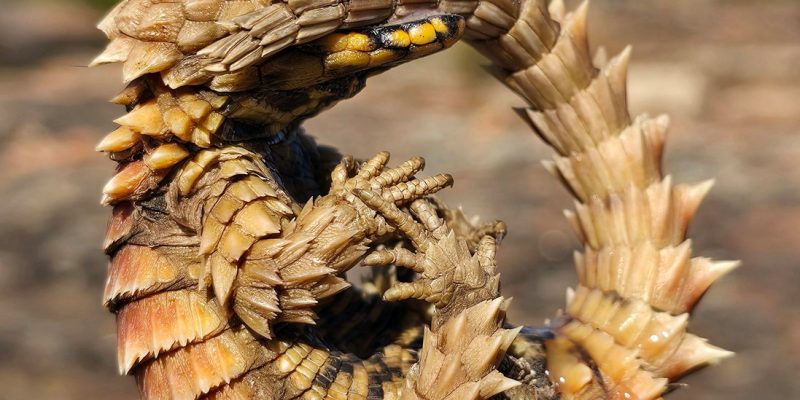
Threatened by a predator, an armadillo girdled lizard curls into a ring and bites its own tail, so that what a jackal meets is a disc of spines with no soft part showing. It is a good defense. It is also, as the Endangered Wildlife Trust points out in a piece published on September 29, precisely the behavior that makes the animal easy to pick up and put in a plastic tub.
The trust’s article covers two South African lizards that look like scale models of dragons and are protected accordingly: the armadillo girdled lizard, Ouroborus cataphractus, and the sungazer, Smaug giganteus, also called the giant girdled lizard. Both are cordylids, both are armored in hard spiny scales, both are unusually social for reptiles, and both are wanted by the international pet trade.
Two animals that cannot replace themselves quickly
Armadillo girdled lizards live in family groups in rocky outcrops in the Western and Northern Cape, eat mostly insects, communicate by body language, reach about 16 centimeters and can live 25 years. A female produces one or two young at a time and may even feed them, which is rare in lizards. The scientific name refers to the tail-biting: Ouroborus, the serpent devouring itself.
Sungazers live in colonies of self-dug burrows in the highveld grasslands of Mpumalanga and the Free State, with some records in KwaZulu-Natal. They average about 22 centimeters, the largest of the girdled lizards, and live around 21 years in the wild. The common name comes from the basking posture, head tipped toward the sky at the burrow mouth. They breed only every second or third year and produce one to three young.
Those two reproductive rates are the whole conservation problem in a sentence. An animal that produces one or two offspring every two or three years cannot absorb collecting pressure, and it cannot refill a colony that has been emptied.
Where the pressure comes from
Both species are on the Threatened or Protected Species list under South Africa’s National Environmental Management: Biodiversity Act, so harvesting, killing, buying, selling or exporting them requires a permit, and both are covered by provincial law as well. The trust notes that violating the act carries a fine of up to 10 million rand, up to 10 years imprisonment, or both. Both are also on South Africa’s Sensitive Species List, which restricts the publication of locality data, because a precise map of a colony is a shopping list.
Illegal trade is hard to quantify by its nature. The trust describes the symptoms investigators actually work from: colonies that vanish from known sites with no other explanation, and animals offered at reptile fairs or on online marketplaces with no evidence of captive breeding. Legal trade is also used to launder wild-caught animals as captive-bred, which is why establishing parentage matters. Sungazers are, with a handful of exceptions, not known to breed in captivity at all, so a sungazer offered as captive-bred is close to a contradiction in terms.
Habitat is the second pressure, and it falls unevenly. The trust describes the rocky outcrops the armadillo girdled lizard uses as not currently under major threat, though climate change, fragmentation and invasive plants all bite. For the sungazer it is far worse: half of its grassland habitat has already been transformed by agriculture, urban development and mining, and the trust puts the resulting population decline at an estimated 48 percent. Sungazers are also used in traditional medicine, a permitted use that becomes a conservation problem when the harvesting is not.
On the listings, and one small correction
The trust’s categories are both right, which is worth saying since we more often print the other kind of note. The IUCN Red List assesses the armadillo girdled lizard as Near Threatened under criterion A4d, in a 2022 assessment by Tolley, Alexander, Pietersen, Conradie and Weeber with an assessment date of September 1, 2021 and a population trend listed as unknown. It assesses the sungazer, which the Red List calls the giant dragon lizard, as Vulnerable under criteria A2bcd and A4bcd, in a 2022 assessment by Alexander, Tolley, Bates and Mouton, with a decreasing population.
One number on that page will look odd beside everything above. The Red List records 677,000 mature sungazers. A Vulnerable listing under criterion A is about the rate of loss rather than the size of what is left, so a species can be numerous and still be sliding fast enough to qualify. That is what a 48 percent decline in a species that breeds every second or third year looks like on a Red List page.
The small correction is a slip of vocabulary rather than of science. The trust’s article says sungazers are oviparous and, in the next clause, that they give birth to one to three live young. Those cannot both be true: oviparous means egg-laying, and bearing live young is viviparous, which is what sungazers do and what makes them unusual among cordylid relatives that lay eggs. The rest of the paragraph is correct and the point it was making, that sungazers are reproductively slow and strange, stands.
Which zoo is behind this
We look for the accredited zoological institutions funding field conservation work, and on this one the trail runs almost entirely cold.
The Endangered Wildlife Trust publishes a funding line for its sungazer habitat work, and it is long: Eskom Holdings, Ezemvelo KZN Wildlife, the Ford Wildlife Foundation, the HCI Foundation, Heather Henson, the International Crane Foundation Conservation Impact Fund, an African Wildlife Initiative Rapid Action Grant co-funded by IUCN Save Our Species and the European Union, the National Lotteries Commission, Millstream Farm, the N3 Toll Concession, Paul L King, Rand Merchant Bank and the Whitley Fund for Nature. A power utility, a provincial conservation agency, a lottery, a toll road operator, a bank and several private foundations.
Exactly one entry on that list is a zoological institution. The International Crane Foundation, which keeps all fifteen of the world’s crane species at its headquarters in Baraboo, Wisconsin, is accredited by the Association of Zoos and Aquariums. Its long partnership with the trust is the African Crane Conservation Programme, and nothing published connects its Conservation Impact Fund to lizard work. We are naming it because it is there and because leaving it out would be tidier than it is honest, not because we can tell you it paid for anything in this story.
So the answer is effectively none, and the trust says what it needs plainly enough that the gap is easy to describe. It is drafting a Biodiversity Management Plan for the sungazer. It wants funding to move colonies out of the path of approved mining applications, to find new rocky homes for confiscated armadillo girdled lizards, and to care for seized animals well enough that they can go back. Its own phrasing for the thing that does not exist yet is a dedicated reptile refuge where seized or injured individuals can recover before going home. That is a request a zoo would recognize, from an organization no zoo appears to be funding.
For scale on the other side, the Association of Zoos and Aquariums reports that in 2025 its 235 accredited and certified facilities spent approximately $372.4 million on conservation across 139 countries. No published breakdown isolates the African share, and we are not going to estimate one.
The same organization appeared here last week for its response to a mass vulture poisoning in Limpopo, which is the loud version of this work. Lizards in a PostNet parcel are the quiet version, and they are harder to fund for exactly that reason.
Source: the Endangered Wildlife Trust’s September 29, 2026 article on threatened South African lizards, and the trust’s published funding statement for its sungazer habitat work.
Quick answers
- Which species is this about?
Two South African cordylid lizards: the armadillo girdled lizard, Ouroborus cataphractus, of the rocky Western and Northern Cape, and the sungazer, Smaug giganteus, also called the giant girdled lizard, of the highveld grasslands of Mpumalanga and the Free State. The Endangered Wildlife Trust published a piece on both on September 29, 2026.
- Why does the armadillo girdled lizard bite its own tail?
It is a defense. Curled into a ring with its tail in its jaws, the animal presents nothing but spined scales to a predator and hides its soft belly. The genus name Ouroborus refers to that posture. The trust's point is that the same behavior makes the lizard trivially easy for a person to pick up.
- What is the legal position?
Both species are on the Threatened or Protected Species list under South Africa's National Environmental Management: Biodiversity Act, so harvesting, killing, buying, selling or exporting them requires a permit, and both are covered by provincial law. The trust says a violation carries a fine of up to 10 million rand, up to 10 years imprisonment, or both. Both are also on the national Sensitive Species List, which restricts publication of locality data.
- How do the lizards reach the pet trade?
Wild collection, and legal trade used to launder it. The trust describes animals offered at reptile fairs and online with no evidence of captive breeding, and colonies that disappear from known sites with no other explanation. Sungazers are, with a handful of exceptions, not known to breed in captivity at all, which makes a captive-bred sungazer a claim worth checking.
- What do the IUCN assessments say?
The armadillo girdled lizard is Near Threatened under criterion A4d, assessed September 1, 2021 by Tolley, Alexander, Pietersen, Conradie and Weeber, with an unknown population trend. The sungazer, which the Red List calls the giant dragon lizard, is Vulnerable under criteria A2bcd and A4bcd, assessed the same day by Alexander, Tolley, Bates and Mouton, with 677,000 mature individuals and a decreasing population. A Vulnerable listing under criterion A is about the rate of decline, not the size of what is left.
- Which zoo funds this work?
Effectively none. The trust's published funding line for its sungazer habitat work names fourteen supporters, including a power utility, a provincial conservation agency, a lottery, a toll road operator and a bank. The only zoological institution on it is the International Crane Foundation, which is AZA-accredited but whose partnership with the trust is the African Crane Conservation Programme, and nothing published ties its money to lizards. The trust says what it needs: somewhere for confiscated reptiles to recover before they go home.