
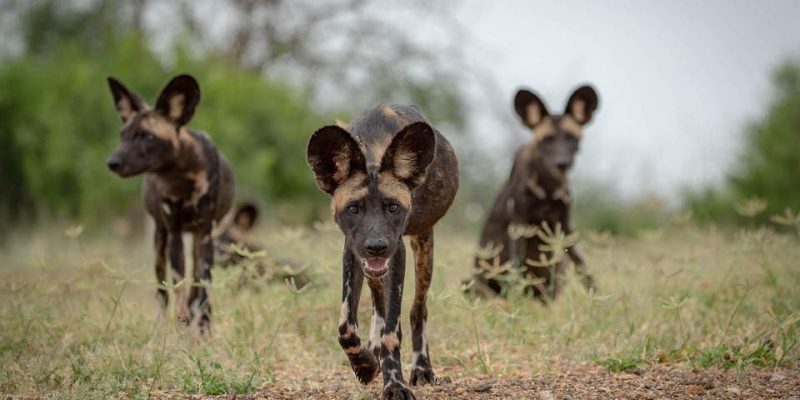
Twenty-five years ago, seeing a single African wild dog in northern Tsavo was astonishing. Angela Sheldrick’s account of the area today describes one becoming two, then three, then ten, and then more than twenty emerging from thick bush onto a red road, pups chirping, adults lying down to rest once they had decided the vehicle was harmless.
That change is the subject of the Sheldrick Wildlife Trust’s September 30 field note, and it is a useful story because the dogs were never the point. They are the receipt.
What was lost
African wild dogs are extraordinarily good at the thing they do. They hunt as a relay, leading animals dropping back and others taking the front without the chase ever slowing, and roughly eight in ten of their pursuits end in a kill, a rate no other large African predator approaches. Their white-tipped tails work as flags so the pack can track itself through cover. They are also, uniquely among the big African carnivores, organized entirely around the pack rather than the individual: the healthy feed the old, the sick and the injured, males stay in the pack they were born into and females leave, and pups are raised communally once they leave the den.
None of that protects them from a wire loop set at the height of an antelope. Snares are not set for wild dogs and kill them anyway. Add habitat fragmentation, add distemper and mange carried in by domestic dogs, add the bushmeat poaching that strips a landscape of the prey a predator needs, and the result is an animal that has disappeared from most of the countries that once held it.
By the 2000s the dogs had all but vanished from Ithumba, in Tsavo’s northern area, along with nearly everything else. The trust’s account of that period is blunt: elephants had left or been killed, prey species had been hunted out, and predators had nothing to eat.
What was done
The trust established operations at Ithumba 25 years ago and worked the problem with the Kenya Wildlife Service rather than around it. The joint SWT/KWS Ithumba anti-poaching team was deployed in 2002 and became the model for the trust’s teams elsewhere in the country; six teams now operate in the northern area. Pilots began flying daily patrols, dropping teams into ground no vehicle could reach and reaching emergencies fast.
The intervention that reached the dogs directly was veterinary and slightly ingenious. Mange was running through the surviving pack, a disease that begins with hair loss and ends in emaciation and death, and the animals were too weak to hunt. Working with the SWT/KWS Tsavo Mobile Vet Unit, the teams injected a carcass with systemic antiparasitic drugs and left it in the pack’s area. The dogs ate all of it. The trust says mange was eradicated from the pack.
Mortality fell, sightings rose, and the surviving pack split into several. Multiple packs now live in the northern area and the largest numbers about 40 animals. That pack has spent this dry season around Ithumba Camp, and it turns up at the orphaned elephants’ mud bath often enough that the young elephants’ trumpeting and mock charges no longer get a reaction.
One snared female, three weeks, and a helicopter
The rest of the field note is about what long-term presence buys you later. A few months ago a ground patrol reported that a female in the large Ithumba pack had a wire snare cutting deep into her waist. The team tried to dart her the same afternoon and could not: the pack was already moving.
For three weeks teams searched from the ground and the air and watched the den, and she did not appear. Wild dogs range over hundreds of square kilometers, move constantly and are superbly camouflaged. The trust’s pilot Roan finally spotted her on an aerial patrol, among hunters returning to the den, with the injury worse than before and the animal still hunting to feed the pack.
The Tsavo Mobile Vet Unit was mobilized while the helicopter, flown by Taru, moved the whole pack toward accessible ground, which is easier than tracking one dog through bush. The team approached on foot, darted her, removed the snare that had encircled her waist, treated the wounds and revived her in shade. She rejoined the pack waiting nearby. The trust says that in the weeks and months since, the pack has been seen at rest, at play and hunting, with no snare on any animal.
Which zoo paid for this
None that we can verify, and that is the finding rather than a gap in it.
We have gone looking for accredited zoo or aquarium funding behind the Sheldrick Wildlife Trust more than once on this beat. We read the trust’s published partners page again for this story and found no zoo, aquarium or zoological society on it. The trust is funded through its own charities in Kenya, the United Kingdom, the United States and Canada, through adoptions, donations and merchandise, and the anti-poaching and veterinary work described here is carried out jointly with a government agency.
It is worth saying that the trust and much of the zoological world are not natural allies. The Sheldrick Wildlife Trust publishes a position opposing the capture of infant elephants for captivity, which is a real disagreement and not something to write around.
For the scale of the sector’s spending elsewhere, the Association of Zoos and Aquariums reports that in 2025 its 235 accredited and certified facilities spent approximately $372.4 million on conservation across 139 countries. No published breakdown isolates the African share of that figure, and we are not going to estimate one. What can be said about these particular dogs is that the money behind the aircraft, the ration packs and the drugged carcass came from somewhere else entirely.
On the numbers
Sheldrick writes that wild dogs have gone from 25 of the 39 countries that once held them and that fewer than 7,000 remain in all of Africa. The country figure matches the assessment closely. The IUCN Red List’s 2025 entry lists the species as extant in 13 countries, extinct in 22, possibly extinct in two more and of uncertain presence in two, which comes to the same 39.
The population figure needs one gentle note. The Red List assesses Lycaon pictus as Endangered under criterion C2b, with 1,676 mature individuals across 45 locations and a decreasing trend, in an assessment by Woodroffe, McNutt, Groom and Ngatia dated June 10, 2025. The two figures are not in conflict: “mature individuals” is a narrower count that excludes every pup and yearling in Africa, and a species whose pack structure produces large litters raised communally will always show a far larger total population than mature count. Both numbers are true, and we default to the assessment when we print one.
The field note opens with a number worth repeating carefully. Sheldrick writes that she had read of three wild dogs covering 4,126 kilometers across Zambia, which she describes as the longest journey ever recorded for an African land mammal, and that the previous record of 3,892 kilometers was held by a pack that walked from the Serengeti to Tsavo West. We have not opened the underlying study and so attribute both figures to her account rather than presenting them as verified here. Her point does not depend on the record: the three tracked animals were part of a larger pack that lost most of its members to snares along the way.
We wrote last week about the other end of the same problem, when a Kenya Wildlife Service team cut a wire snare off a Maasai giraffe in the Mara. Different species, different agency, same loop of wire, and the same answer when you ask who paid.
Source: the Sheldrick Wildlife Trust’s Field Notes for September 2026, written by Angela Sheldrick, and the trust’s published partners page.
Quick answers
- What is the news here?
The Sheldrick Wildlife Trust's September 30, 2026 field note describes the recovery of African wild dogs in Ithumba, in the northern area of Kenya's Tsavo ecosystem, where the species had been reduced to near local extinction. Multiple packs now live there and the largest numbers about 40 animals.
- How were the dogs brought back?
Indirectly, mostly. The trust and the Kenya Wildlife Service established joint anti-poaching teams at Ithumba from 2002 and added daily aerial patrols, which restored the prey base predators depend on. The one direct intervention was veterinary: a carcass injected with systemic antiparasitic drugs was left for a pack too weak with mange to hunt, and the trust says mange was eradicated from the pack.
- What happened to the snared female?
A ground patrol found her with wire cutting into her waist and the team could not dart her that day. Three weeks of ground and aerial searching followed before a pilot spotted her returning to the den with the hunting party, the injury worse. A helicopter moved the pack to accessible ground, the SWT/KWS Tsavo Mobile Vet Unit darted her, removed the snare and treated the wounds, and she rejoined the pack.
- How threatened is the African wild dog?
The IUCN Red List assesses Lycaon pictus as Endangered under criterion C2b, with 1,676 mature individuals across 45 locations and a decreasing population, in an assessment by Woodroffe, McNutt, Groom and Ngatia dated June 10, 2025. The Red List lists the species as extant in 13 countries and extinct in 22 more.
- Why does the trust say fewer than 7,000 remain?
Because that is a total population figure and the Red List's 1,676 counts mature individuals only, which excludes every pup and yearling. In a species that raises large litters communally the gap between those two numbers is wide. Both can be true at once. Where we print one, we default to the assessment.
- Which zoo funds this?
None that we can verify. We read the Sheldrick Wildlife Trust's published partners page again for this story and found no zoo, aquarium or zoological society on it. The trust is funded through its own charities in Kenya, the United Kingdom, the United States and Canada. It also publishes a position opposing the capture of infant elephants for captivity, which is a real disagreement with part of the zoological world.