
A giraffe stands up for most of its life. It rests standing, it sleeps standing, and when something frightens it, the only thing between it and a predator is a leg about 1.8 meters long, near enough the height of a tall adult man. So a loop of wire around one hind leg is not a minor injury on a giraffe. It is an injury to the animal’s entire strategy for staying alive.
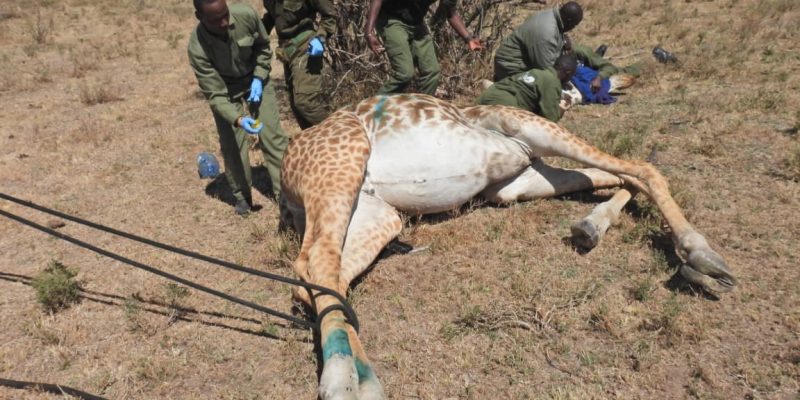
The Kenya Wildlife Service published an account on September 29 of its Mara veterinary unit attending an adult female Maasai giraffe with a wire snare around her right hind leg. The service says the team was lucky: the snare was loose and had not caused serious injury, though there were abrasion wounds where it had rubbed. The wire was cut away, the wounds were treated with antibiotic spray, and the service describes her recovery outlook as good.
That is the whole veterinary event. It took one team, one morning, and some antibiotic spray, and it is the kind of intervention that never makes a headline anywhere because nothing dramatic happened. Which is roughly the service’s own point. “For KWS teams, every rescue is a shopping cart moment,” the account says. “No one is watching and no applause awaits.”
Who pays for the vehicle
This is the part we went looking for, and the answer is not a zoo.
Kenya’s mobile veterinary units are a joint arrangement. The Sheldrick Wildlife Trust’s own description of the model says each unit is equipped with a vehicle, a refrigerator for vaccines and medicines, an operating table and the drugs and equipment needed for a rapid response, and that each team is led by a Kenya Wildlife Service veterinarian and includes KWS capture rangers and a Sheldrick Wildlife Trust driver. The trust lists a Mara unit among the areas it covers in Kenya, alongside Tsavo, Meru, Amboseli, Mount Kenya, the Rift Valley, a southern unit and an air-supported service, and it publishes a monthly Mara veterinary report.
So the state supplies the veterinarian and the legal authority, and a charitable trust supplies the vehicle that gets the veterinarian to a giraffe. We have looked for accredited zoo or aquarium funding behind the Sheldrick Wildlife Trust more than once on this beat and have not been able to verify any. That remains the position here. It is a real finding rather than a gap: a significant share of the veterinary response to snaring in Kenya runs on money that has nothing to do with the zoo sector, and saying so is more useful than reaching for a connection that is not there.
The trust also publishes a position opposing the capture of infant elephants for captivity, which is a genuine disagreement with part of the zoological world and not something to write around.
For scale on the other side of the ledger, the Association of Zoos and Aquariums reports that in 2025 its 235 accredited and certified facilities spent approximately $372.4 million on conservation across 139 countries. No published breakdown isolates the African share of that, and we are not going to estimate one. What can be said about this particular giraffe is that the money behind the wire cutters came from somewhere else.
Why snares catch the wrong animals
A snare is a loop of wire, nylon or plant fiber set in a path an animal uses. It does not choose. The service makes the point that snares set across Kenya catch not only whatever the person setting them intended, but also endangered species, pregnant females and young animals, and that each one removed is a potential life saved.
The account is careful about what it does and does not say. It states that the snare was set deliberately by someone who treats wildlife as a resource to exploit. It does not claim to know who, and neither do we.
On the listing
The service calls the Maasai giraffe Endangered, and the assessment agrees. The IUCN Red List assesses the Masai Giraffe, Giraffa camelopardalis ssp. tippelskirchi, as Endangered under criterion A2abd, with 35,000 mature individuals and a decreasing population, in an assessment by Bolger, Ogutu, Strauss, Lee, Muneza, Fennessy and Brown dated December 5, 2018 and published in 2019. The Red List spells the name with one a and the service with two; they are the same animal.
Worth saying plainly, since we more often print the correction: the facility got this right. The service also ties the work to its Strategic Plan 2024 to 2028, which it says prioritizes science-driven intervention, community engagement and technology.
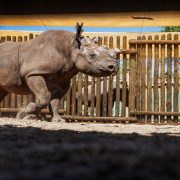
We have covered the larger end of the same agency’s work this month, when Kenya opened an expanded rhino sanctuary in Tsavo West. A 3,200-square-kilometer sanctuary and a spray can of antibiotic on one giraffe’s leg are the same conservation budget seen from two ends.
Source: the Kenya Wildlife Service’s September 29, 2026 account and the Sheldrick Wildlife Trust’s published description of the mobile veterinary units.
Quick answers
- What happened to the giraffe?
The Kenya Wildlife Service's Mara veterinary unit attended an adult female Maasai giraffe with a wire snare around her right hind leg. The service says the snare was loose and had not caused serious injury, though it left abrasion wounds. The wire was removed, the wounds were treated with antibiotic spray, and the service describes her recovery outlook as good. It published the account on September 29, 2026.
- Why is a leg injury serious for a giraffe?
Because a giraffe spends most of its life standing, including while resting and sleeping, and escapes danger by running. Each leg is about 1.8 meters long. Anything that compromises one leg compromises the animal's main defense.
- Who funds the veterinary unit?
Kenya's mobile veterinary units are run jointly. The Sheldrick Wildlife Trust's own description says each unit has a vehicle, a refrigerator for medicines, an operating table and field equipment, and that each team is led by a KWS veterinarian and includes KWS capture rangers and a Sheldrick Wildlife Trust driver. The trust lists a Mara unit among the areas it covers and publishes a monthly Mara veterinary report.
- Which zoo is behind this one?
None that we could verify. We have looked for accredited zoo or aquarium funding behind the Sheldrick Wildlife Trust more than once and have not found any. That is a real finding rather than a gap: a significant share of the veterinary response to snaring in Kenya runs on money unconnected to the zoo sector. The trust also publishes a position opposing the capture of infant elephants for captivity.
- How threatened is the Maasai giraffe?
The IUCN Red List assesses the Masai Giraffe, Giraffa camelopardalis ssp. tippelskirchi, as Endangered under criterion A2abd with 35,000 mature individuals and a decreasing population, in an assessment by Bolger, Ogutu, Strauss, Lee, Muneza, Fennessy and Brown dated December 5, 2018. The service's own wording, Endangered, matches it.
- Why do snares catch animals nobody was hunting?
A snare is a loop of wire, nylon or plant fiber set in a path an animal uses, and it does not discriminate. The service says snares across Kenya catch endangered species, pregnant females and young animals alongside whatever was intended, and that every snare removed is a potential life saved.