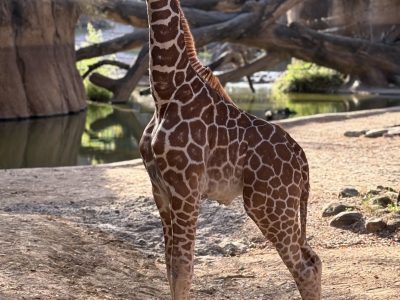

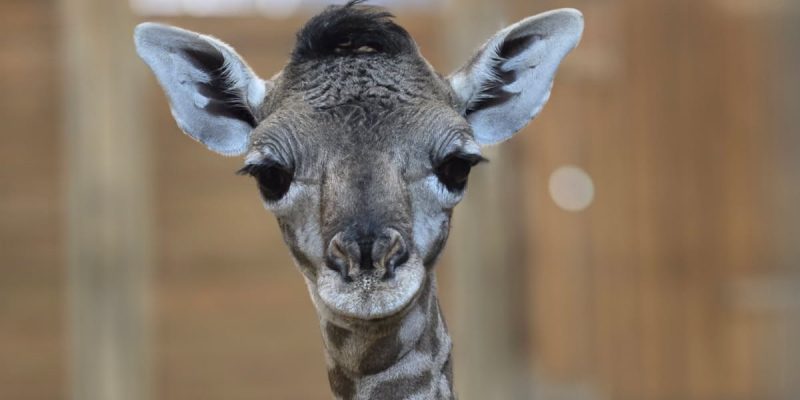
Brevard Zoo has its first giraffe calf in six years. A female Masai giraffe weighing 119 pounds and standing nearly six feet tall was born in the zoo’s behind-the-scenes Africa Barn to twelve-year-old Kumi, sired by six-year-old Mapenzi, and announced on September 16.
She is named Gail, after the mother of zoo supporter Nancy Tomassone, who named her along with Mark Tomassone.
Thirty minutes to standing
Gail was on her feet at 9:32 a.m., about half an hour after being born. For a hoofed animal that is the whole early test, and it is the number a zoo reports first because a calf that stands promptly is a calf that can nurse.
The zoo’s team had been preparing for weeks, running overnight checks on Kumi and adding extra bedding to her birthing stall. The veterinary team examined the calf afterward and reported her doing well.
Mother and calf are staying in the Africa Barn for now to bond. The rest of the herd was close by for the birth, with the zoo’s other two females, Aurora and Tisa, in an adjacent stall, which is how a giraffe birth is supposed to go in a well-run barn: private enough for the mother, not so private that the calf arrives into an empty building.
Introductions to the rest of the herd, and then to the public giraffe habitat in Expedition Africa, will run at whatever pace Kumi and Gail set.
There is a second calf coming
Tisa is pregnant too. Brevard went six years without a giraffe birth, Mapenzi’s own in 2020 being the last, and is now expecting two inside a year.
Why the pairing was arranged
Kumi and Mapenzi were matched under the Association of Zoos and Aquariums Species Survival Plan for Masai giraffes, which manages breeding across accredited institutions to keep the population genetically diverse rather than letting animals pair by proximity. A Species Survival Plan is essentially a studbook with authority: it tracks who is related to whom across the continent and recommends which animals should breed with which.
How endangered is a Masai giraffe?
More than most people assume, and the taxonomy is worth getting right because it changes what you are looking up.
The IUCN does not currently recognize the Masai giraffe as a separate species. It assesses it as a subspecies, Giraffa camelopardalis ssp. tippelskirchi, and lists it as Endangered in an assessment published in 2019, with an estimated 35,000 animals remaining and the population decreasing. The listing rests on a decline of roughly half over three generations, about 30 years: combined estimates for Kenya and Tanzania fell from 69,000 to 71,000 at the start of the series to around 35,000 at the most recent count.
The zoo’s description of the subspecies as endangered, threatened by habitat loss, poaching and disease in Tanzania and Kenya, matches the assessment. Searching the Red List for Giraffa tippelskirchi as a species, however, returns nothing, which trips up more people than it should.
Where this fits
Brevard Zoo is an independent nonprofit that takes no recurring government funding for operating costs, which makes a birth like this a fair measure of what a community-supported institution can sustain. The zoo has had a busy month otherwise, including a West African crowned crane chick at the start of September.
Masai giraffe programs are getting more deliberate across the country, from purpose-built facilities like Seneca Park Zoo’s giraffe training barn to the SSP pairings behind births like this one.
For visitors the practical question is when Gail appears in Expedition Africa, and the answer is honest rather than satisfying: when she and her mother are ready. In the meantime there is a second calf on the way, which means the herd she was born into is about to change shape again.
Quick answers
- When will Gail be on view at Brevard Zoo?
The zoo has not given a date. Gail and her mother Kumi are staying in the behind-the-scenes Africa Barn to bond, and introductions to the herd and then to the public habitat in Expedition Africa will go at the pace the two of them set.
- How big is a newborn giraffe?
Gail weighed 119 pounds and stood nearly six feet tall at birth. She was on her feet at 9:32 a.m., about half an hour after being born.
- Is Brevard Zoo expecting another giraffe calf?
Yes. Tisa, one of the zoo's other female giraffes, is also pregnant.
- Are Masai giraffes endangered?
The IUCN assesses the Masai giraffe as a subspecies, Giraffa camelopardalis ssp. tippelskirchi, and listed it as Endangered in an assessment published in 2019, with an estimated 35,000 animals remaining and the population decreasing.