On Monday, October 12, four rescued manatees left Ohio for Florida. On Wednesday, six more flew the other way. Ten animals changed places inside three days, on cargo flights, in crates built with eight inches of foam under them, and the whole thing was arranged so that the right manatee would be in the right pool at the right stage of its recovery.
The swap ran through the Manatee Rescue & Rehabilitation Partnership, a network of nonprofit, private, state and federal organizations coordinated with the Florida Fish and Wildlife Conservation Commission. Six institutions moved animals: the Columbus Zoo and Aquarium, the Cincinnati Zoo and Botanical Garden, SeaWorld Orlando, the East Coast Zoological Foundation at Brevard Zoo, Jacksonville Zoo and Botanical Gardens, and DHL Express, which flew them.
“These transfers are a culmination of the dedication and expertise of the experienced professionals that make up the MRP,” said Patrick Berry, president of the partnership.
Who went south
Three female manatees left the Columbus Zoo for the East Coast Zoological Foundation’s Manatee Rehabilitation Center at Brevard Zoo, which is a short drive from the lagoon most of them came out of. Their names are Redrock, Rosalyn and Erie, and all three were orphaned young and needed somewhere safe to put on size.
The weights tell you how long that takes. Redrock was rescued from the Indian River Lagoon at Titusville on May 10, 2024, at 49 pounds. She is now about 528 pounds. Rosalyn came out of the Banana River at Cocoa Beach on December 2, 2024, at roughly 50 pounds, and now weighs 624 pounds. Erie was rescued in the DeSoto Canal area of Cocoa Beach on January 9, 2025, at 110 pounds, after surviving severe cold stress that cost her skin around her face. She is now about 648 pounds.
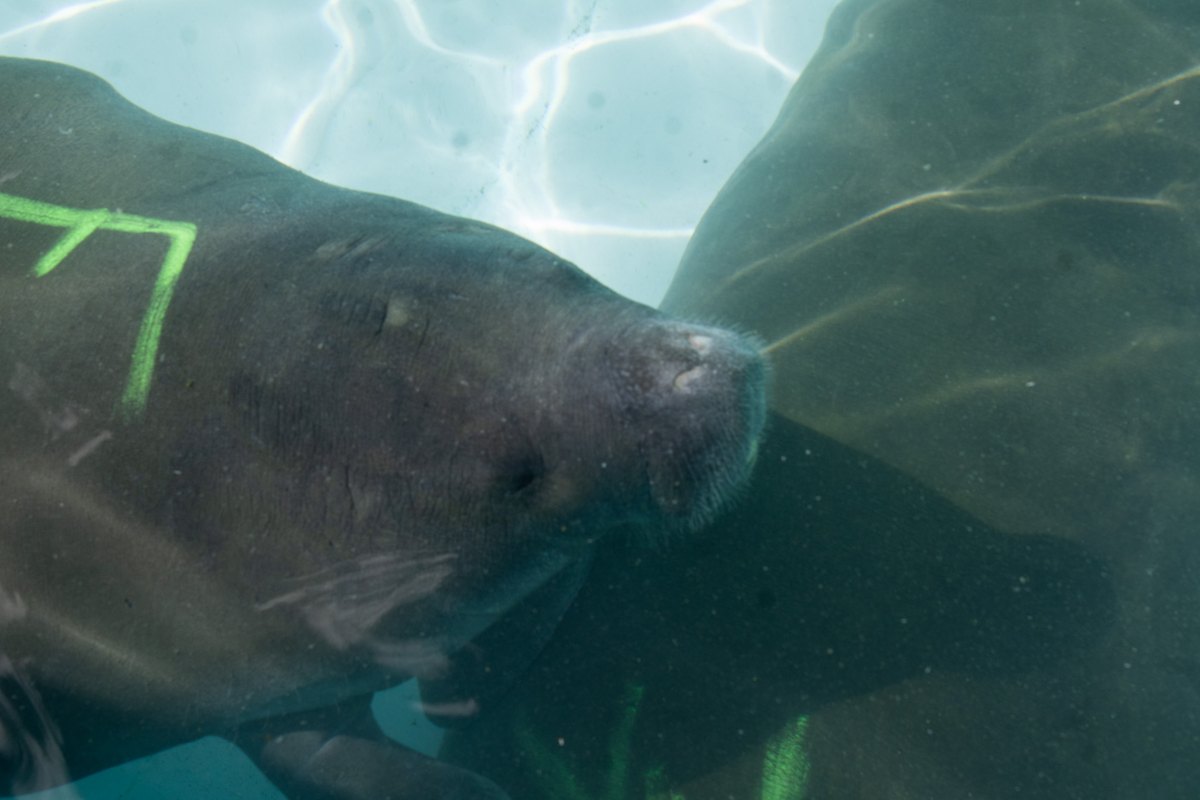
A fourth manatee, a male named Hundo, left the Cincinnati Zoo for Jacksonville Zoo and Botanical Gardens the same day. All four are expected to go back into Florida waters this winter.
“So many organizations have been a part of this trio’s journey, including SeaWorld Orlando and Columbus Zoo and Aquarium,” said Becca Downey, senior conservation manager with the East Coast Zoological Foundation. “We’re ready to do our part in offering Redrock, Erie and Rosalyn a chance to thrive in their Florida home.”
Who came north
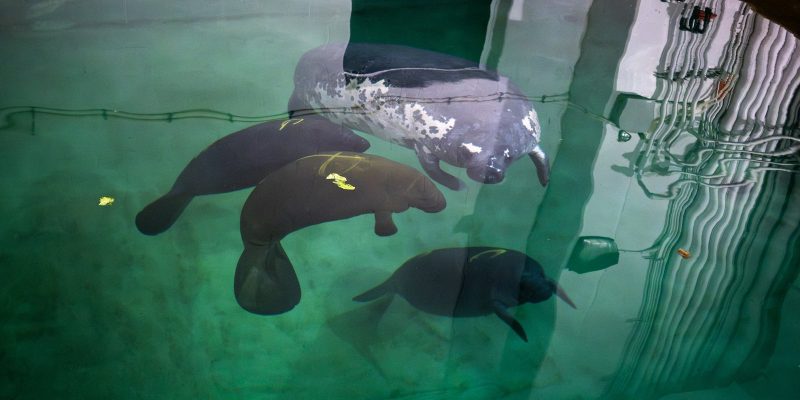
The same flights that emptied the Ohio pools refilled them. Six manatees arrived from SeaWorld Orlando on Wednesday, October 14. Three females, Celine, Poplin and Gingham, went to the Columbus Zoo’s Manatee Rescue and Rehabilitation Center. Three males, Smidge, Tuglet and Zimomo, went to the Cincinnati Zoo’s Manatee Springs habitat.
At Columbus the new arrivals join Stubby, who is the reason that particular pool works. Stubby was injured in a boat strike and is considered conditionally non-releasable, and over the years she has repeatedly taken on the role of surrogate mother to younger manatees passing through. A calf arriving in an unfamiliar building meets an adult who already lives there.
“We are excited to follow Hundo’s journey back to his native Florida waters and ready to begin the rehab process for the three new calves that are now in Manatee Springs,” said Kim Scott, the Cincinnati Zoo’s curator of mammals.
What it takes to fly a manatee
This is the part that does not fit in a headline. DHL Express flew the animals between its global hub at Cincinnati/Northern Kentucky International Airport and Orlando, with specially equipped trucks run by the zoos and SeaWorld handling both ends on the ground.
A manatee in the air is a weight and balance problem before it is anything else. The crates are large enough and heavy enough that DHL used a specialized loading plan to secure them and keep the aircraft within limits, and forklift equipment rated for the job to move them. Inside, each custom container held an eight-inch bed of foam to support the animal’s body, because a manatee out of water is carrying its own weight in a way it never has to in a pool.
Then there is skin. Manatees are tropical animals that dry out and chill fast. Care teams from the Columbus Zoo’s animal care and conservation medicine staff flew with the animals on both DHL flights, wrapping them in wool and space blankets, checking body temperature with laser thermometers, and misting them with water under the blankets for the length of the trip.
“Having supported multiple manatee transports, we understand how important safe, carefully coordinated journeys are to these remarkable animals’ recovery,” said Laurice Bancroft, senior vice president of network operations at DHL Express Americas.
Why Ohio
The question a Florida reader asks is why a manatee goes to Ohio at all. The answer is that Florida’s critical care capacity is finite and the demand for it has been brutal, and an inland zoo with a large warm pool can take an animal that is stable but not ready, which frees a critical care slot for one that is neither.
That is the division of labor the partnership runs on, and the moves this week show it working in both directions at once. The Brevard center, which opened in April 2025, exists for the last stage: stable patients that need monitoring, weight gain or better weather before release. Brevard has said it hopes to upgrade the facility eventually to handle critical care as well.
“Helping rescued manatees recover and return to their native waters is at the heart of our conservation work,” said Becky Ellsworth, curator of the Columbus Zoo’s Shores and Aquarium region.
Brevard notes that its region has been at the center of a historic wave of manatee deaths in recent years, which is the plain reason a lagoon town now has a rehabilitation center in its zoo. The Florida Fish and Wildlife Conservation Commission, which coordinates the rescues, publishes its rescue and mortality statistics for anyone who wants the scale of it.
We have covered the other end of this network before, at ZooTampa’s manatee critical care center, which has treated more than 640 animals. Ten manatees moved this week because six organizations agreed in advance which of them was best placed to do what. Four of them should be back in the Indian River Lagoon and the waters around it before spring.
Quick answers
- Which manatees moved?
South: Redrock, Rosalyn and Erie went from the Columbus Zoo to the East Coast Zoological Foundation’s center at Brevard Zoo, and Hundo went from the Cincinnati Zoo to Jacksonville Zoo and Botanical Gardens. North: Celine, Poplin and Gingham went from SeaWorld Orlando to Columbus, and Smidge, Tuglet and Zimomo from SeaWorld Orlando to Cincinnati’s Manatee Springs.
- Why does a Florida manatee go to Ohio?
Because Florida’s critical care capacity is finite. An inland zoo with a large warm pool can take a stable animal that still needs months of growth, which frees a critical care slot for an animal in worse shape. The Brevard center, which opened in April 2025, handles the last stage before release.
- How do you fly a manatee?
DHL Express flew them between its hub at Cincinnati/Northern Kentucky International Airport and Orlando, with zoo and SeaWorld trucks on the ground at both ends. Each custom container held an eight-inch bed of foam. Care staff flew with the animals, wrapping them in wool and space blankets, checking temperature with laser thermometers and misting them with water throughout.
- Who coordinates this?
The Manatee Rescue & Rehabilitation Partnership, a cooperative network of nonprofit, private, state and federal organizations working with the Florida Fish and Wildlife Conservation Commission.
- How big were the manatees when they were rescued?
Redrock was 49 pounds when she was rescued from the Indian River Lagoon at Titusville on May 10, 2024, and is now about 528 pounds. Rosalyn was about 50 pounds on December 2, 2024, and is now 624. Erie was 110 pounds on January 9, 2025, and is now about 648.
- Who is Stubby?
A manatee at the Columbus Zoo who was injured in a boat strike and is considered conditionally non-releasable. She has repeatedly acted as a surrogate mother to younger manatees in rehabilitation there, which means a calf arriving in an unfamiliar pool meets an adult who already lives in it.
- When will they be released?
The four that flew to Florida are expected to return to their native waters this winter.