
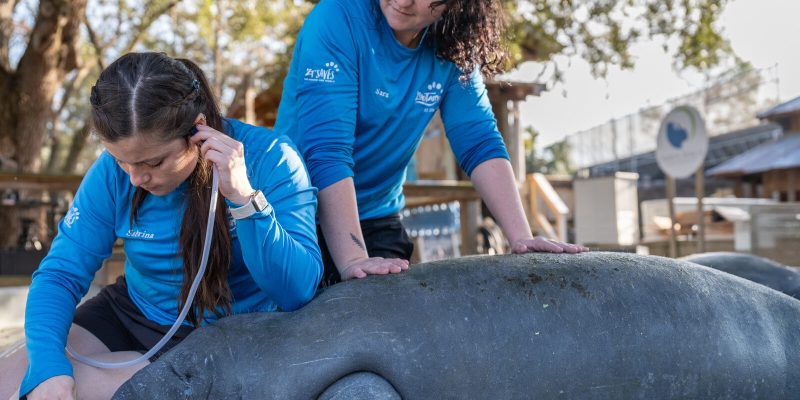
If you have ever taken your family to ZooTampa at Lowry Park, you have already helped save a manatee. You were probably not told, and you almost certainly did not go for that reason. It happened anyway.
The zoo says manatee care costs it close to two million dollars a year. Florida reimbursed it $767,158.02 for the 2024-25 fiscal year. Everything above that line comes from the front gate.
The zoo’s David A. Straz, Jr. Manatee Critical Care Center has just marked 35 years. Over three decades it has taken in more than 640 manatees, and the visitors are a load-bearing part of how.
What a critical care center actually is
Florida has four acute-care manatee facilities, the places a badly injured animal goes first. Three of the four are zoos or aquariums: ZooTampa, SeaWorld Orlando, and Jacksonville Zoo and Gardens. The fourth is Ellie Schiller Homosassa Springs Wildlife State Park.
Once an animal is stable it moves to a second-stage facility to put on weight and finish recovering. Those are also zoos: the Cincinnati Zoo and Botanical Garden, the Columbus Zoo and Aquarium, The Seas at Epcot, and the Bishop Museum of Science and Nature in Bradenton.
The entire chain that takes a struck manatee from a canal back to open water is built out of zoological institutions. There is no state hospital for manatees. There are zoos with federal permits.
So where does the money actually come from?
Since 1991 the state has run the Florida Manatee Oceanaria Reimbursement Assistance Program, administered by the Fish and Wildlife Research Institute. It is not a grant program so much as a partial refund, and the Florida Fish and Wildlife Conservation Commission says plainly that most reimbursements follow a statutory formula rather than what the care actually cost.
The appropriation for fiscal 2024-25 was two million dollars, split across five facilities:
- SeaWorld Orlando: $1,146,094.27
- ZooTampa at Lowry Park: $767,158.02
- Bishop Museum of Science and Nature: $57,043.51
- Jacksonville Zoo and Gardens: $29,704.21 (field-based work only)
- Ellie Schiller Homosassa Springs Wildlife State Park: $0
Set ZooTampa’s reimbursement against the roughly two million dollars a year it says the work costs and the state is covering something in the region of 38 percent. Admissions, memberships and donors carry the other 62.
That is the funding model people argue about in the abstract, sitting there with a number on it. A family who spends a Saturday at the zoo is quietly underwriting the night shift on a manatee that was hit by a boat. Nobody asks them to. Nobody thanks them for it. It is simply what a ticket does once it is inside the building.
The first husbandry workshop
ZooTampa hosted the first Manatee Husbandry Workshop ever run by the Manatee Rescue & Rehabilitation Partnership, the cooperative of agencies and facilities that handles rescue, rehabilitation, release and post-release monitoring in Florida.
Around 40 people came, from 18 facilities. Two attended on scholarships from the Wider Caribbean Manatee Alliance, which is the tell that this is not only a Florida problem: the West Indian manatee ranges from the southeastern United States down through the Caribbean into South America, and most of that range has nothing like Florida’s rehabilitation network.
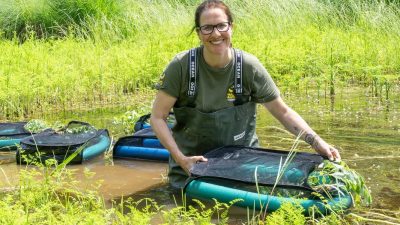
ZooTampa’s own media materials for the anniversary include a photograph of one of its manatee care staff working with the Caribbean Manatee Conservation Center in Puerto Rico on an orphaned calf. That is what a workshop is for. The technique for tube-feeding an orphan is not proprietary, and the only way it reaches a facility in another country is if somebody carries it there.
Why the last two years were bad
ZooTampa’s anniversary announcement cites more than 620 manatee deaths in 2025, 97 of them from boat strikes. The Florida Fish and Wildlife Conservation Commission’s final year-in-review puts the totals slightly higher, at 632 deaths with 98 attributed to watercraft among necropsied carcasses, a quarter of all deaths with a known cause. The release was written against preliminary counts, which is normal; the shape of the year is the same either way.
A few other figures from that review are worth having. The commission rescued 33 live manatees with watercraft injuries in 2025, the highest number on record. Perinatal deaths, calves of 150 centimeters or less, came to 136 against a five-year average of 106. A southwest Florida red tide bloom killed 50. The year’s total sat below the five-year average of 731, but above both 2023 (555) and 2024 (565).
Thirty-three live animals with propeller injuries is the number that lands on a critical care center’s doorstep. It is also the number that has to be met with staff, water, veterinary time and lettuce, seven days a week, for as long as each animal takes. Somebody has to make that possible before the first rescue call comes in.
Thirty-five years
Six hundred and forty animals across 35 years averages out to about 18 a year, which understates it badly. The mortality events of the early 2020s, driven by seagrass collapse in the Indian River Lagoon, pushed intake far above that line and the state’s rehabilitation capacity was the binding constraint on how many animals could be saved.
The center’s anniversary is a good moment to notice who built that capacity and who keeps it standing. Zoos built it. Zoo visitors, roughly two thirds of them without ever hearing about it, keep it open. The next manatee pulled out of a canal in Hillsborough County will be alive because of a decision somebody made about how to spend a Saturday.
ZooTampa’s manatee program has turned up here before, in a story about the zoo using veterinary acupuncture on a manatee and a sloth. On the other end of the pipeline, Florida Keys Aquarium Encounters returned two rehabilitated manatees to the wild earlier this year.
Sources: FWC, Florida Manatee Oceanaria Reimbursement Assistance Program; FWC, 2025 Manatee Mortality in Review; FWC, Manatee Rescue & Rehabilitation Partnership; ZooTampa at Lowry Park.