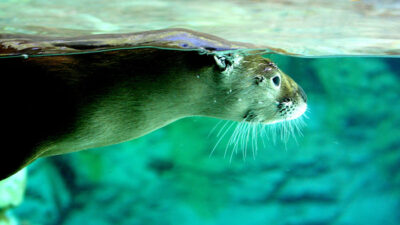

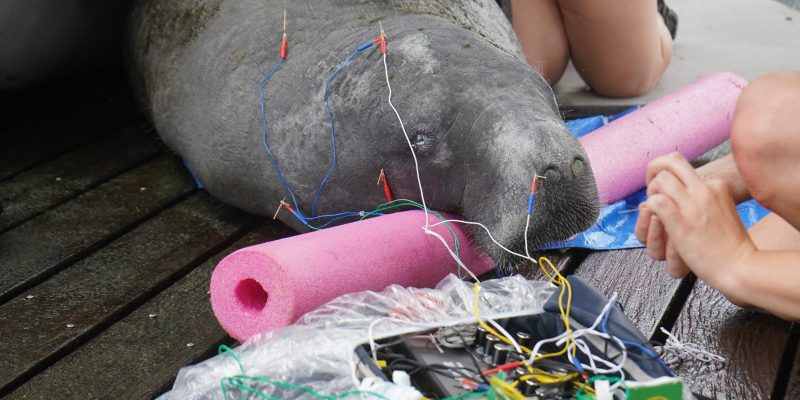
A manatee named Sloth is lying on wet decking at ZooTampa at Lowry Park with a row of fine needles along his back and a bundle of colored leads running to a small box. He is being treated for a chronic nerve injury, and the treatment is acupuncture.
ZooTampa has begun integrating acupuncture into veterinary care for animals with complex medical needs. It is used alongside conventional medicine, physical therapy and pain management rather than in place of any of it.
What it is doing
The needles stimulate nerves, increase blood flow, and prompt the body’s own pain management and healing responses. In veterinary practice it is a complementary therapy, which is the important word: nobody at ZooTampa is treating a broken leg with needles.
The version being used on several of these patients is electroacupuncture, where a mild current is passed between needle pairs. That is what the wires and the box in the photograph are.
The work is done by Dr. Alex Mason, DVM, MS, CVA, CertAqV, a staff veterinarian certified in veterinary acupuncture. The CVA is a certification in veterinary acupuncture; the CertAqV is a certification in aquatic veterinary medicine, which is the credential that matters when your patient is a manatee.
Three patients
Earl Grey, a 14-year-old black-bellied whistling duck, developed sudden weakness in his right leg. After the first of three electroacupuncture sessions his care team saw improvement in movement, posture, coordination, strength and walking.
A roseate spoonbill chick was hospitalized with a leg injury. Electroacupuncture alongside pain medication and physical therapy brought the limb back to normal function.
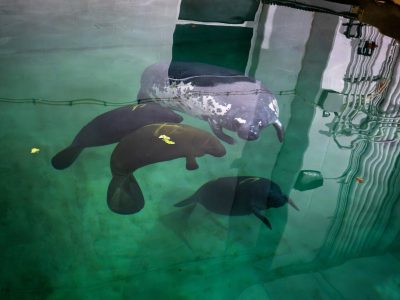
Sloth, a manatee in ZooTampa’s care, arrived with a chronic condition causing significant nerve injury to one side of his face, affecting his ability to open one nostril and blink one eye. The gains here are described as mild: more movement in the affected areas. That is an honest way to report it, and it is worth noticing that the zoo said so rather than claiming a recovery.
“At ZooTampa, each animal receives individualized care, and acupuncture gives us another way to support patients.”
Dr. Alex Mason, staff veterinarian, ZooTampa at Lowry Park
Why a zoo can do this and a wild animal cannot get it
A nerve injury in a wild manatee is usually a death sentence, slowly. There is no follow-up, no second session, no way to assess whether the nostril is moving better this week than last.
What a zoo hospital offers is repetition and observation: the same animal, the same clinician, a course of treatment, and somebody watching closely enough to notice a small change in how a duck stands. Most of the medicine that happens at a zoo is invisible to visitors, and this is a fair sample of it. It is unglamorous, it is incremental, and it is the reason a 14-year-old duck with a bad leg gets three sessions instead of a shrug.
ZooTampa runs one of the busiest manatee critical care centers in Florida, which is part of why an aquatic veterinary certification and a manatee with a nerve injury end up in the same room.