Mote Marine Laboratory’s sea turtle patrol has closed the 2026 nesting season with 4,928 nests counted on 35 miles of Sarasota County beach. Of those, 4,732 were loggerhead and 196 were green turtle. The same stretch of sand has now been walked and recorded every season since 1982.
Mote published the season totals on November 2, 2026. The patrol covers the shoreline from Longboat Key down to Venice, and it surveys daily from April 15 through October 31.
What the count is actually for
A single season’s nest total is a number. Four decades of them in a row is a dataset, and the dataset is what the walking is for. Mote’s Sea Turtle Conservation and Research Program has been running this survey since 1982, which makes it one of the longest continuous sea turtle monitoring efforts in the United States.
On the count of seasons, Mote’s own release is not consistent with itself: the headline and the opening line say the 44th year, while the web address of the same page says 45. Counting 1982 through 2026 inclusive gives 45. Rather than pick one, we have used the start year.
Length is what lets the data answer questions a single year cannot: whether nesting is shifting earlier or later in the calendar, how nest density is changing along the same beaches, how many hatchlings make it out, and how all of that moves with weather and development. Local, state and federal agencies use the series when they set management decisions, which is the unglamorous reason a volunteer walks a beach at dawn in July.
“Protecting sea turtles requires an incredible amount of dedication throughout the nesting season,” said Melissa Macksey, senior biologist and data manager of the program. “Our staff, interns and volunteers worked diligently each day to document nesting activity, protect nests and monitor hatchling success. We could not achieve our mission without them.”
The 253 that went the wrong way
Alongside the nest count, the program logged 253 disorientations in 2026. A disorientation is what happens when artificial light along the shore pulls hatchlings, or a nesting female, away from the water instead of toward it. Hatchlings find the sea by heading for the brightest, lowest horizon, which on an undeveloped beach is the ocean reflecting the sky and on a developed one can be a parking lot. The animals that go the wrong way exhaust themselves, dehydrate, or die.
That figure is the one with a direct remedy attached, and Mote names three: turn beachfront lighting down, take beach furniture in at night, and leave nesting areas clear.
Which turtles these are
Loggerheads account for the overwhelming majority of nests here, 96 percent of this year’s total. Sarasota County occasionally gets a Kemp’s ridley or a leatherback nest; neither turned up in 2026.
Mote describes the loggerhead, Caretta caretta, as a threatened species protected under the U.S. Endangered Species Act, which is accurate. The two lists are separate, though, and the global picture is a different one. The IUCN Red List assesses the loggerhead as Vulnerable under criterion A2b with a decreasing trend, in an assessment dated August 23, 2015, published in 2017 and annotated by the Red List as needing updating.
The green turtle is the one where the record has moved. Chelonia mydas was listed as Endangered for twenty years, and that is still the figure in wide circulation. The current assessment, dated December 9, 2024 and published in 2025, lists the species as Least Concern with an increasing population trend. Mote does not state a category for green turtles and so gets nothing wrong here, but anyone reading 196 green nests against a remembered “endangered” is reading against a superseded page. The downlisting is the result of decades of exactly this kind of nest protection, on beaches around the world, and Sarasota’s 196 are part of the reason.
Who walks the beach
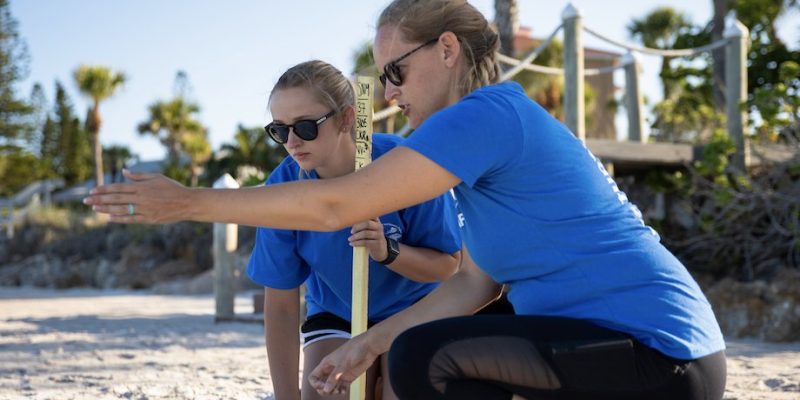
The patrol is staff, interns and more than 300 volunteers, out every morning from mid-April to the end of October, logging crawls, marking and protecting nests, and recording hatchling emergences. Biologists at Mote Marine Laboratory and Aquarium, which runs the program out of its Sarasota campus, then use the record to study the timing and density of nesting and what the season’s conditions did to it.
The program’s other public-facing moment comes at the opposite end of the calendar. In April, the same patrol found the season’s first nest on Venice Beach, dug on April 27. Between that crawl and this count are 4,927 more.
Quick answers
- How many sea turtle nests were counted in Sarasota County in 2026?
Mote Marine Laboratory's Sea Turtle Conservation and Research Program documented 4,928 nests: 4,732 loggerhead and 196 green turtle. No Kemp's ridley or leatherback nests were recorded this year.
- What beaches does Mote's sea turtle patrol cover?
Thirty-five miles of Sarasota County shoreline, from Longboat Key to Venice. The patrol surveys daily from April 15 through October 31.
- What is a sea turtle disorientation?
It is when artificial lighting along the shore draws hatchlings, or a nesting female, away from the water instead of toward it. Hatchlings orient to the brightest, lowest horizon, which on a developed beach may not be the sea. Mote logged 253 disorientations in 2026.
- How can people reduce sea turtle disorientations?
Mote asks for three things: reduce beachfront lighting, remove beach furniture at night, and keep nesting areas clear.
- How long has Mote monitored sea turtle nesting?
Since 1982, making it one of the longest continuous sea turtle monitoring efforts in the United States. The patrol is staff, interns and more than 300 volunteers.
- What is the conservation status of loggerhead and green sea turtles?
The IUCN Red List assesses the loggerhead, Caretta caretta, as Vulnerable under criterion A2b, in an assessment dated August 23, 2015 that the Red List annotates as needing updating. The green turtle, Chelonia mydas, was reassessed on December 9, 2024 and published in 2025 as Least Concern with an increasing population trend, replacing the Endangered listing that is still widely quoted. Separately, the loggerhead is listed as threatened under the U.S. Endangered Species Act.