
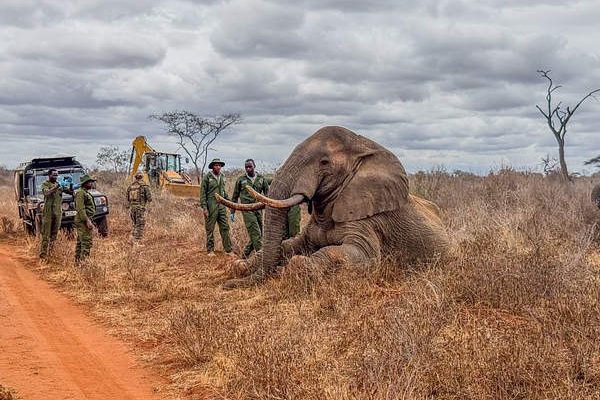
On September 15 and again on September 16, the Sheldrick Wildlife Trust and the Kenya Wildlife Service picked up two African savanna elephant bulls, one per day, and drove them deep into the Tsavo ecosystem. Both bulls had learned to break fences onto community land. Both are now standing in country with food, water and room, several hours’ drive from the crops they were raiding. Neither was shot, which until fairly recently was the usual end of this story.
Why move an elephant at all?
The first bull had become what the trust calls a notorious fence-breaker: going through onto farmland, destroying crops and, by the trust’s own account, presenting a real danger to the people living there. That combination is the sharp end of human-elephant conflict. A bull who has worked out that a fence is a suggestion does not unlearn it, and the people whose maize he is standing in have every reason to want the problem solved.
Everything short of moving him had already been tried. When those efforts failed, the trust mobilized a full translocation, which is a considerable undertaking: helicopter pilots, crane truck operators, rangers and veterinarians, all working on one animal that weighs several tons and is not cooperating.
Dr Limo of the SWT/KWS Tsavo Mobile Vet Unit walked through the operation for the trust. Once the bull was located, the helicopter maneuvered him into position and Dr Limo darted him from the air. Ground teams moved in, loaded him onto a low-loader and strapped him down, and then gave him a full escort down the Mombasa Highway and into Tsavo. He was revived in an area with plenty of browse and water.
The second bull had a story on his face
The next day the teams went back for the first bull’s companion, described by the trust as his partner in crime. This one carried a human-inflicted injury on his face.
The trust does not dress that up, and neither will we. It is the argument for the whole expensive exercise. Historically, an elephant that kept coming through the fence was killed, because there was no other option on the table. A wound on a bull’s face is what the alternative looks like when it is still in progress. Translocation is the option that did not use to exist.
The second darting went more easily than the first. The helicopter put the bull in position, Dr Limo darted him from the air, and he went down near the road, which made loading relatively straightforward. Straightforward is relative: the work still takes heavy machinery and a team that does nothing else, and once the bull is on the truck there are several hours of transit along park roads and then the Mombasa Highway before anyone can stand down.
He was delivered to the same place his companion had landed the day before. Two bulls, two days, one new address, and the pair back together at the end of it.
What the Red List says about these animals
The trust does not attach a conservation category to either bull, so there is nothing here to correct, but it is worth stating what the animals are. The African savanna elephant, Loxodonta africana, is listed as Endangered on the IUCN Red List under criteria A2bd, in an assessment last carried out on November 13, 2020 and published in 2022 as an amended version of the 2021 review. The global population trend is decreasing.
That listing is the reason a fence-breaking bull is a conservation problem and not just an agricultural one. An Endangered species cannot spare the individuals that a shoot-the-problem policy removes, and the bulls that break fences are frequently large, mature males, which is to say the ones with the most breeding years behind them and the most social weight in a population.
Which zoos fund this work?
We looked, and we did not find any. The Sheldrick Wildlife Trust does not publish a funder list naming accredited zoos or aquariums behind its veterinary units, and we could not verify zoological institutional funding for this operation from either side of the relationship. That is a finding rather than a gap, and we would rather print it than manufacture a connection.
There is a second thing worth saying, because writing around it would be dishonest. The trust publishes a position opposing the capture of infant elephants for captivity, which puts it at odds with part of the zoological world on a question that matters to both. We cover the field rather than police it, and the tension is real. It also does not touch the facts of these two days: a mobile veterinary unit, a helicopter and a low-loader kept two Endangered bulls alive and got a farming community its fence back.
The same unit and the same ecosystem produced the Voi orphans we wrote about earlier this month. Tsavo is where a great deal of this work happens, and most of it looks like these two days: slow, expensive, and better than the alternative.
Quick answers
- Why were the elephants moved?
Both bulls had become persistent fence-breakers, going through onto community land and destroying crops, which the Sheldrick Wildlife Trust describes as a real danger to the people living there. Everything short of moving the first bull had already been tried.
- How do you translocate a bull elephant?
With a helicopter, heavy machinery and a specialist team. A helicopter maneuvers the bull into position, a veterinarian darts him from the air, ground teams load him onto a low-loader and strap him down, and the truck is escorted for several hours along park roads and the Mombasa Highway before the animal is revived at the other end.
- What happened to the second bull?
He was moved the following day, on September 16, and delivered to the same place as the first, so the two are back together. He was carrying a human-inflicted injury on his face, which is what the alternative to translocation used to look like.
- How threatened is the African savanna elephant?
The IUCN Red List lists Loxodonta africana as Endangered under criteria A2bd, in an assessment last carried out on November 13, 2020 and published in 2022 as an amended version of the 2021 review. The global population trend is decreasing.