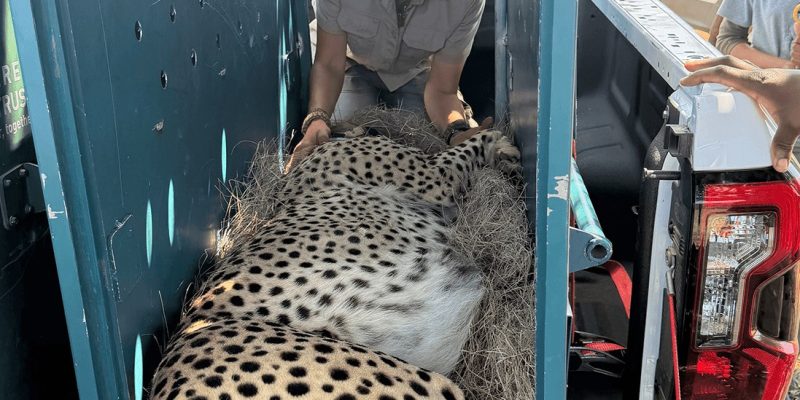
On 23 September 2026 the Endangered Wildlife Trust moved two adult male cheetahs out of Madikwe Game Reserve and into Pilanesberg National Park, in South Africa’s North West Province. On 13 October the gates of their holding boma were opened. They have been exploring the park since.
Read on its own, that is a routine wildlife move. Read against what the same organization published eleven months earlier, it is the closing half of a sentence Pilanesberg started in 2025.
Why did Pilanesberg have no male cheetahs?
In November 2025 the EWT moved two young male cheetahs in the opposite direction, out of Pilanesberg and south to Shambala Private Game Reserve. Those two were sons of Tale, a daughter of a female called Rain who was introduced to Pilanesberg in 2014 and died in 2023 at the age of 12. Tale has raised nine cubs to independence. Her sons had to leave, because leaving was the only way to keep them from breeding with their own relatives.
The EWT said so at the time, and said what came next: attention would turn to welcoming a new coalition of males so that breeding could continue with Tale and her sister Mapula. That is what arrived in September. At the moment of the translocation Pilanesberg held two resident females and no resident males at all, which is a gap the park created on purpose and then had to fill.
This is the part of fenced-reserve conservation that rarely makes the news. Animals are not simply added. They are circulated, and a gain in one reserve is usually a loss somewhere else, booked deliberately.
What is the Cheetah Metapopulation Project?
The move was made under South Africa’s managed Cheetah Metapopulation Project, which coordinates cheetah movements between reserves so that the long-term conservation of the species is handled as one problem rather than as dozens of small ones.
The term does real work here and the story does not make sense without it. South Africa’s cheetahs do not live in one continuous landscape. They live in fenced reserves, each holding a handful of animals. Left alone, each of those groups would drift toward inbreeding within a few generations, because the fence that keeps the cheetahs safe is the same fence that stops their genes from moving. A metapopulation program treats the whole set of reserves as a single population, and moves individual animals between them to do what an open landscape would have done by itself.
Which is why two males arriving at Pilanesberg is not an arrival story. The introduction balances the population’s sex ratio, brings in genetic diversity the park did not have, and reopens breeding for two females who had no unrelated mate available.
How do you move a cheetah?
Carefully, and with a veterinarian. Both males were immobilised, given health assessments, fitted with tracking collars and monitored closely while they were prepared for transport. The EWT credits the wildlife veterinarian Dr Zoe Glyphis, along with the management teams at Madikwe Game Reserve and Pilanesberg National Park.
Then comes the detail that explains the three-week gap between the move and the release. Madikwe and Pilanesberg are close to each other, and a cheetah’s homing instinct is strong enough that an animal released straight out of a crate may simply set off back toward where it came from. So the two males went into a temporary boma on arrival and stayed there until they had taken in the sounds and smells of the new reserve. The gates opened on 13 October.
Which zoos paid for this?
We looked, and the honest answer is that we did not find one.
The EWT’s Cheetah Conservation Project names two supporters at the foot of its own account: the Ford Wildlife Foundation and MetroFibre. Neither is a zoo or an aquarium. We could verify no accredited zoological institution behind this particular translocation.
The near miss is worth recording, because it is the shape that catches people out. The Metro Richmond Zoo does list the Endangered Wildlife Trust among the conservation organizations it supports, and it runs one of the largest cheetah breeding programs in the United States. But its own conservation page sends its cheetah money elsewhere, naming the Cheetah Conservation Fund, Cheetah Conservation Botswana, Cheetah Outreach and We Wild Africa as the recipients of its cheetah enhancement funds. Supporting an organization is not the same thing as funding a given piece of its work, and we are not going to collapse the two.
None of that makes the translocation less of a conservation result. It makes the funding picture a different story from the one a reader might assume.
How many cheetahs are left?
The IUCN Red List assesses the cheetah as Vulnerable under criteria A4b and C1. The assessment was carried out on 17 May 2021 and published in 2024 as an amended version of the 2023 assessment, by Durant, Groom, Ipavec, Mitchell and Khalatbari. It gives 6,517 mature individuals, a decreasing trend, and a population it describes as severely fragmented.
That last phrase is the one that matters for a story about moving two animals between neighboring reserves. Severe fragmentation is the condition a metapopulation program exists to manage. A figure in the region of 7,500 cheetahs is often quoted, including by organizations working on the species, and it does not contradict the Red List: mature individuals and total population are different quantities. We have used the assessment’s number and said which number it is.
South Africa is one of 19 countries where the Red List still records the cheetah as an extant resident. It is recorded as extinct in 29 others.
What happens next at Pilanesberg
Two unrelated males are now in a park with two breeding-age females from a line that has already produced nine independent cubs. The EWT describes itself as privileged to support government-managed reserves like Madikwe and Pilanesberg, and coordinates these movements with reserve managers, veterinarians and government authorities.
For a visitor the change is simple enough: there are cheetahs in Pilanesberg that were not there in September, and they are out of the boma and moving. For the metapopulation, a ledger that was opened in November 2025 has been closed.
We have covered the same program’s work elsewhere on the continent, including the return of cheetahs to Zambia’s Luangwa Valley, another move made by the same organization for the same reason.
Quick answers
- How many cheetahs were moved to Pilanesberg National Park?
Two adult males were moved from Madikwe Game Reserve to Pilanesberg National Park in South Africa’s North West Province on 23 September 2026, and released from a holding boma on 13 October 2026.
- Why did Pilanesberg National Park need male cheetahs?
The park had two resident females and no resident males. Its previous two young males were themselves moved out to Shambala Private Game Reserve in November 2025 to avoid inbreeding, which is the gap this move fills.
- What is the Cheetah Metapopulation Project?
It is South Africa’s managed program for coordinating cheetah movements between fenced reserves, so that small separate populations are managed as one genetically connected whole.
- Why were the cheetahs held in a boma before release?
Madikwe and Pilanesberg are close together, and cheetahs have a strong homing instinct. The temporary boma let the two males settle before the gates were opened, making it less likely they would try to walk home.
- What is the conservation status of the cheetah?
The IUCN Red List assesses the cheetah as Vulnerable, with 6,517 mature individuals and a decreasing, severely fragmented population. That assessment was carried out on 17 May 2021 and published in 2024.
- Which zoos fund the EWT Cheetah Conservation Project?
The project names the Ford Wildlife Foundation and MetroFibre as its supporters. Neither is a zoo or aquarium, and we could not verify funding from any accredited zoological institution for this particular work.