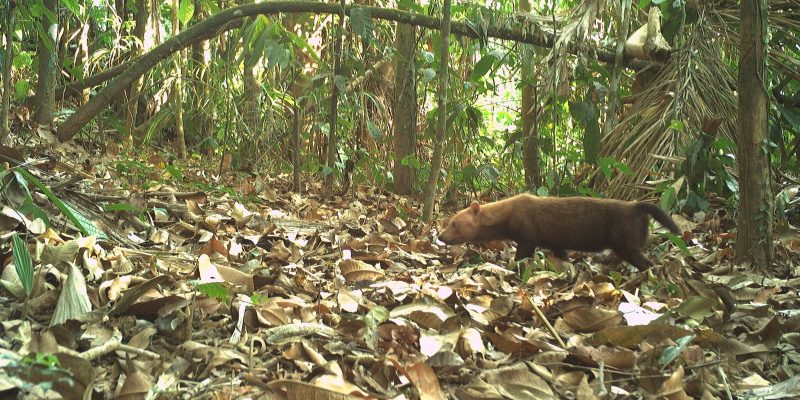
Set thousands of camera traps across seven South American countries, leave them running for twenty-five years, and you will photograph a bush dog twelve times.
That is the finding of an analysis published in Canid Biology & Conservation, the journal of the IUCN Species Survival Commission’s Canid Specialist Group, by scientists from the Wildlife Conservation Society, which runs the Bronx Zoo. The team pooled camera-trap surveys the organization ran between 2001 and 2025: 125 surveys at 97 sites in Bolivia, Brazil, Colombia, Ecuador, Paraguay, Peru and Venezuela, 6,756 camera stations, and 611,159 camera-trap nights. A camera-trap night is the unit of effort in this kind of work, one camera watching one spot for one night, and it is the number that makes the result mean something. Across all of it, bush dogs appeared on twelve occasions, totaling fourteen individual animals.
How rare is that, exactly?
Rarity is hard to feel in the abstract, so the researchers did the useful thing and compared the bush dog against other carnivores photographed by the same cameras, in the same forests, during the same surveys. Bush dogs turned up about 50 times less often than the short-eared dog, a species so seldom seen that field biologists call it the ghost dog. They turned up about 100 times less often than jaguars and nearly 280 times less often than ocelots.
“Scientists who work in these forests have long known that seeing a bush dog is an extraordinary event. What these data show is just how extraordinary,” said Robert Wallace, a WCS senior conservation scientist, a member of the Canid Specialist Group and the study’s lead author. “That gives us compelling evidence that this isn’t simply an elusive animal. It exists at extraordinarily low densities.”
The distinction Wallace is drawing there is the whole argument. An animal can be scarce in the photographs because it is genuinely scarce, or because it is bad at being photographed. Bush dogs are small, standing low to the ground, which could plausibly make them harder for a camera to catch than a jaguar. So the authors checked: the same cameras regularly recorded pacas, forest rodents of broadly similar size and shape. Bush dogs also live in groups of up to a dozen and hunt cooperatively, which should raise the odds of a detection rather than lower them. The cameras were working. The dogs were not there.
Where the dogs were not found at all
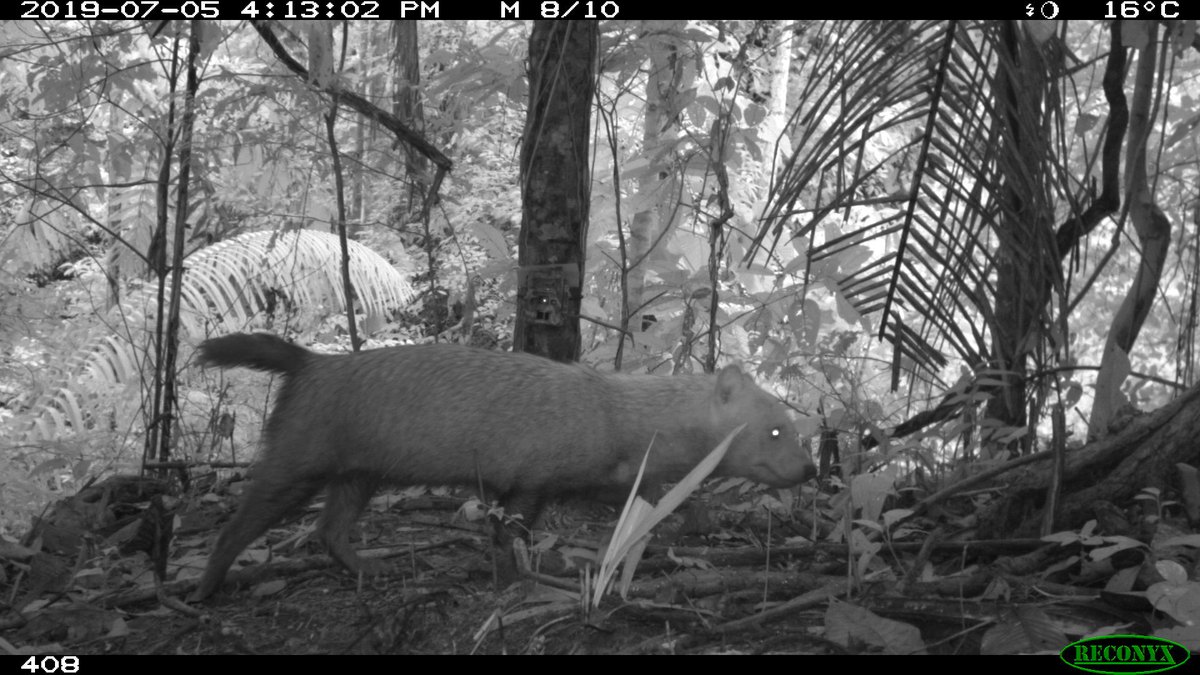
Detections came from four countries: Bolivia, Brazil, Colombia and Ecuador. In Paraguay, Peru and Venezuela, more than 80,000 camera-trap nights produced nothing.
From the detection rate, the authors conclude that bush dogs probably occur at densities well below one animal per 100 square kilometers, roughly 39 square miles, across much of their range, and in Amazonian forest, the core of that range, possibly fewer than one animal per 350 square kilometers, about 135 square miles. They are careful to flag that those figures remain uncertain, and that the dataset leans heavily toward continuous rainforest in the western Amazon rather than covering the whole of the species’ distribution.
“When you work with camera traps, you become accustomed to waiting a long time for rare species to appear. But the bush dog is in a category of its own,” said María Estela Viscarra, a WCS Bolivia biologist and a co-author. “That rarity makes every record important, but it also tells us how vulnerable these populations may be when their habitat is fragmented or disturbed.”
What this means for the species’ listing
The bush dog, Speothos venaticus, is listed as Near Threatened on the IUCN Red List, on an assessment made on August 4, 2011 by DeMatteo, Michalski and Leite-Pitman. The population trend is recorded as decreasing, and the Red List gives no global population figure for the species. The assessment also carries an annotation from the Red List itself: “Needs updating.”
That is the opening the study is aiming at. Its authors write that the evidence supports reassessing the species’ conservation status, and they are not alone in saying so: regional camera-trap studies from Brazil and elsewhere have been reporting the same extremely low detection probabilities for years.
The threats they name follow from the arithmetic. An animal at that density, with a large home range and a possibly semi-nomadic life, has little margin when forest is cleared or cut into pieces by roads, when fires run through it, or when it is hunted. Disease is the other pressure, and the carrier is familiar: domestic dogs, and the canine distemper virus, parvovirus and rabies they bring to the forest edge.
The authors’ recommendation is not a conclusion but an instruction to keep looking. Camera-trap data from the other ecosystems the bush dog occupies, outside the western Amazon, needs the same treatment, to find out whether the species is this rare everywhere or only here. WCS has done this before, turning a continent of camera and collar data into a single argument: last month the same organization published the first range-wide map of jaguar connectivity built from recorded jaguar movement.
Twelve photographs in twenty-five years is a thin record of an animal. It is also, now, the best evidence anyone has that the bush dog needs a second look.
Quick answers
- How rare is the bush dog?
Across 125 Wildlife Conservation Society camera-trap surveys at 97 sites in seven South American countries between 2001 and 2025, totaling 6,756 camera stations and 611,159 camera-trap nights, bush dogs were recorded on 12 occasions, representing 14 individual animals. The same cameras detected short-eared dogs about 50 times more often, jaguars about 100 times more often and ocelots nearly 280 times more often.
- What is a camera-trap night?
One camera watching one location for one night. It is the standard unit of survey effort, so a figure like 611,159 camera-trap nights describes how much looking was done rather than how many cameras were used.
- Is the bush dog endangered?
The IUCN Red List lists Speothos venaticus as Near Threatened on an assessment made on August 4, 2011, with a decreasing population trend and no global population figure given. The Red List annotates that assessment "Needs updating". The study's authors write that current evidence supports reassessing the species' conservation status.
- Where do bush dogs live?
The surveys detected them in Bolivia, Brazil, Colombia and Ecuador, and not at all in Paraguay, Peru or Venezuela despite more than 80,000 camera-trap nights in those three countries. The authors estimate densities well below one animal per 100 square kilometers across much of the range, and possibly below one per 350 square kilometers in Amazonian forest.