
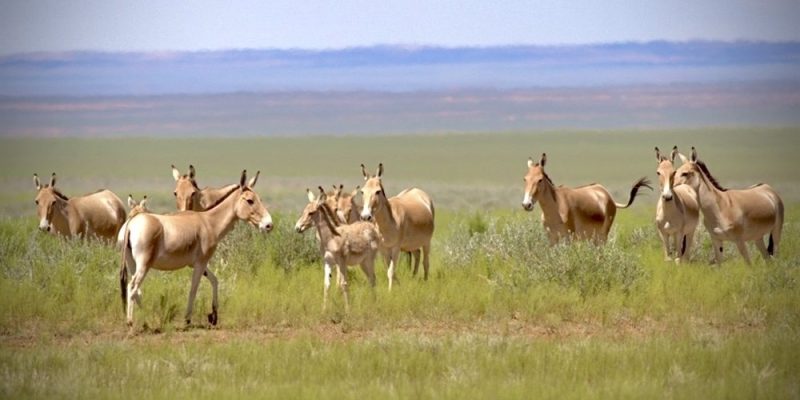
The Asiatic wild ass, known in Mongolia as khulan, has returned to the east of the country after more than 65 years away. Hundreds are now documented east of the Trans-Mongolian Railway, and the findings were published in the journal Oryx.
The animals were not reintroduced. Nobody moved them. What changed is that they were allowed to cross a fence.
A railway as a wall
For decades, fencing along the Trans-Mongolian Railway cut the steppe in two for anything that could not jump it. Khulan are wide-ranging animals in an arid, highly variable landscape: they need to move between seasonal grazing and water, and a linear barrier across their range does not merely inconvenience them, it removes half the options they depend on in a bad year.
The Wildlife Conservation Society and Mongolian government partners went at the barrier itself. They tested temporary unfenced sections along the railway, and in May 2025 formally designated a monitored “safe passage” zone near the China–Mongolia border to be kept clear of fencing.
Monitoring recorded crossings, including in winter. Follow-up surveys then found hundreds of khulan on the eastern side, evidence that the animals are not simply passing through but beginning to re-establish.
Why this result matters beyond Mongolia
“Documenting khulan crossing this long-standing barrier and beginning to re-establish in their former range represents an extraordinary conservation breakthrough,” said Buuveibaatar Bayarbaatar, WCS senior scientist and the study’s lead author. “It demonstrates that restoring connectivity in fragmented landscapes can support population recovery for wide-ranging species.”
That is the finding worth holding onto. Most conservation interventions add something: animals, money, protected acreage, a captive-breeding program. This one subtracted an obstacle, and a species walked back into 65 years of absent range on its own.
Connectivity work is unglamorous, fence gaps, underpasses, easements, negotiations with a railway authority, and it is difficult to photograph or fundraise around. But for wide-ranging species on open landscapes, it is frequently the binding constraint, and the khulan result is a rare clean demonstration that removing it works.
The steppe as a system
Mongolia’s steppe is one of the largest intact temperate grasslands left anywhere, and its functioning depends on animals being able to move across it at scale. Keeping khulan able to reach seasonal grazing and water supports the broader resilience of that system, not just the one species.
Reintroduction and recovery projects are running along similar lines elsewhere: the Saint Louis Zoo’s red wolf pups were fostered into a wild litter in North Carolina to strengthen a population in place rather than build a new one.