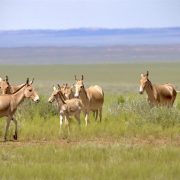

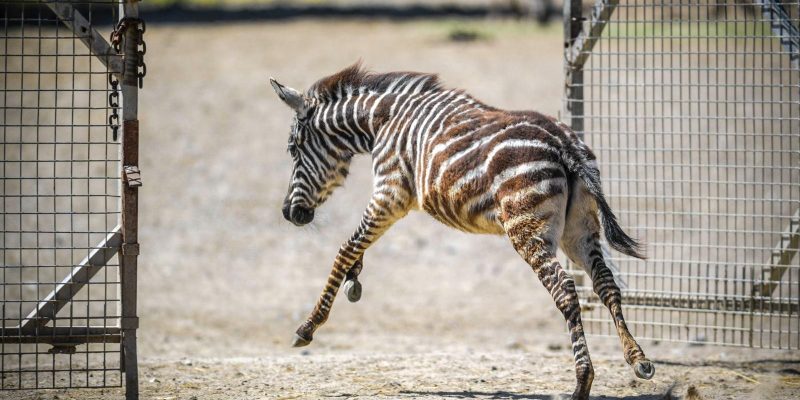
A zebra foal named Gözde lost her mother when she was three months old, was hand-raised by the veterinary staff at İzmir Doğal Yaşam Parkı, and when the day came to put her out with the other zebras she walked past them and went to stand with the giraffes instead.
She has stayed there. Gözde now moves around the shared paddock with Kamili and Radost, and the two giraffes have taken her on: they keep her with them, and they keep an eye on her.
How does a hand-raised foal end up with the wrong species?
Through a fence, mostly. Gözde spent the most fragile stretch of her life being raised by people. Veterinarians, keepers and technicians fed her from special bottles and watched her day and night, and the plan throughout was the obvious one: when she was strong enough, she would join the zebra herd, because that is what zebras are for.
The park’s veterinarian Duygu Aldemir explained what happened instead. “Zebralar sürü halinde hareket eden ve birbirini destekleyen, kollayan hayvanlar. O nedenle zebra sürüsüne katılmasını istedik. Ancak çok şaşırdığımız bir durum yaşandı. Gözde’yi alana saldıktan sonra onun zebralarla değil de zürafalarla yakın arkadaş olmak istediğini gördük,” she said. In English: “Zebras are animals that move as a herd and support and look out for one another. That is why we wanted her to join the zebra herd. But something happened that surprised us a great deal. After we released Gözde into the enclosure, we saw that she wanted to be close friends with the giraffes rather than with the zebras.” Translation by ZooReviews from the Turkish.
The explanation the staff favor is that the friendship was already built before the gate opened. Gözde and the giraffes had been neighbors, communicating across the wire, and by the time she had the run of the place the giraffes were the animals she already knew. Aldemir’s reading is that Gözde chose the group where she felt safe over being alone, and that being in a group at all is healthier for her than the alternative. The park expects her to work her way into the zebra herd in time, and is not rushing it.
The bears in the same announcement have a longer story
İzmir announced Gözde alongside a set of births. One of the park’s six bears, a female called Şımarık, followed her natural winter behavior, went into her den and gave birth there. Serkan Eğrilmez, the biologist who heads the wildlife park division, said the two cubs, one female and one male, each weighed around 300 grams.
That is not a rounding error, it is the biology, and Eğrilmez spelled it out: bears give birth to cubs that are tiny, eyes closed and hairless, despite the size of the adults, and the mother nurses them inside the den for months before they come out with the spring. The park’s point was that it let that whole sequence run on the animal’s terms rather than managing her through it. The cubs are being watched closely, and a controlled introduction to the park’s other bears will follow when they are ready, with scent and sound doing the introductions before anything else.
Then Eğrilmez said the part that explains why there are bears in İzmir at all. “Biz mümkün olduğunca yaban hayvanlarını doğal yaşamlarında görmek istiyoruz. Fakat doğal hayatta yaşama şansı olmayan, insanla temas eden hayvanlara da Doğal Yaşam Parkı’nda sahip çıkıyoruz. Ayılar da o canlılardan.” In English: “We want to see wild animals in their natural lives as far as that is possible. But we also take responsibility at the wildlife park for animals that have no chance of living in the wild, animals that have been in contact with people. The bears are among those.” Translation by ZooReviews from the Turkish.
He meant it literally. The park’s bears go back to animals rescued from the streets, where they had been forced to perform as dancing bears. Those bears went first to the city’s old zoo and then to the wildlife park, and the bears living there today are their grandchildren. The park set all of this out in its own Turkish-language announcement.
What the park is actually telling you
Two generations separate a bear chained in a town square from a bear that dens on her own schedule and raises cubs without being managed through it. That is the whole argument for this kind of facility, made without anybody having to say it out loud, and it sits in the same press release as a zebra foal who decided giraffes were her people.
The park puts its collection at roughly 1,800 animals of 140 species. Neither the zebras nor the giraffes are identified to species anywhere in the announcement, so no single Red List assessment applies to either, and we are not going to guess at one from a photograph.
Orphan stories are the best thing this beat produces, and this region produces a lot of them. See also the Sheldrick Wildlife Trust’s Voi orphans four years on from the Tsavo drought.
A note on zoo funding
We trace the accredited zoological institutions behind conservation and rescue work in this region as a matter of routine. In this case there is nothing hidden to find. İzmir Doğal Yaşam Parkı is a municipal zoological facility and it did this itself, with its own veterinarians and its own budget, under the İzmir Metropolitan Municipality’s Department of Veterinary Affairs. No external zoo funder is named, and the work does not depend on one.
Quick answers
- Who is Gozde?
A zebra foal at Izmir Dogal Yasam Parki who lost her mother when she was three months old and was hand-raised from bottles by the park's veterinarians, keepers and technicians.
- Why is she with giraffes instead of zebras?
She chose them. The plan was for her to join the zebra herd, but when she was turned out she went to the giraffes Kamili and Radost, whom she had got to know through the fence while she was being reared. The park's veterinarian Duygu Aldemir reads it as Gozde choosing the group where she felt safe over being alone, and expects her to join the zebra herd in time.
- What else was in the same announcement?
Two bear cubs, one female and one male, weighing around 300 grams each, born in the den to a female called Simarik who followed her natural winter behavior without being managed through it.
- Why does a Turkish wildlife park keep bears?
Its bears descend from animals rescued from the streets, where they had been forced to perform as dancing bears. Those bears went to the city's old zoo and then to the wildlife park, and the bears living there today are their grandchildren.