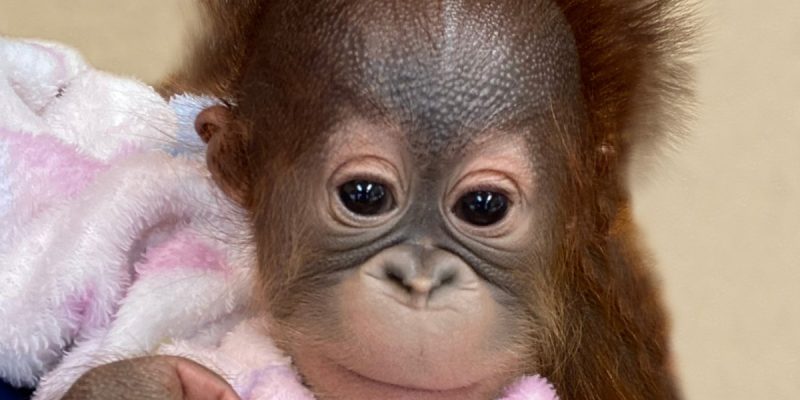
Gulf Breeze Zoo had two orangutan infants born four months apart. Isadora arrived on September 11, 2021. Satu followed on January 20, 2022. One of them was raised by keepers and the other by her mother, and the distance between those two sentences is most of what a great ape team does for a living.
The Florida zoo announced the first birth on November 23, 2021 and the second on May 3, 2022. Both infants were sired by the same male, Louie. By the time the second announcement went out, the collection held eight orangutans.
Why was Isadora raised by people?
Because her mother would not do it. Indah showed no maternal instincts toward the newborn, and the zoo’s animal care specialists stepped in and took over.
Hand-rearing is the intervention nobody wants to need. It is what a zoo does when the alternative is an infant that does not survive the week, and it buys that survival at a price: a baby ape who spends her first months in human arms is a baby ape who is not learning how to be an orangutan from an orangutan. So the goal, from the first day, was to hand her back. The zoo said at the time that it was looking to introduce her to another orangutan who could act as a surrogate mother, and that until then she would stay behind the scenes rather than go on exhibit.
“Our animal care staff has been working round-the-clock to ensure she receives the best care possible,” said Jamie McMaster, director of Gulf Breeze Zoo, in November 2021. “We’re thrilled to report that she continues to meet all growth and developmental milestones, and now weighs 7 pounds.”
Seven pounds is a figure worth sitting with. That is the whole animal, two months in, being kept alive on a schedule measured in hours.
Did the hand-rearing work?
By the following spring, yes. The May 2022 announcement put Isadora at almost eight months old, healthy, thriving and hitting every milestone for her age. Her keepers had started calling her Izzy. She was eating solid food daily, and McMaster listed the menu: “She’s eating solids daily. She munches on the adults’ primate biscuits and loves cucumber, carrot, sweet potato, and banana.”
The more consequential development was social. Staff had begun reintroducing Isadora to the rest of the zoo’s orangutans, giving her supervised time in sight of them several times a week. McMaster put the reason for it in one sentence, and it is the sentence that explains the entire program: “It is very important that she knows that she is an orangutan.”
That is the part of hand-rearing that does not show up in a weight chart. An infant pulled out of an ape group and raised by people has to be put back, deliberately and slowly, or the rescue produces an adult who cannot live with her own species. Gradual, supervised, visual-contact-first reintroduction is how that is done.
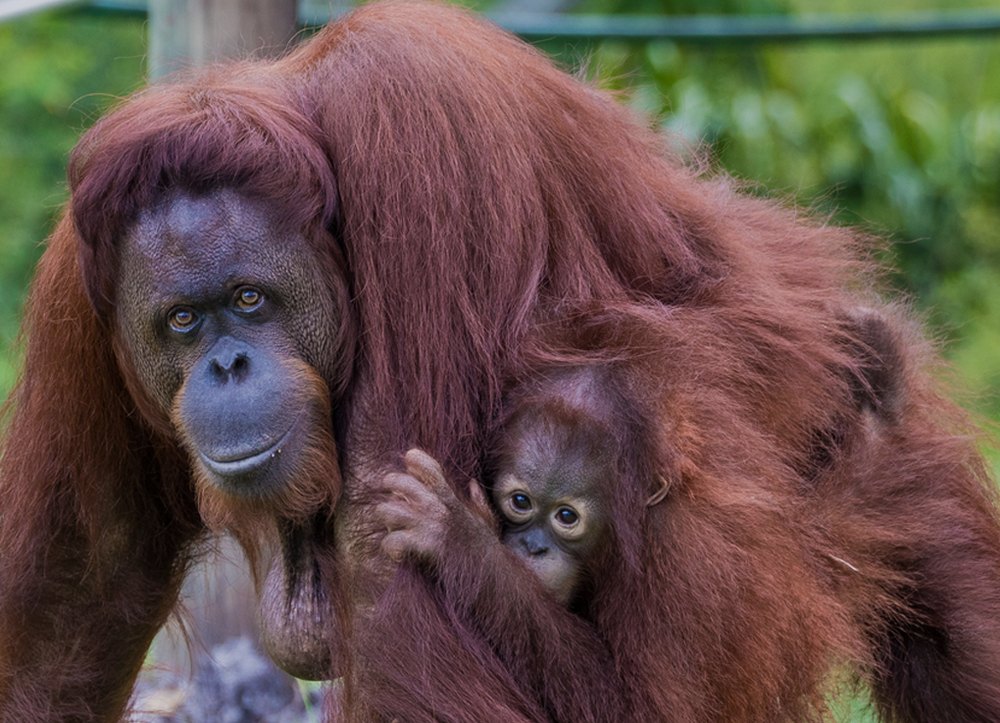
Satu’s first months were the ordinary kind
Satu was born to Sara, an experienced mother, and the zoo reported him doing exceptionally well in her care. He had something Isadora did not get: no intervention at all. He and Sara could be watched from the boardwalk that overlooks the zoo’s orangutan island.
Running the two infants side by side is what makes this pair of announcements interesting. Same father, same collection, four months apart, and two completely different sets of first months. One of them is the outcome every breeding program is aiming at. The other is the outcome a breeding program has to be able to produce when the first one does not happen, and it took round-the-clock staffing and a months-long reintroduction to get there.
What two births meant for a privately owned zoo
“The births of Satu and Isadora in such a short time here is a really big deal for our zoo, and species conservation as a whole,” McMaster said. “These great apes are critically endangered and risk extinction in the wild, so we are trying to ensure future generations survive.”
Gulf Breeze Zoo is privately owned and takes no state or federal tax support, which puts the cost of a round-the-clock infant care rotation on gate revenue. At the time it was one of three facilities run by Zoofari Parks alongside the Virginia Safari Park and the Alabama Safari Park. The same collection has gone on producing: a Nile hippo calf in 2024, four reticulated giraffe calves, and a second-generation rhino calf in 2025.
Orangutan infancy is where a lot of this work actually gets decided, and other collections are attacking the same problem from the front end rather than after the fact. Fort Wayne Children’s Zoo runs maternal training with its orangutans, coaching females on holding and nursing before there is an infant to get wrong.
One set of numbers we would put differently
The November 2021 announcement said that about 230,000 orangutans lived a century ago and that fewer than 50,000 survive today. The first figure is widely cited. The second is lower than the species estimates published by the World Wide Fund for Nature, which gives roughly 104,700 Bornean orangutans, about 13,846 Sumatran orangutans and no more than 800 Tapanuli orangutans. We default to the published assessment, so that is the set of numbers we would use, and we are naming WWF as where ours came from.
Neither announcement says which species the zoo keeps, and that matters for reading any of these figures. The zoo describes its orangutans as Sumatran orangutans, Pongo abelii. It is the rarer of the two species that most collections hold, and against a Sumatran population in the low tens of thousands, two surviving infants in four months is a real contribution rather than a rhetorical one.
None of that changes the thing a visitor could actually go and see in the spring of 2022, which was a mother and a baby on an island, in the open, from a boardwalk.
Sources: Gulf Breeze Zoo, announcement of November 23, 2021 and announcement of May 3, 2022; WEAR-TV, May 3, 2022.
Quick answers
- When were the two Gulf Breeze Zoo orangutans born?
Isadora was born on September 11, 2021 and Satu on January 20, 2022, four months apart. The zoo announced the first birth on November 23, 2021 and the second on May 3, 2022.
- Why was Isadora raised by keepers instead of her mother?
Her mother, Indah, showed no maternal instincts toward the newborn, so the zoo’s animal care specialists intervened and hand-raised her. She stayed behind the scenes rather than going on exhibit, and at the November 2021 announcement she weighed 7 pounds.
- Did Isadora rejoin the other orangutans?
The reintroduction was under way by the spring of 2022. Keepers were giving her supervised time in sight of the other orangutans several times a week. Director Jamie McMaster put the reason simply: "It is very important that she knows that she is an orangutan."
- Who are the parents of Isadora and Satu?
Both infants were sired by the same male, Louie. Isadora’s mother is Indah and Satu’s mother is Sara, who raised him herself and was described by the zoo as an experienced mother.
- How many orangutans does Gulf Breeze Zoo keep?
Eight, as of the May 2022 announcement. The zoo is privately owned, takes no state or federal tax support, and was at that time one of three parks run by Zoofari Parks alongside the Virginia Safari Park and the Alabama Safari Park.
- Which orangutan species does Gulf Breeze Zoo keep?
Neither birth announcement says. The zoo describes its orangutans as Sumatran orangutans, Pongo abelii.
- How many orangutans are left in the wild?
The zoo’s 2021 announcement said fewer than 50,000 survive, against about 230,000 a century ago. That is lower than the species estimates published by the World Wide Fund for Nature, which gives roughly 104,700 Bornean orangutans, about 13,846 Sumatran orangutans and no more than 800 Tapanuli orangutans. We use the published assessment and name WWF as the source of it.