
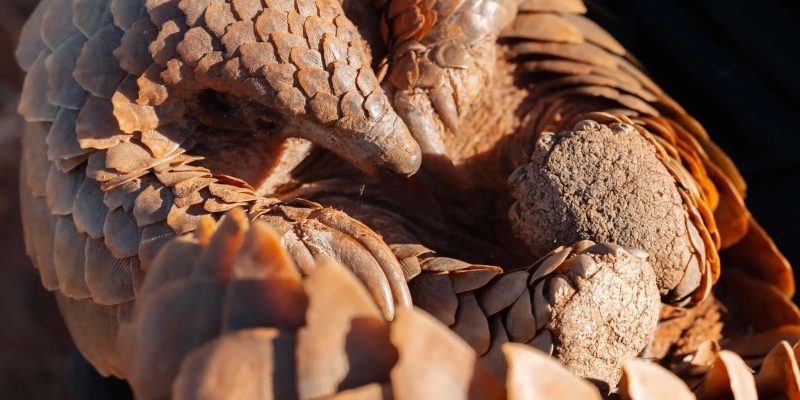
AfriCat has been tracking pangolins at Okonjima in Namibia for eight years. In September 2026 it published what eight years of movement data looks like.
Temminck’s pangolin is the most trafficked mammal on earth by weight of seizures, and it is also one of the hardest to study, because it is nocturnal, solitary, fossorial and almost impossible to observe directly. Everything known about how far one travels comes from putting a device on it and waiting.
The tag problem
That is harder than it sounds. A pangolin has no neck to speak of, walks through dense scrub, and reverses into burrows, which strips off anything protruding. Tags have to be attached to scales, survive abrasion, and run long enough to produce a movement record rather than a snapshot.
AfriCat has worked on this with Smart Parks since 2024 on LoRaWAN tag development, using EarthRanger for the data side. The research program also runs with Wildlife Protection Solutions, which donated SIM-enabled cameras, and with a long list of universities including the Technical University of Munich, Queensland, Ljubljana, NUST, Georgia, Mpumalanga, Stellenbosch, Glasgow and the UNAM School of Veterinary Medicine.
Why the length of the study is the finding
Eight years is unusual for any wildlife telemetry program and close to unheard of for pangolins.
Short studies tell you where an animal went last summer. Long ones tell you whether the range it used last summer is the range it uses in a drought, whether individuals shift as they age, and whether the population is doing something a two-year grant would have read as normal. For a species being removed from the wild at the rate this one is, the difference between those two answers is the difference between a reserve that works and one that looks like it does.
Who is paying for it, honestly
We looked for zoo funding here and did not find any.
AfriCat’s named contributors to the pangolin work are technology companies giving equipment, universities giving researchers, and one individual donor, Freek Vonk, who donated pangolin tags and carnivore collars. Its own support page names no institutional donors at all, and points instead at Okonjima Lodges, which it describes as an example of the way tourism supports conservation.
So this one runs on ecotourism revenue, in-kind technology and academic collaboration. That is a different model from SANCCOB’s forty-plus institutional supporters or the zoo-seeded Sahara Conservation, and it is worth saying plainly rather than assuming every good field program has a zoo behind it. Plenty do not.
Temminck’s pangolin is listed as Vulnerable by the IUCN, with a decreasing population trend.
Source: The AfriCat Foundation; IUCN Red List.