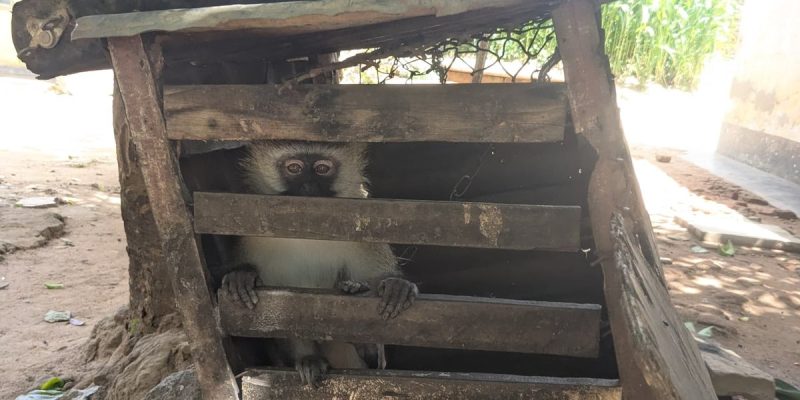
Chilinde, a vervet monkey, spent five years in a small cage in Malawi, kept illegally as somebody’s pet. She is now at the Lilongwe Wildlife Centre, which published her case on November 18, and she is safe, fed and under specialist care. The difficult part is the part that does not photograph well. After five years on her own, she does not know how to be around other monkeys.
What five years alone does to a social animal
Vervets build their lives out of contact with each other. They bond by grooming, by playing and by sitting close, and a monkey who has not done any of that since infancy arrives at a sanctuary missing the vocabulary. The trust says years of isolation have left Chilinde struggling to develop normal social behaviors, and that she shows signs of stress, including obsessive grooming.
Her introduction to the resident troop is being done through a fence, which is standard practice and also the clearest diagnostic anyone has. Her reactions to the other monkeys through it range from friendly to aggressive, with no settled pattern yet. The obsessive grooming is the harder problem, because it is both a symptom and an obstacle: it occupies the animal, and it occupies the time she would otherwise spend learning to read other vervets.
The center’s response is unglamorous and specific. Staff are running enrichment designed to get her foraging, on the theory that an animal working for her food has less attention left over for the repetitive behavior. Integration, the trust says, will take time. It does not give a timetable, and it is right not to.
What she is being prepared for is a real destination rather than an abstraction. In April the same center put an entire vervet troop back into a Malawian national park after years of work, and tracked them for three days afterward to watch them forage. Many of those monkeys arrived as orphans too. A full-troop release is among the hardest things a primate rehabilitation center attempts, and Chilinde has to learn to belong to a troop before she can be part of one.
She is the majority case, not the unusual one
Around 60 percent of the primates who arrive at the Lilongwe Wildlife Centre have been rescued from the illegal pet trade. That figure is the one worth sitting with, because it reframes what the center is. A wildlife rescue facility in Malawi is not mostly treating road casualties or snare injuries in its primate section. It is mostly undoing what people did to animals they bought.
The trust is blunt about where infant monkeys come from: mothers are routinely killed so that their infants can be taken and sold. It also makes the public-health and ecological case, that removing wild animals from their habitats damages biodiversity, increases the spread of disease and puts people at risk. And it names the thing that has changed the economics, which is that social media has made it easier than ever for buyers and sellers to find each other.
The trust’s last point is the one that applies to Chilinde directly. A rescue is not the end of the cost. Years in captivity leave lasting physical and psychological damage, rehabilitation is correspondingly slow, and the trust says the long-term cost of caring for these animals places significant demands on its resources. Chilinde will be expensive for a while.
The species is common. That is not what this is about.
The vervet monkey, Chlorocebus pygerythrus, is listed as Least Concern on the IUCN Red List. The trust states no conservation category for her at all, which is the honest choice, because none applies. Nothing about this case is a numbers story. There is no population being pushed toward a threshold here.
What there is instead is one animal who lost five years, and an unknown number of adult females shot so that infants could be carried to a market. Conservation status measures the health of a species. It is not a measure of harm done, and the gap between those two things is most of what a rehabilitation center deals with.
Which zoos or aquariums are behind this work?
None that we can find, and in this case we were able to check properly rather than guess. The Lilongwe Wildlife Trust publishes its funders. The page lists 28 donors, 29 partners and 14 government partners, and not one of the 71 is a zoo, an aquarium or a zoological society. The conservation money on that list comes from organizations like the Born Free Foundation, Fondation Segré, Tusk Trust, the Elephant Crisis Fund and the Pangolin Crisis Fund, alongside government and trust funding.
The accreditations point the same way. Lilongwe Wildlife Centre holds accreditation from the Global Federation of Animal Sanctuaries, the Pan African Sanctuary Alliance and Born Free’s PAW initiative. Those are sanctuary accreditors. The trust claims no membership of WAZA, AZA, EAZA, BIAZA or PAAZA anywhere on the page.
We make a point of tracing this because a great deal of African rescue and rehabilitation work does run on money raised by accredited zoos and aquariums, and readers are entitled to know which cases do and which do not. AZA reported that 235 facilities spent roughly $372.4 million on conservation across 139 countries in 2025. No published breakdown isolates how much of that reached Africa, so we do not print a figure for it. What we can say about this particular center is narrower and more useful: by its own published list, no zoo is paying for Chilinde’s rehabilitation.
Quick answers
- What happened to Chilinde the vervet monkey?
She was kept illegally as a pet in Malawi for five years in a small cage. She is now at the Lilongwe Wildlife Centre, where staff are trying to integrate her into a troop of other vervets.
- Why is the integration difficult?
Vervets are highly social and bond through grooming, play and close contact. The Lilongwe Wildlife Trust says five years of isolation left Chilinde struggling to develop normal social behavior. She shows signs of stress, including obsessive grooming, and her reactions to the other monkeys through the fence range from friendly to aggressive.
- How many rescued primates come from the pet trade?
The trust says around 60 percent of the primates that come into its care were rescued from the illegal pet trade. It adds that mothers are routinely killed so that their infants can be taken and sold.
- Are vervet monkeys endangered?
No. The vervet monkey, Chlorocebus pygerythrus, is listed as Least Concern on the IUCN Red List. The harm in a case like this one is to the individual animal and to the adults killed to supply the trade, not to the global population.
- Do any zoos fund the Lilongwe Wildlife Centre?
Not according to its own published list. The trust names 28 donors, 29 partners and 14 government partners, and none is a zoo, an aquarium or a zoological society. Its accreditations come from the Global Federation of Animal Sanctuaries, the Pan African Sanctuary Alliance and Born Free, which accredit sanctuaries rather than zoos.