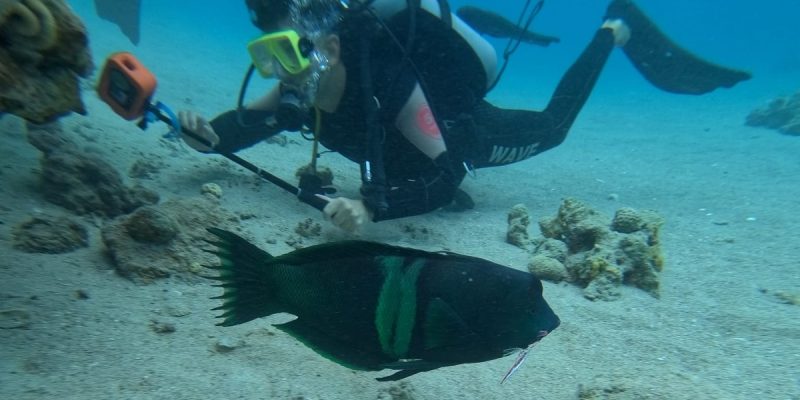
A diving instructor in Eilat noticed a fish in trouble on 24 October, and kept noticing it. Three weeks later, inspectors from Israel’s Nature and Parks Authority and divers from the Coral World Underwater Observatory Marine Park found the same Red Sea wrasse on the reef, pulled the fishing hook out of its mouth underwater, and watched it swim off to feed. Removing the hook took about a minute. Finding the fish took two weeks and several failed dives.
How does anyone find one fish twice?
By not letting go of it. Rotem Hatuka, a diving instructor with the Aqua Sport club in Eilat, first saw the wrasse near a rock close to shore in the Gulf of Eilat, a fishing hook lodged in its mouth and a long line trailing behind it. She reported it to the Nature and Parks Authority and then did the part that made a rescue possible at all: she kept going back, tracking the animal and sending the authority a stream of reports, photographs and video of where it was.
Over the following days more reports arrived of other fish in the same area carrying hooks in their mouths. The first attempts to locate any of them failed. Hatuka and other instructors working the same sites kept updating the authority on where the fish were being seen.
This week a fresh report came in of a Red Sea wrasse with a large hook in its mouth, and the authority’s marine unit went out again, this time with divers from the Underwater Observatory’s team.
“במשך יותר משבועיים קיבלנו דיווחים על דגים שנפגעו מקרסי דיג באזור, וביצענו מספר ניסיונות לאתר אותם. בזכות הערנות וההתמדה של מדריכי הצלילה ושיתוף הפעולה עם צוללי המצפה התת־ימי, הצלחנו לאתר ולהציל את היולית”.
“For more than two weeks we received reports of fish that had been injured by fishing hooks in the area, and we carried out several attempts to locate them. Thanks to the alertness and the persistence of the diving instructors, and the cooperation with the Underwater Observatory divers, we managed to locate and rescue the wrasse.”
That is Omri Omasi, an inspector with the marine unit of the Nature and Parks Authority, quoted in the authority’s Hebrew release. The translation is ours.
Why the fish never left the water
The decision that mattered was made on the seabed. Aviv Levy, scientific director of the Underwater Observatory Marine Park, examined the hook where the fish was rather than bagging the animal and carrying it to the surface.
“הקרס היה חיצוני ולכן יכולנו להוציא אותו במקום, ללא צורך בהבאת הדג לבית החולים הימי של המצפה. הצלחנו להסיר אותו בהצלחה וכדקה מהתפיסה כבר שחררנו אותו לדרכו בשונית האלמוגים ועקבנו אחר תנועותיו, כדי לוודא שמצבו הבריאותי טוב”.
“The hook was external, and so we were able to take it out on the spot, with no need to bring the fish to the Observatory’s marine hospital. We managed to remove it successfully, and about a minute after the catch we had already released it on its way into the coral reef, and we followed its movements to make sure its condition was good.”
That distinction, an external hook against a swallowed one, is most of the veterinary question in a hooked fish. A hook caught in the lip or the cheek is a foreign body sitting in tissue a diver can reach. A hook taken deep means surgery, and surgery means capture, transport, anesthesia and a tank. The marine park keeps a marine hospital for exactly that case, and the point of Levy’s sentence is that this fish did not need it. A minute in a diver’s hands, and the animal was back on the reef with people watching to see whether it behaved normally.
It did. Levy’s second line is the one worth keeping:
“זאת לא הפעם הראשונה בה אנחנו מאתרים ומצילים בעלי חיים פצועים, אך התרוממות הרוח, כשראינו את היולית מתחילה לחפש מזון בסביבה הטבעית שלה היא גדולה מאוד”.
“This is not the first time that we have located and rescued injured animals, but the lift in spirits, when we saw the wrasse begin to look for food in its natural surroundings, is very great.”
What is a Red Sea wrasse?
One of the big ones. Levy describes it as among the largest members of the wrasse family and says it reaches 80 centimeters, roughly 31 inches. At night the fish digs into the sand and sleeps buried, which is its defense against predators. Juveniles are white speckled with bright orange. Adults turn dark green crossed by pale bands, and an adult male carries a pronounced bulge on the forehead. They eat mostly molluscs and crustaceans, which is work the reef benefits from, because several of those animals are coral predators.
The fish in the authority’s photograph is an adult, dark bodied, with a single bright band across the flank and the hook and line plainly visible at the mouth.
On status, the authority and the Red List are describing two different lists, and both are right. Levy notes that the species is a protected natural value under Israeli law, which is a national protection and says nothing about global numbers. Internationally the fish is Coris aygula, called the clown coris in English, and the IUCN Red List assesses it as Least Concern. Nobody here has overstated anything, which is worth recording as often as the reverse. A common species is still an individual animal with a hook in its face, and the Red List category is not the reason anyone got in the water.
Which zoos or aquariums paid for this?
Nobody beyond the two organizations already named, as far as we can establish. This is a case where the zoological facility is not a distant funder but the party doing the work: Coral World supplied the divers, the scientific director and the marine hospital that stood ready, and the Nature and Parks Authority supplied the marine unit and the legal mandate. We went looking for an outside zoo or aquarium behind this particular effort and did not find one. The authority’s release names no sponsor, no grant and no partner institution. That is worth saying plainly rather than implying a wider network the documents do not show.
What the public did, and what it is being asked to do
Omasi’s closing point is about tackle rather than fish. Hooks and line left in the water, he says, are dangerous to marine animals and cause serious injuries and deaths, and the authority asked the public to take responsibility, to stop leaving fishing gear in the sea, and to report animals in distress. Levy made the same ask from the park’s side: anyone who meets an injured marine animal, or one that looks like it needs help, should report it to the Underwater Observatory Park or to the Nature and Parks Authority. Israel’s wildlife hotline is *3639.
Both organizations thanked Hatuka and the other instructors in the release, which is unusual and correct. Without a diver who went back to the same rock over and over with a camera, there is no rescue here, only a fish nobody could find twice. The photograph at the top of this article is hers.
Written from the Nature and Parks Authority’s Hebrew release, published 17 November 2026. For more of the authority’s marine work, see our report on eight sea turtles released after plastic was cleared out of them.
Quick answers
- What happened to the fish in Eilat?
A Red Sea wrasse was seen on 24 October with a fishing hook lodged in its mouth and a line trailing from it. On 17 November, inspectors from the Israel Nature and Parks Authority and divers from the Coral World Underwater Observatory Marine Park found it, removed the hook and released it.
- Why was the hook removed underwater?
Because it was external. Aviv Levy, the marine park scientific director, says the hook could be taken out on the spot, with no need to bring the fish to the Observatory's marine hospital. About a minute after the catch the fish was back on the reef, with divers following it to check its condition.
- Who found the fish?
Rotem Hatuka, a diving instructor with the Aqua Sport club in Eilat. She reported it, kept returning to track it, and sent the authority the reports, photographs and video that made a second search possible. The photograph on this article is hers.
- Is the Red Sea wrasse endangered?
No. The species is Coris aygula, the clown coris, and the IUCN Red List assesses it as Least Concern. It is separately a protected natural value under Israeli law, which is a national protection rather than a global status.
- Which zoo or aquarium funded the rescue?
None from outside. The marine park itself supplied the divers, the scientific director and the marine hospital, and the Nature and Parks Authority supplied its marine unit. We looked for an outside zoo or aquarium behind the effort and did not find one.