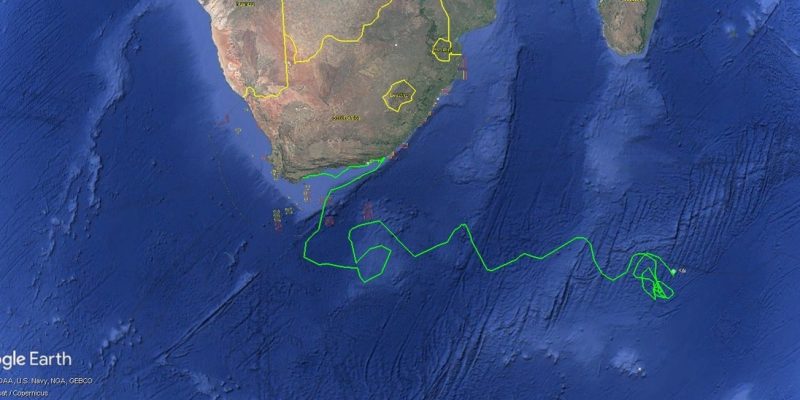
Kai, a loggerhead turtle who spent nearly six years in rehabilitation with lung and buoyancy problems, has now been at sea for 182 days and has covered 8,815 kilometers, about 5,477 miles. The Two Oceans Aquarium published his latest satellite tracking update on November 17. The number is not the interesting part. The interesting part is that a turtle who could not hold his depth in a tank is now using the Indian Ocean’s largest current exactly the way turtles who were never in a tank use it.
Where he actually is
Kai was released into the De Hoop Marine Protected Area in May 2026 by the Two Oceans Aquarium Foundation’s Turtle Conservation Centre. Since then he has averaged 48.4 kilometers a day, roughly 30 miles, and a good share of that pace is not his own effort. He went south down the east coast of South Africa on the Agulhas Current, the warm fast current that runs down that coast and then turns back on itself below the country. The returning limb is called the Agulhas Return Current, and it runs east into the southern Indian Ocean. Kai is on it.
It has carried him to a remote stretch of the southwestern Indian Ocean, far southeast of South Africa and south of Madagascar. The aquarium describes the water there as dynamic, full of swirling eddies at moderate temperatures, and notes that he could be encountering places where currents concentrate food. The published track shows exactly that: long smooth eastward curves for thousands of kilometers, then a knot of tight loops where his position marker now sits. A turtle traveling in straight lines is going somewhere. A turtle circling is usually eating.
Why the aquarium is pleased rather than merely relieved
Because the shape of the track is familiar. Some of South Africa’s earliest sea turtle tracking work followed female leatherbacks after nesting, and 42 satellite-tagged leatherbacks from the nesting beach at iSimangaliso Wetland Park, tracked between 1996 and 2013, produced tracks that run along the Agulhas the same way Kai’s does. Later studies of loggerhead and leatherback hatchlings found the same thing: young turtles dispersing into the open ocean also use the Agulhas retroflection, the place where the current doubles back.
And in both the adult leatherbacks and the hatchlings, the animals were not simply being carried. They were swimming and navigating while using the current. The aquarium’s point about Kai is that he appears to be doing the same, which is a specific claim about a rehabilitated animal rather than a general one about turtles.
That matters because the question that hangs over every release is not whether the animal swims away. It is whether it behaves like a wild animal six months later, when nobody is watching and the water is cold and a thousand kilometers from anywhere. Six years is a long time in a tank. Loggerheads are not taught migration by their parents, and the aquarium’s read is that the instinct is intact and switched on the moment he was back in the ocean.
There is precedent at this aquarium for exactly that. Yoshi, a female loggerhead, spent 20 years at the Two Oceans Aquarium before her release and then crossed the Indian Ocean to Australia. Two decades in human care did not take the navigation out of her.
What tracking cannot tell anyone
Whether he lives. The aquarium says so itself: tracking alone cannot tell us everything about long-term survival. A transmitter reports position until it stops, and when it stops it does not say why. Tags are shed, batteries die, biofouling kills the signal, and animals die, and from shore those four look identical.
The aquarium has recent experience of the ambiguity. Nori, the green turtle we wrote about alongside Kai in September, went quiet in October after 309 days and 12,540 kilometers, and the aquarium’s position on that silence is that it is almost certainly the tag rather than the turtle. That is a reasonable read and it is also an admission that nobody can be sure. Kai’s dataset is now the live one of the two.
His tag was still reporting as of the aquarium’s November 17 update, and nothing the aquarium has published since changes that.
A note on the listing
The loggerhead turtle, Caretta caretta, is assessed as Vulnerable on the IUCN Red List as a global species. The aquarium states no category in this update, so there is nothing here to correct, which is worth recording as often as the reverse. It is worth naming the list anyway, because sea turtle status is frequently reported as a single global figure when the Red List also assesses regional subpopulations separately and they do not all carry the same category.
Which zoos or aquariums paid for this?
This one is unusual on our beat, because the zoological institution is not a distant funder writing a check to somebody else’s project. The Two Oceans Aquarium Foundation runs the Turtle Conservation Centre itself, held Kai for nearly six years, released him and owns the tracking program. The aquarium is the funder, and it is also the party in the water.
We looked for an outside zoo or aquarium behind Kai’s tag specifically and did not find one. The November 17 update names no sponsor, no grant and no partner institution at all. The only satellite tag the aquarium has publicly credited to an outside payer in this program is Nori’s, which its own update attributes to the Morukuru Goodwill Foundation, described there as her adopters, and that is a private foundation rather than a zoological institution. Who paid for Kai’s tag is simply not stated anywhere we can read, and we would rather say that than imply a network the documents do not show.
Quick answers
- How far has Kai the loggerhead turtle traveled?
8,815 kilometers, about 5,477 miles, in the 182 days since his release, according to the Two Oceans Aquarium’s update of November 17, 2026. That is an average of 48.4 kilometers a day.
- Where was he released?
Into the De Hoop Marine Protected Area on the Western Cape coast of South Africa, in May 2026, by the Two Oceans Aquarium Foundation’s Turtle Conservation Centre. He had spent nearly six years in rehabilitation with lung and buoyancy problems.
- Where is he now?
In the southwestern Indian Ocean, far southeast of South Africa and south of Madagascar, carried east by the Agulhas Return Current. The aquarium describes that water as full of swirling eddies where currents can concentrate food.
- Why does his route matter?
Because it looks like a wild turtle’s route. Tracks from 42 satellite-tagged leatherbacks nesting at iSimangaliso Wetland Park between 1996 and 2013 follow the Agulhas the same way, and studies of hatchlings found the same use of the Agulhas retroflection. In all of those cases the animals were actively swimming and navigating, not drifting.
- Is the loggerhead turtle endangered?
The loggerhead, Caretta caretta, is assessed as Vulnerable on the IUCN Red List as a global species. The Red List assesses some regional subpopulations separately, and they do not all carry the same category.