
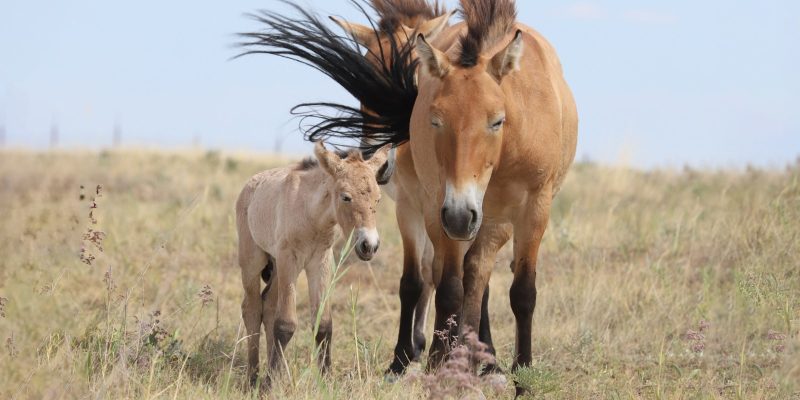
On August 22, 2026, a Przewalski’s horse foal was born on the steppe of central Kazakhstan. Nobody arranged the mating, nobody was standing by, and that is the entire point.
The colt was born at the Alibi reintroduction center on the edge of the Altyn Dala state reserve. His mother is a mare named Tessa, from Tierpark Berlin. His father is a stallion named Zorro, from Prague Zoo. Both arrived in Kazakhstan in June 2024, on the first of three planned transports organized by Prague Zoo and its partners.
He is the first Przewalski’s horse foal born in the wild in Kazakhstan to parents who were themselves brought back.
And then a second one
Update, September 10, 2026. There are now two. In the last week of August a second foal was born at Alibi, to a mare named Umbra who also came out of Tierpark Berlin in 2024. Both foals are healthy, and both were on their feet a short time after being born.
Tessa and Umbra were both among the first seven Przewalski’s horses flown to Kazakhstan under the Return of the Wild Horses project, which Prague Zoo leads. They traveled on a Czech military transport aircraft. Two years later, the two of them have produced the first foals born on central Kazakh soil in roughly two hundred years.
Die Geburt des ersten Fohlens ist das Ergebnis einer enormen Menge an Arbeit, die lange vor der Ankunft der Pferde in Kasachstan begonnen hat.
The birth of the first foal is the result of an enormous amount of work that began long before the horses arrived in Kazakhstan.
Vera Voronova, director of the Association for the Conservation of Biodiversity of Kazakhstan, in a statement translated from German
Voronova’s team prepared the ground and the infrastructure, ran the logistics of moving the animals, and monitors the herd daily. What she said next is the part worth holding onto: the task now is to watch how this first Kazakh-born generation grows, and whether it becomes the foundation of a population that sustains itself without help.
The herd is still being assembled. Four more mares arrived in 2026 from Nuremberg, Marwell Zoo in the United Kingdom and Tierpark Berlin, along with four stallions from Prague Zoo. Kazakhstan is the third country where Przewalski’s horses have been returned to their original range, after Mongolia and China.
What was lost
Przewalski’s horse is the last wild horse on earth. Every other free-roaming horse, including American mustangs, descends from domestic animals that got loose. This one never went through human hands as a species, which makes it a genuinely different animal from the horse in a paddock.
It went extinct in the wild. The last confirmed sighting in Mongolia was in the 1960s, and for roughly thirty years the entire species existed only in zoos, descended from a small founder group. Everything alive today traces back to that bottleneck.
Kazakhstan lost its horses even earlier. Bringing them back to the Altyn Dala means returning a species to a landscape it has been absent from for around two centuries.
Why a foal is the milestone and a transport is not
Moving horses is logistics. It is difficult, expensive logistics, involving crates and aircraft and quarantine, but a delivered animal is a delivered animal. What nobody can guarantee in advance is whether animals raised in European zoos will find enough to eat on a Kazakh steppe, survive a winter there, form a functioning herd, and then breed.
A foal born on the ground answers all of those questions at once.
“Narození hříběte je jeden z mnoha kroků na cestě k úspěšné reintrodukci.”
The birth of the foal is one of many steps on the road to a successful reintroduction.
Lenka Poliaková, director of Prague Zoo, in a statement translated from Czech
That is a careful sentence, and she is right to be careful. One foal is not a population. But the difference between a reintroduction that is going to work and one that is not usually shows up right here, in the first generation born on site.
Prague’s long involvement
Prague Zoo has been central to this species for decades. It has kept the international studbook for Przewalski’s horse, which means the record of who is related to whom, across every zoo holding the species, has been maintained from Prague. In a species rebuilt from a handful of founders, that bookkeeping is not administrative. It is the thing that keeps the remaining genetic diversity from collapsing.
The Kazakhstan project is the practical end of that work: taking the studbook’s careful pairings and putting the results on a steppe.
North American zoos hold the species too. A Przewalski’s horse foal was born at the Bronx Zoo this year, part of the same global population that fed the Kazakh releases.
Sources: Zoo Praha and Tierpark Berlin. Quotations translated from the Czech and the German. This article was updated on September 10, 2026 to add the second foal.
Quick answers
- What happened in Kazakhstan?
A Przewalski's horse foal was born on the steppe of central Kazakhstan on August 22, 2026, at the Alibi reintroduction center on the edge of the Altyn Dala state reserve. He is the first Przewalski's horse foal born in the wild in Kazakhstan to parents who were themselves brought back.
- Who are the parents?
A mare named Tessa from Tierpark Berlin and a stallion named Zorro from Prague Zoo. Both arrived in Kazakhstan in June 2024, on the first of three planned transports organized by Prague Zoo and its partners.
- Why is the Przewalski's horse different from other wild horses?
It is the last wild horse on earth. Every other free-roaming horse, including American mustangs, descends from domestic animals that got loose. The Przewalski's horse never went through human hands as a species.
- When did it go extinct in the wild?
The last confirmed sighting in Mongolia was in the 1960s, and for roughly thirty years the entire species existed only in zoos, descended from a small founder group.