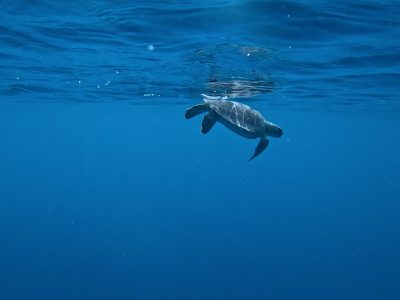

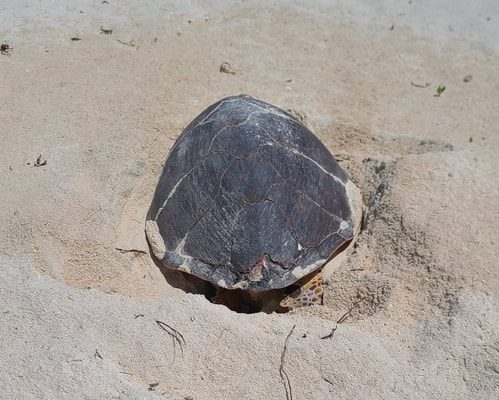
A hawksbill sea turtle spent three hours on a beach on Ile Plate, in the Seychelles, excavating one egg chamber after another and abandoning each of them before she finally found ground she would accept. The Island Conservation Society team watching her got something out of the long morning that they would not have had from a quick nest: enough time to tag her.
ICS published the account on 6 October 2026, as part of an update on a nesting season that is now well under way on the island.
Five nests since 20 August
The team on Ile Plate has recorded five successful hawksbill sea turtle (Eretmochelys imbricata) nests since 20 August. As activity has picked up, patrols along the shoreline have gone to as many as two a day, which is how the team records emergences, follows nesting attempts and keeps track of individual nests through the season.
The long encounter came on 18 September. The female began before 7 a.m. and worked at it for hours, digging several potential chambers and leaving each one, before completing a nest at around 10 a.m. She carried no tags when the team found her, which ICS is careful to say does not mean this was her first season: a turtle can nest for years without ever meeting anybody with a tag applicator.
What a tag is actually for
Tagging is the part of this that pays off later rather than now. An identified individual can be recognized the next time she comes ashore, which is what turns one morning into data on repeat nesting, on movement between nesting sites, and on whether Ile Plate is holding its place as a nesting beach over the long run. One turtle tagged in September 2026 is a line in a table; the same turtle recorded again in 2029 is a population trend.
For Maria Daniella Aza, Assistant Conservation Officer for ICS on Ile Plate, it was also the first sea turtle she had ever tagged.
“After receiving training on both Ile Plate and Aride Island, being able to put that training into practice was an amazing experience,” she said. “Every turtle we record contributes to something much bigger, helping us better understand Hawksbill populations and their nesting activity over time.”
Five nests is the opening of a season rather than its result. ICS expects the picture to fill in as patrols continue through the rest of the nesting period.
How endangered is the hawksbill?
ICS calls the species critically endangered, and on this one the facility and the assessment agree. The IUCN Red List assesses Eretmochelys imbricata as Critically Endangered, so there is no correction owed here, which is worth saying out loud because it is not always the case.
Which zoo is behind this?
Here the answer is partial, and the limit is worth stating. The Island Conservation Society is a Seychellois non-governmental organization founded in 2001 that runs conservation centers on five islands. It publishes its partners as a single composite image of logos rather than as a list of names, so the trace has to be done by reading the picture.
Read that way, one zoological institution appears on it: the Institute of Zoology, the research division of the Zoological Society of London, which operates London Zoo and Whipsnade Zoo. It appears twice. The rest of the wall is governments, funds and universities: the Government of Seychelles, UNDP, the Global Environment Facility, SeyCCAT, the Seychelles Fishing Authority, the Seychelles National Parks Authority, the Seychelles Islands Foundation, The Nature Conservancy, the Save Our Seas d’Arros Research Center, Islands Development Company, several resorts, and universities including Exeter, La Reunion, Seychelles, Carleton, Cardiff, Leeds and UMass Amherst.
The wall says nothing about which project any partner is attached to, and nothing in this story names a funder at all. So we are not claiming that ZSL paid for turtle patrols on Ile Plate. What we can say is that of roughly forty-five organizations ICS puts its name beside, exactly one is a zoological institution, and no accredited zoo or aquarium is named anywhere in this piece of work. Earlier ICS stories we have traced named the Islands Development Company and a hotel group as funders and no zoo at all, and that remains the pattern.
For the scale of the sector that is largely absent here: the Association of Zoos and Aquariums reports that in 2025 its 235 accredited and certified facilities spent approximately $372.4 million on conservation across 139 countries. There is no published breakdown isolating what any region received, and we will not print one.
ICS has produced this kind of patient, single-animal record before. A tagged hawksbill came back to Desroches Island after fifteen years, which is exactly the payoff that a tag applied on a long September morning is reaching for.
Source: Island Conservation Society, 6 October 2026.
Quick answers
- How many hawksbill nests have been recorded on Ile Plate this season?
Five successful nests since 20 August 2026, which the Island Conservation Society describes as the start of the season rather than its total.
- Why did the team tag the female they watched on 18 September?
Tagging lets the same turtle be identified if she returns, which builds records of repeat nesting, movement between nesting sites and long-term nesting patterns on the island.
- Does an untagged turtle mean a first-time nester?
No. ICS is explicit that a turtle found without tags may well have nested before without ever having been tagged.
- How is the hawksbill sea turtle assessed?
The IUCN Red List assesses Eretmochelys imbricata as Critically Endangered, which matches the wording ICS uses.
- Does a zoo or aquarium fund this work?
No accredited zoo or aquarium is named in connection with it. Of roughly forty-five organizations on the ICS partner wall, the only zoological institution is the Zoological Society of London’s Institute of Zoology, and nothing attaches it to the Ile Plate turtle patrols.