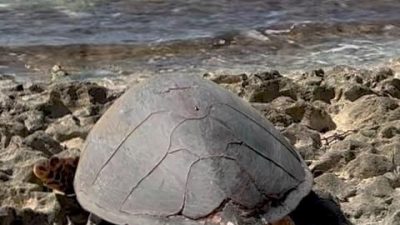

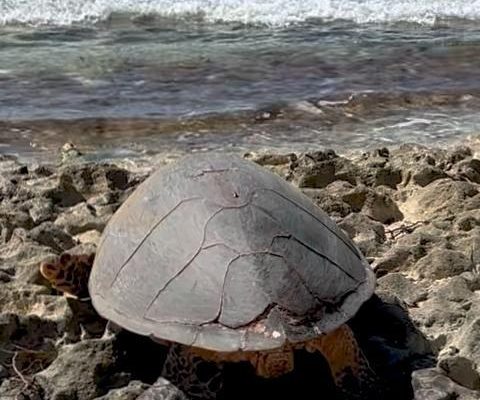
A female hawksbill turtle hauled out on Desroches Island in the Seychelles outer islands, dug a nest in the bushes in front of a resort villa, laid her clutch and went back to the sea. Then the conservation team checked the tag on her flipper and found she had done the same thing on the same stretch of shore fifteen years earlier.
The Island Conservation Society, which runs a conservation center on Desroches, reported the return on November 25, 2025. It is one of the oldest tagged turtles the organization has on its books, not only for the island but for Seychelles.
How do you know it is the same turtle?
By the tag. Sea turtle programs fit small numbered metal tags to the trailing edge of a front flipper, and the number is the animal’s identity for the rest of her life. When a tagged female comes ashore to nest, a team that reads the tag knows exactly who she is and where she has been recorded before.
In this case the number sent the team back into fifteen years of records.
“Once we realized it was a returning female turtle, we checked the GPS data from our archives dating back to 2009, when ICS first arrived on the island, and were able to determine that it’s not just a returning turtle, it’s a turtle that had a special spot on the island where she wanted to lay eggs again,” said James Wareing, assistant conservation officer for the Island Conservation Society on Desroches.
How close was the second nest to the first?
Close enough to be the point of the story, and the two published figures do not quite agree. The society’s written account says the turtle laid “just a few meters away from its first nest location.” The caption on the society’s own map of the two nest sites says they sit “just 140 meters apart.” Both descriptions come from the same organization on the same day, and we have not been able to reconcile them, so here are both.
Either way the behavior is the same and it is the reason biologists care. Nesting females return to the beach where they themselves hatched, and many return to a favored patch of it, season after season, across decades. A gap of fifteen years between two recorded nests a short walk apart is that fidelity showing up in a field notebook.
What else is nesting on Desroches?
More than most visitors would guess. The island averages over thirty hawksbills a year and more than one hundred nests. Green turtles nest there in larger numbers and all year round, with over seventy females and roughly four hundred nests annually, and the society reports that the green turtle count on Desroches has nearly doubled since it began collecting data in 2009.
The hawksbill season that this female opened had started late, around the middle of October rather than August or September. Wareing said that matters.
“From our data, a late start in the season usually means that we will see fewer hawksbill turtles this year compared to other years. This highlights the need to continue conservation efforts,” he said.
Because females lay several clutches in a season, he expected her to come back before the season closed around March. The society has published nothing further about her, and its news page carries no item later than December 2025, so we do not know whether she did.
A note on the listings
The hawksbill, Eretmochelys imbricata, is Critically Endangered on the IUCN Red List, with a decreasing global population. That is what the society says and it is what the Red List says.
The green turtle listing has moved. The society’s account calls Chelonia mydas Endangered, which was its category for two decades. The current global assessment, dated December 9, 2024 and published in 2025 by B.P. Wallace and A.C. Broderick, places the green turtle at Least Concern with an increasing population trend. We default to the assessment. It is worth saying that the society’s own Desroches number, a nesting count that has nearly doubled since 2009, points in exactly the same direction as the reassessment does.
Which zoo or aquarium is behind this?
We looked, and we did not find one. The partners the Island Conservation Society names around its Desroches work are the island’s resort operator and the Islands Development Company, and neither is a zoological institution. There is no accredited zoo or aquarium we can put behind this nest count, and we are not going to imply one.
That is worth stating plainly rather than skipping, because zoos and aquariums do fund an enormous amount of this kind of work elsewhere. The Association of Zoos and Aquariums reports that 235 accredited and certified facilities spent approximately $372.4 million on conservation across 139 countries in 2025. No published breakdown isolates how much of that reaches any one region, and the Seychelles outer islands appear to be running this particular program on their own.
Our earlier piece on the booby colony on St Francois Atoll reached the same answer about the same organization, from a different island.
Sources: the Island Conservation Society’s account of the nesting, and the IUCN Red List assessment for Chelonia mydas.
Quick answers
- What happened on Desroches?
A female hawksbill turtle came ashore on Desroches Island in the Seychelles outer islands and nested in front of a resort villa. The Island Conservation Society team read the numbered tag on her flipper and found she had been recorded nesting on the same island fifteen years earlier, in 2010.
- How do they know it is the same animal?
A flipper tag. Sea turtle programs fit a small numbered metal tag to the trailing edge of a front flipper, and that number identifies the animal for life. The society matched the number against GPS and nesting records it has kept since it arrived on Desroches in 2009.
- How far apart were the two nests?
The society gives two figures. Its written account says the second nest was a few meters from the first. The caption on its own map of the two sites says they are 140 metres apart. We could not reconcile them, so we report both.
- How many turtles nest on Desroches?
The society reports an average of more than thirty hawksbills and over one hundred hawksbill nests a year. Green turtles nest year round in larger numbers, with more than seventy females and around four hundred nests annually, and the green turtle count has nearly doubled since 2009.
- How threatened are these species?
The hawksbill, Eretmochelys imbricata, is Critically Endangered on the IUCN Red List with a decreasing population. The green turtle, Chelonia mydas, was reassessed on December 9, 2024 and is now Least Concern with an increasing population trend, which is a change from the Endangered listing the society cites.
- Which zoo or aquarium funded this?
None that we could verify. The partners the Island Conservation Society names around its Desroches work are the island's resort operator and the Islands Development Company, and neither is a zoological institution. We looked for accredited zoo or aquarium funding behind this and did not find any.