
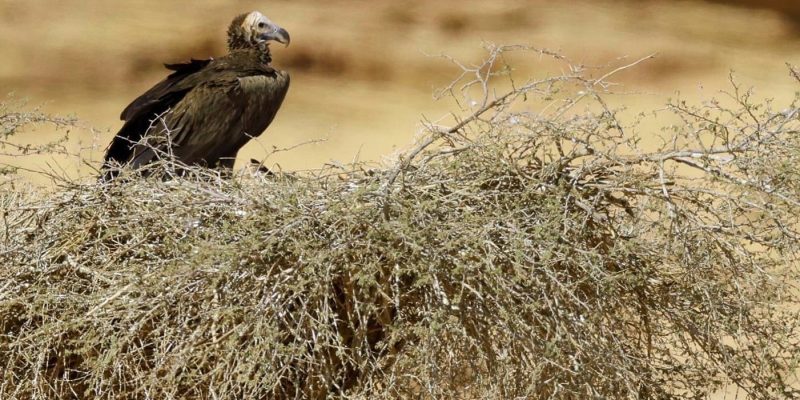
A lappet-faced vulture in northwestern Saudi Arabia is now carrying a solar-powered satellite tag, and the people who put it there went looking for her nest first. The Royal Commission for AlUla and King Abdullah University of Science and Technology found an active nest, monitored it, ran the veterinary checks, fitted the transmitter and returned the bird to the nest. The program was announced on July 16, 2026, and by September the commission had widened it.
The numbers underneath it are small enough to be worth stating plainly. Field monitoring records between 20 and 30 lappet-faced vultures in AlUla, which the commission puts at roughly 2.5 percent of the species’ population in Saudi Arabia. Four breeding pairs were observed in the area during the current season. One of those four raised the bird now wearing the tag.
What a tag on one bird is actually for
The stated aim is not to follow a single vulture for its own sake. It is to record where this bird goes after it leaves the nest, and to use that track to identify which habitats matter, which corridors it moves along, and where along those routes it runs into trouble. Vultures are long-lived, wide-ranging and slow to breed, so the places they are killed are often nowhere near the places they are counted. A tag is one of the few instruments that connects the two.
That is also why the rest of the Saudi effort reads the way it does. Alongside the tracking, Arab News reported in September that measures now include insulating power lines along migration routes, regulating hunting seasons, and monitoring through the National Center for Wildlife. Power lines matter here in a specific way: the commission’s own account notes that the tagged bird had been roosting regularly on a high-voltage line.
A second sighting worth more than it sounds
In September the commission reported that the environmental monitoring team in Sharaan Nature Reserve, a protected area of more than 1,500 square kilometers, had documented a Ruppell’s vulture, in what is believed to be only the second official record of that species in AlUla. A single bird is not a population. But for a species the IUCN Red List assesses as Critically Endangered, a confirmed second record of a Ruppell’s vulture in a reserve that is being actively surveyed is the kind of observation that tells a monitoring team its survey is working.
The lappet-faced vulture itself is assessed as Endangered on the IUCN Red List, which is the category the commission used. That is worth a sentence only because it so often goes the other way: facilities and agencies tend to reach for a stronger word than the assessment supports. Here the wording and the assessment match.
We looked for a zoo behind this and did not find one
ZooReviews traces the funding behind conservation work in this region as a matter of routine, because a great deal of it turns out to run on money raised at zoo and aquarium gates. This one does not, as far as we can establish. The partners named are the Royal Commission for AlUla, a Saudi government body, and King Abdullah University of Science and Technology. The broader national measures are credited to the National Center for Wildlife, also governmental. No accredited zoological institution appears anywhere in the program’s own account of itself, and we are not going to imply one.
The commission does have a documented tie to the zoological world, and it belongs to a different program. Its Arabian Leopard Fund runs a fully funded partnership with the Durrell Conservation Academy in the United Kingdom, alongside a training program at the Arabian Leopard Conservation Breeding Center in Taif. That is leopard work, not vulture work, and stretching it across to cover this would be exactly the sort of connection we try not to invent.
For contrast, the trace does sometimes land. When VulPro in South Africa hatched its first lappet-faced vulture chick, the organization named Cincinnati Zoo and Zoo Zlin among the funders it thanked, in its own announcement. Same species, a continent away, and a chain that holds.
What would settle it
The tagged bird’s track is the test. If the data show where AlUla’s vultures go when they leave, and the commission publishes it, the four breeding pairs stop being a seasonal count and start being a baseline. Until then this is one transmitter on one bird, which is how almost every useful tracking dataset begins.
Source: the Royal Commission for AlUla, Royal Commission for AlUla, KAUST Launch Specialist Lappet-Faced Vulture Tracking Program, July 16, 2026, carried the same day by the Saudi Press Agency; and Arab News, September 7, 2026.
Quick answers
- What did the Royal Commission for AlUla and KAUST do?
They fitted a solar-powered GPS transmitter to a lappet-faced vulture in AlUla, in northwestern Saudi Arabia, after identifying and monitoring an active nest and carrying out veterinary examinations. The bird was returned to its nest. The program was announced on July 16, 2026.
- How many lappet-faced vultures are there in AlUla?
Field monitoring regularly records between 20 and 30 lappet-faced vultures in AlUla, which the commission puts at approximately 2.5 percent of the species’ population in Saudi Arabia. Four breeding pairs were observed in the area during the current season, including the pair that raised the tagged bird.
- How is the lappet-faced vulture assessed on the IUCN Red List?
As Endangered. That is the same category the Royal Commission for AlUla used in its own announcement, so no correction is owed here.
- What is the Ruppell’s vulture record?
The environmental monitoring team in Sharaan Nature Reserve, a protected area of more than 1,500 square kilometers, documented a Ruppell’s vulture in what is believed to be only the second official sighting of the species in AlUla. The IUCN Red List assesses the Ruppell’s vulture as Critically Endangered.
- Which zoo or aquarium funds this program?
None that we could verify. The partners named are the Royal Commission for AlUla, a Saudi government body, and King Abdullah University of Science and Technology. Broader national measures are credited to the National Centre for Wildlife, also governmental. We looked for an accredited zoological funder behind this work and did not find one, which is a finding rather than a gap.
- What else is Saudi Arabia doing for vultures?
Arab News reported in September 2026 that measures include installing protective insulation on power lines along migration routes, regulating hunting seasons under environmental rules, and running monitoring programs and field studies through the National Centre for Wildlife. Power lines are directly relevant: the commission’s own account notes the tagged bird had been roosting regularly on a high-voltage line.