
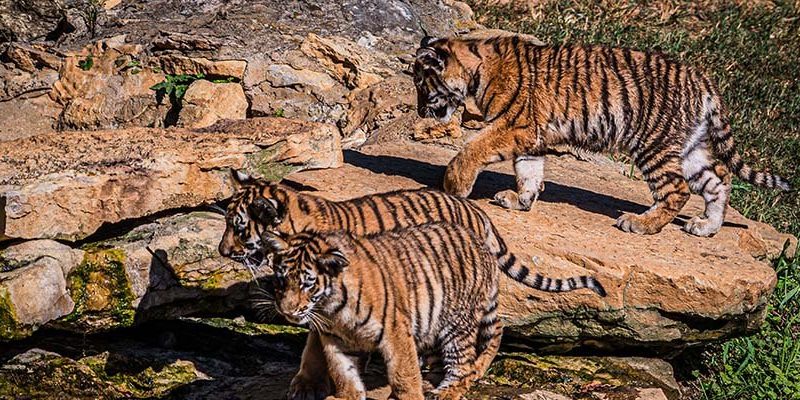
The Louisville Zoo’s three Amur tiger cubs now have a posted schedule. Frankie, Masha and Mira are out in their outdoor habitat every day from noon to 3 p.m., which the zoo says is the window with the best odds of catching all three at once. The sisters are frequently out before and after it too, but noon to three is the appointment to keep.
They are the first Amur tiger cubs born at the Louisville Zoo in 22 years.
Twenty-two years between litters
The trio was born on May 27, 2026 at 1:24 a.m. to four-year-old Viktoria and Timmy, who is nearly nine. The last Amur tiger cubs born at the zoo were Irisa and Anya, on October 1, 2004. With these three, 29 Amur tiger cubs have been born at the Louisville Zoo across its 57-year history.
A 22-year gap is not neglect, and it is worth understanding why. Breeding in an accredited collection is not a decision a single zoo makes on its own. The Association of Zoos and Aquariums runs a Species Survival Plan for Amur tigers, a cooperative program that tracks the pedigree of every animal in the North American population and recommends which pairs should breed, and when, so the managed population keeps as much of its genetic variation as it can for as long as it can. A zoo can go two decades without a recommendation and be doing exactly what it should be. Louisville has worked inside the same system on other species, most recently with a maned wolf named Ayla who arrived on an SSP recommendation.
How the cubs got their names
Two of the three were named by donors. At the Friends of the Louisville Zoo’s annual Zoofari gala in June, attendees could adopt the tigers, and two of those adoptions came with the chance to work with zoo staff on a name.
Frankie was co-adopted by Central Bank and by Donna and Ron Kramer, and is named for Donna’s late father, Frank Arnold, Sr., a longtime zoo supporter and a member of the Zoo Foundation Board. Masha, the Russian form of Mary, was chosen by Jessica and Mac Thompson of White Clay, honoring several members of Jessica’s family who share the name. Jessica’s sister Mary Whitney shares a birthday with the cubs. Mira was named by the cubs’ care team; it means “peace” or “world” in Slavic languages.
Why they will be out more, not less, as it gets cold
“As the cubs continue to grow and become more comfortable in their habitat, we’re excited to make it even easier for families to plan a visit to see them,” said Louisville Zoo Director Dan Maloney. “At nearly five months old, Frankie, Masha, and Mira are becoming more active, independent, and playful each day, and we know our visitors will enjoy watching their development in the months ahead. As a species native to the Amur River region of eastern Russia, northeastern China, and into the Korean peninsula, the cubs are perfectly suited for the cooler winter months ahead.”
That last point is the one most visitors get backwards. Amur tigers were once called Siberian tigers, a name they have outgrown, since they are no longer found in Siberia. Their range is the Amur River region, and they are built for it. A December morning is better tiger weather than an August one.
“The excitement around Frankie, Masha, and Mira has been incredible,” said Louisville Mayor Craig Greenberg. “These cubs have quickly become some of Louisville’s most beloved new residents, and this viewing schedule gives more guests the opportunity to experience the wonder of seeing these endangered animals grow and thrive at the Louisville Zoo.”
About the species
The Amur tiger is the largest living cat. Males average 400 to 600 pounds and measure up to 14 feet long including the tail; females average 250 to 300 pounds. Every tiger’s stripe pattern is unique, which is how researchers identify individuals from camera-trap photographs in the wild.
The IUCN Red List assesses the tiger as Endangered, which matches the zoo’s own description. One point of precision worth having: the Red List assesses tigers as a single species, Panthera tigris, rather than issuing separate categories for the Amur, Sumatran, Bengal and other populations. So “Endangered” is the standing of the tiger as a whole, and the Amur population sits inside it.
If you are planning a visit
The Louisville Zoo is open daily year-round. From now through March 19, 2027 the gates are open 10 a.m. to 4 p.m., with guests exiting by 5 p.m. The zoo is closed on Thanksgiving, Christmas and New Year’s Day. The cub window of noon to 3 p.m. sits comfortably inside the day either way.
Source: Louisville Zoo, October 8, 2026.
Quick answers
- When can I see the Louisville Zoo tiger cubs?
Every day from noon to 3 p.m. in their outdoor habitat. The zoo says that window gives the best odds of seeing all three at once, though the cubs are frequently outside at other times too.
- What are their names?
Frankie, Masha and Mira. All three are female.
- When were they born?
May 27, 2026, at 1:24 a.m., to four-year-old Viktoria and Timmy, who is nearly nine.
- Why is this a big deal?
They are the first Amur tiger cubs born at the Louisville Zoo in 22 years. The last were Irisa and Anya, on October 1, 2004. Counting these three, 29 Amur tiger cubs have been born at the zoo in its 57-year history.
- How did the cubs get their names?
Two were named by donors who adopted the tigers at the Friends of the Louisville Zoo's Zoofari gala in June. Frankie is named for Frank Arnold, Sr., the late father of co-adopter Donna Kramer and a member of the Zoo Foundation Board. Masha, the Russian form of Mary, was chosen by Jessica and Mac Thompson to honor family members who share the name. Mira was named by the care team and means peace or world in Slavic languages.
- Will the cubs be outside in winter?
Yes, and more rather than less. Amur tigers come from the Amur River region of eastern Russia, northeastern China and the Korean peninsula, and the zoo expects the cubs to be well suited to the cold months ahead.
- Are Amur tigers endangered?
The IUCN Red List assesses the tiger as Endangered. The Red List treats tigers as a single species, Panthera tigris, rather than assessing the Amur, Sumatran and other populations separately, so that category covers the species as a whole.