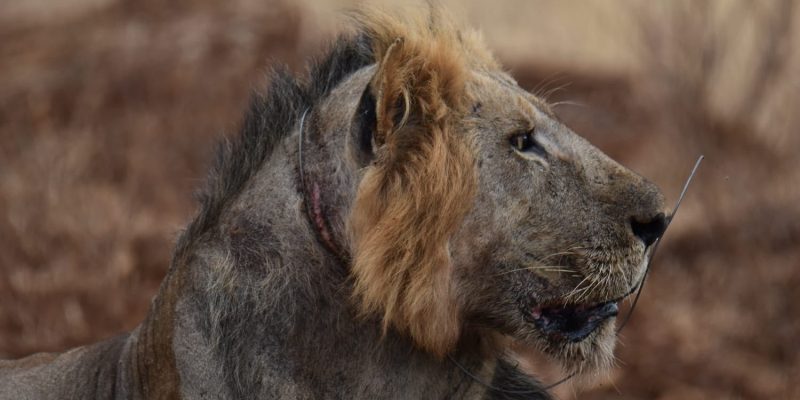
A young male lion in Kenya’s Meru National Park was found with a wire snare pulled tight around his neck. On September 25 the Kenya Wildlife Service published what happened next: a team drawn from its Meru staff and from Born Free cut the wire off, cleaned and treated the wound, gave him antibiotics and pain relief, and left him with what the service calls a positive recovery outlook.
The snare had not been set for him. It was set for whatever grazing animal walked into it first, anything sellable as bushmeat. As the service puts it in its own account, snares do not discriminate or consult a target list.
What the team found, and what they did
The wire had constricted the lion’s neck tightly enough to cause injuries that, left alone, would have killed him slowly. By the time the team reached him he was too weak and too worn down by pain to put up much resistance, which made the approach possible.
The veterinarians removed the wire and treated the neck wound. A fuller examination turned up a second, unrelated injury, damage to a testicle that the service suspects came from a fight, and they treated that as well. Samples went into bio-banking, which is the unglamorous part: tissue and blood stored against future work on lion health and genetics, useful to people who will not be born for a while.
Kenya Wildlife Service has published nothing further about the animal since. That is worth saying plainly rather than implying a happy ending we have not confirmed. What the service reported was a prognosis, not an outcome.
Why snares are the problem they are
A snare is a loop of wire and a bit of patience. It costs almost nothing, it works while nobody is watching, and it catches whatever walks into it. The service lists the consequences it sees: animals maimed and killed indiscriminately, and contaminated bushmeat entering human food systems, which makes this a public health matter as well as a wildlife one. Its #SayNoToBushmeat campaign asks communities to refuse the trade and report illegal activity to a toll-free hotline.
Lions are not a rare casualty of this. The current IUCN Red List assessment for Panthera leo, published in 2025 and assessed on May 6 of that year by Nicholson and colleagues, lists the species as Vulnerable under criterion A2c on the basis of an estimated 34 percent decline, with the population still decreasing. Kenya is one of the countries where lions remain extant. Hunting and trapping of terrestrial animals is one of the threats the assessment names.
We have covered the other end of this species’ story, the managed side, in Saint Louis Zoo’s return of two African lions to habitat. A snared lion in Meru and a lion pair on exhibit in Missouri are not the same animal in the same world, but the Red List assessment that governs both is.
Which zoo funded this? None, and the reason is interesting
Our standing practice on conservation stories in this region is to trace the money back to the accredited zoos and aquariums paying for the work, and to say so when there are none. Here there are none, and the absence is not an accident.
Born Free runs the Pride of Meru program, started in 2014, across the Meru Conservation Area’s national parks, reserves and surrounding community land. The partners it names for that work are the Kenya Wildlife Service, the Wildlife Research and Training Institute, the Leo Foundation, the Sheldrick Wildlife Trust and local communities. Not one is a zoological institution, and no zoo or aquarium appears anywhere on the program’s published partner list.
That is because Born Free opposes zoos. The organization’s own position statement says it opposes the exploitation of wild animals in zoos and aquaria, that “zoos can never recreate the complex environment that animals have evolved to encounter in the wild,” and that “the majority of species kept in most zoos are not threatened with extinction in the wild.” It is one of the most effective field conservation organizations working in Kenya, and it would decline the framing this publication usually applies.
We think that is worth printing rather than working around. The Association of Zoos and Aquariums reports that its 235 accredited and certified facilities spent approximately $372.4 million on conservation across 139 countries in 2025, and no published breakdown isolates the African share, so we do not print one. What the Meru rescue shows is the other half of the picture: a great deal of the veterinary work that keeps individual African animals alive is done by national agencies and by NGOs, some of which want nothing to do with the zoo world at all. A lion out of a snare is the same good day either way.
Quick answers
- What happened in Meru National Park?
A young male lion was found with a wire snare tight around his neck. A team from Kenya Wildlife Service's Meru staff and from Born Free removed the wire, cleaned and treated the wound, and gave him antibiotics and pain relief. The service published the account on September 25, 2026 and reported a positive recovery outlook.
- Was the snare set for the lion?
No. Snares are set for grazing animals that can be sold as bushmeat and they catch whatever walks into them. The Kenya Wildlife Service's own account makes that point: a snare does not consult a target list.
- Is the lion alive now?
We do not know. The service reported a prognosis rather than an outcome, and it has published nothing further about the animal since. Its newest item as of this writing is dated September 28, 2026.
- Which zoo or aquarium funded this work?
None that we could find, and the reason is unusual. Born Free runs the Pride of Meru programme, begun in 2014, and the partners it names are the Kenya Wildlife Service, the Wildlife Research and Training Institute, the Leo Foundation, the Sheldrick Wildlife Trust and local communities. Born Free also publicly opposes keeping wild animals in zoos and aquaria, so no zoological institution appears anywhere in this story.
- How threatened are lions?
The IUCN Red List's most recent assessment of Panthera leo was published in 2025 and assessed on May 6 of that year by Nicholson and colleagues. The species is Vulnerable under criterion A2c, on an estimated 34 percent decline, with the population still decreasing. Hunting and trapping of terrestrial animals is one of the threats the assessment names, and Kenya is one of the countries where lions remain extant.