Saudi Arabia’s National Center for Wildlife has published the Kingdom’s first national guide to running vulture restaurants, and says three of the feeding stations will be established this year alongside local partners. The point is not to feed hungry birds. It is to put a clean carcass in front of a vulture before a poisoned one does.
What a vulture restaurant actually is
The term is a term of art, and it is doing real work here. A vulture restaurant is a managed site where carcasses of known origin are put out deliberately for wild vultures, on a schedule, under hygiene rules, and watched. Conservation biologists also call it supplementary feeding. The distinction that matters is the word known: anyone can leave a dead cow in a field, and across this region that is precisely the problem.
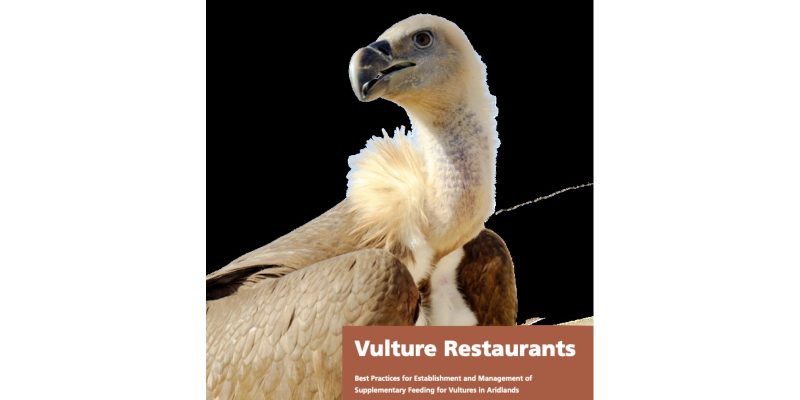
The guide, Vulture Restaurants: Best Practices for Establishment and Management of Supplementary Feeding for Vultures in Aridlands, runs to eighteen pages and was written by Sharif Jbour, Saleh Al A’amri, Ali Al Ahmari and Ahmad Boug. The National Center for Wildlife published it, and it was released in English and Arabic through the Convention on Migratory Species memorandum of understanding on migratory birds of prey in Africa and Eurasia, the Raptors MOU, in August 2026.
The problem the stations are built around
Vulture populations are collapsing across Africa and the Middle East, and the guide is blunt about the main reason. Farmers lace cattle carcasses with poison to kill the predators taking their livestock, and the scavengers that arrive first eat it. A second threat is pharmaceutical. Veterinary anti-inflammatory drugs, diclofenac above all, cause fatal liver failure in vultures at doses a treated cow carries easily, and a study cited in the guide found diclofenac and ketoprofen widely available in Saudi veterinary pharmacies, imported from Spain, India, Pakistan and Jordan and also produced locally.
The guide does not oversell its own remedy. It cites a provisioning trial in which mean daily vulture mortality fell to 0.072 birds per day, eight birds across 111 days, against 0.387 birds per day, 41 birds across 106 days, in control periods when no safe food was provided. It then describes feeding stations as “a valuable interim measure in slowing vulture population decline locally until Diclofenac can be withdrawn from veterinary use.” That is a conservation document conceding that the real fix is a drug ban, and running a stopgap in the meantime.
Where a feeding station can go
The siting rules are specific enough to rule most places out. A station should sit no more than about two kilometers from the nearest breeding cliff, in open ground with few trees so the birds can see it, and near water, with the water fenced where livestock use is a risk. Sites where livestock owners already dump dead animals are preferred, because the vultures already know them. Areas near medium and high voltage power lines and wind farms are excluded outright for electrocution and collision risk. A station must be at least twenty kilometers from the nearest aerodrome and, by preference, at least two kilometers from paved roads.
What goes on the table, and what does not
Only carcasses known to be free of predator poison, veterinary anti-inflammatories and lead shot may be used. Animals from dairy farms and livestock holdings are examined before they are accepted. Road kill is excluded entirely, including feral dogs and other carnivores, on the grounds that a dead animal by a road may have been poisoned or shot. Large carcasses are opened at the soft tissue of the abdomen so that the birds can reach the organs immediately.
Food goes out at least twice a week, daily at large stations serving big colonies, and in the early morning so that mammalian scavengers do not get there first. The carcass position is rotated within the same general site for hygiene, and the site is cleaned after every feed. There is even guidance on how the food is laid out: scattered remains let more birds in at once and stop adults monopolizing the meal, while whole carcasses suit Griffon Vultures and can shut Egyptian Vultures and kites out.
Watching without being seen
Daily monitoring is advised, and the guide would rather it happened through a lens than a person. Camera traps or livestreaming cameras are preferred to avoid disturbance, with several cameras at larger stations, and trap cameras come with a side benefit of recording which nocturnal carnivores are visiting. Where cameras are not workable, observation runs from a camouflaged hide at least 500 meters back.
Which species, and which list
Five vultures are covered. The guide gives each one an IUCN Red List category, and gets them right, which is worth saying because facility and agency write-ups often do not. The Lappet-faced Vulture (Torgos tracheliotos) and the Egyptian Vulture (Neophron percnopterus) are both listed Endangered. The Bearded Vulture (Gypaetus barbatus) and the Cinereous Vulture (Aegypius monachus) are Near Threatened. The Griffon Vulture (Gyps fulvus) is Least Concern, and its Saudi colonies are, by the guide’s account, the largest vulture population on the Arabian Peninsula. The Cinereous Vulture turns up only as a winter visitor, in small numbers, and the Bearded Vulture is present in the Kingdom but probably no longer breeds there.
One number in the guide is worth carrying out of it: where vultures are absent, carcasses take three to four times longer to decompose. The birds are, as the text puts it, nature’s organic waste collectors, and the economic argument for keeping them is the speed at which they work.
Which zoos are behind it
We looked for an accredited zoo or aquarium funding this work and did not find one. The guide’s partners are the National Center for Wildlife, the Royal Society for the Protection of Birds, the IUCN Species Survival Commission’s Vulture Specialist Group, the Convention on Migratory Species, Saving Asia’s Vultures from Extinction and the Raptors MOU, with field input credited to colleagues at the King Salman Royal Nature Reserve. The named reviewers are Dr. John W. Mallord and Chris Bowden of the RSPB, Dr. Olivier Duriez of the University of Montpellier, Umberto Gallo-Orsi of the CMS and Ruben Moreno-Opo Diaz-Meco of Spain’s Ministry for Ecological Transition. Not a zoological collection among them.
That is the second Saudi vulture story in two months to come out this way. In September we traced a solar GPS tag fitted to a lappet-faced vulture in AlUla and found no zoo behind that either. The pattern is not an accusation. Vulture conservation on the Arabian Peninsula is being run by a state regulator, a British bird charity and a UN treaty secretariat, and those are the institutions that deserve the credit for it. For scale on the other side of the ledger, the Association of Zoos and Aquariums reports that 235 accredited and certified facilities spent approximately $372.4 million on conservation across 139 countries in 2025. No published breakdown isolates what any one region received.
The guide is public, in both languages, at the Raptors MOU document library.
Quick answers
- What is a vulture restaurant?
A managed site where carcasses of known origin are put out deliberately for wild vultures, on a schedule, under hygiene rules, and monitored. Conservation biologists also call it supplementary feeding. The point is to give vultures a meal that has not been poisoned.
- What has Saudi Arabia announced?
The National Center for Wildlife has published the Kingdom’s first national guide to establishing and managing vulture restaurants, and says three feeding stations will be set up this year with local partners. Other national bodies may open their own in the same period.
- Why do vultures in the region need this?
Two reasons the guide names. Farmers across the region lace cattle carcasses with poison to kill predators taking their livestock, and scavengers eat it. Separately, veterinary anti-inflammatory drugs such as diclofenac and ketoprofen cause fatal liver failure in vultures, and a study cited in the guide found both widely available in Saudi veterinary pharmacies.
- Where can a feeding station be built?
The guide sets siting rules: no more than about two kilometers from the nearest breeding cliff, in open ground with few trees, near water, and away from high-risk infrastructure. Areas near medium and high voltage power lines and wind farms are excluded, stations must be at least twenty kilometers from the nearest aerodrome, and at least two kilometers from paved roads is preferred.
- What food is allowed?
Only carcasses known to be free of predator poison, veterinary anti-inflammatories and lead shot. Dairy and livestock animals are examined first. Road kill is excluded entirely, including feral dogs and other carnivores, because an animal dead by a road may have been poisoned or shot.
- Which vultures does the guide cover?
Five. The Lappet-faced Vulture and the Egyptian Vulture, both listed Endangered on the IUCN Red List; the Bearded Vulture and the Cinereous Vulture, both Near Threatened; and the Griffon Vulture, Least Concern, whose Saudi colonies the guide describes as the largest vulture population on the Arabian Peninsula.
- Which zoo or aquarium funds this work?
We looked and did not find one. The guide was produced by the National Center for Wildlife with the Royal Society for the Protection of Birds, the IUCN Species Survival Commission’s Vulture Specialist Group, the Convention on Migratory Species, Saving Asia’s Vultures from Extinction and the Raptors MOU. None of them is a zoological collection. That is the second Saudi vulture story in two months to trace out this way.
- Does supplementary feeding actually work?
The guide cites a trial in which mean daily vulture mortality fell to 0.072 birds per day, eight birds across 111 days, against 0.387 birds per day, 41 birds across 106 days, in control periods with no safe food provided. The guide still calls feeding stations an interim measure until diclofenac can be withdrawn from veterinary use.