The African Penguin and Seabird Sanctuary at Gansbaai, on South Africa’s Western Cape coast, is taking in starving penguins faster than it can buy fish to feed them. Its usual sardine supplier has no stock. The Dyer Island Conservation Trust, which runs the sanctuary, has found one supplier still holding a tonne and is trying to raise the roughly R39,100 it would cost, plus three freezers to put it in.
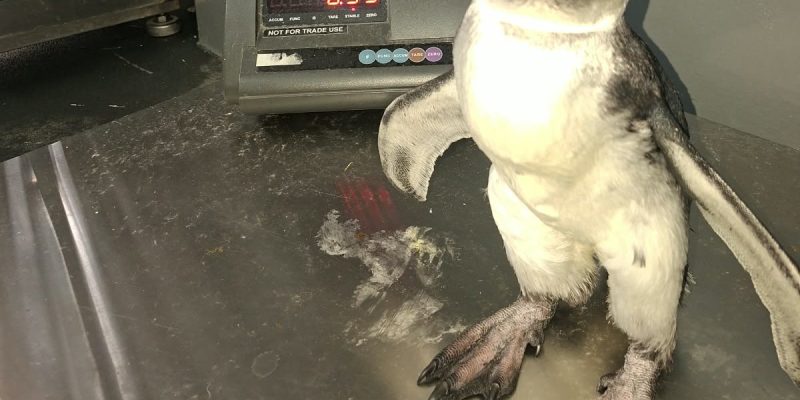
Some of the birds arriving at the sanctuary weigh as little as 950 grams. These are young adults, birds that should be at sea feeding and are instead being carried in off the sand.
What the rescue team is seeing
The trust says it now receives calls daily from members of the public reporting weak, emaciated penguins. Its rescue team works a long stretch of coastline, from Kleinmond in the west to Stilbaai in the east, and brings the birds back to the hospital at Gansbaai.
Rehabilitation is not complicated in principle. A thin penguin needs warmth, fluids, treatment for whatever else is wrong with it, and a great deal of fish. The fish is the part that has failed. Sardines are the staple for African penguins in care, as they are for the birds in the wild and for most of the other predators working the same water, and a sanctuary without a freezer full of them cannot do the work at all.
The South African Foundation for the Conservation of Coastal Birds, better known as SANCCOB, has offered to sell the Gansbaai sanctuary some of its own sardine supply. That is an unusual thing for one rehabilitation center to do for another, and that it was necessary says something about how tight the supply has become.
Why are the sardines missing?
The shortage in the freezer and the shortage at sea are the same story. When the African penguin was assessed for the IUCN Red List in 2024, it was placed in the Critically Endangered category under criteria A3bce+4bce, and the assessment named the cause plainly: an extremely rapid decline driven principally by competition with commercial fisheries and by climate-driven shifts in where the prey fish are. Sardine and anchovy are those prey fish.
The numbers behind that assessment are stark. BirdLife International’s species factsheet gives 19,800 mature individuals, about 9,900 breeding pairs, from a 2023 count, against 141,000 pairs in the 1956 and 1957 season and 17,700 pairs as recently as 2019. The projected reduction over three generations exceeds 80 percent, and nine colonies now hold more than 95 percent of every African penguin alive.
Dyer Island itself, the island the trust is named for and which lies a short distance off Gansbaai, is one of those nine. It held 903 breeding pairs in the 2023 count, which placed it fifth among South African colonies behind Dassen Island, Bird Island in Algoa Bay, Stony Point and Robben Island. The birds coming through the sanctuary’s door are not an abstraction from somewhere else. They are from the colony on the horizon.
Who pays for this work?
We make a habit of asking which accredited zoos and aquariums stand behind the field conservation we cover, because the connection is real more often than readers expect and because the institutions that fund it rarely say so loudly. In this case the honest answer is that we looked and did not find one.
The Dyer Island Conservation Trust names its primary partners on its own About page as Marine Dynamics and Dyer Island Cruises, two commercial marine tourism operators that the trust says provide it with both significant funding and the operational platform it works from. We found no accredited zoo or aquarium listed as a funder of the trust or of the sanctuary.
SANCCOB, the organization sharing its fish, is a different picture. Its published supporter page carries the logos of a long row of zoological institutions, among them Cheyenne Mountain Zoo, the Cincinnati Zoo and Botanical Garden, the Columbus Zoo, the Dallas Zoo and the California Academy of Sciences, alongside the Italian Association of Zookeepers. That is zoo money reaching African penguins, and it is worth saying so. It is not, however, the money that would buy the tonne of sardines in this story, and we are not going to imply that it is. Those institutions support SANCCOB’s own program. What SANCCOB did here was offer a neighbor part of its stock.
What happens next
The trust is asking for two specific things rather than general support: the price of a tonne of sardines, and three freezers, so that the next time a supplier runs dry the sanctuary is not starting from an empty cold room. Its own framing is the part that will still be true in six months. A rescue operation cannot keep answering an ongoing crisis on sporadic donations.
We have written before about the same team collecting stranded African penguins at Struisbaai, and the shape there was the same: birds found thin, carried in, fed back up, returned to the water. The feeding is the whole middle of that sentence, and it is the part that costs money.
Anyone who finds a penguin in trouble on that coast can call the trust’s penguin rescue line on +27 72 598 7117.
Quick answers
- Why can a penguin sanctuary not buy sardines?
The Dyer Island Conservation Trust says its usual supplier has no stock. It has found one supplier still holding a tonne, at a cost of about R39,100, and is raising that amount along with the price of three freezers to store it.
- How underweight are the penguins coming in?
Some weigh as little as 950 grams. They are young adult birds that should be at sea feeding, and the trust now gets calls daily from the public reporting weak and emaciated penguins between Kleinmond and Stilbaai.
- How many African penguins are left?
BirdLife International gives 19,800 mature individuals, about 9,900 breeding pairs, from a 2023 count. The species was assessed as Critically Endangered in 2024. There were 141,000 pairs in the 1956 and 1957 season.
- Do any zoos fund this sanctuary?
We looked and did not find one. The trust names Marine Dynamics and Dyer Island Cruises, two commercial marine tourism operators, as its primary partners. SANCCOB, which offered to share its own sardine stock, is separately supported by a long list of zoos and aquariums.