
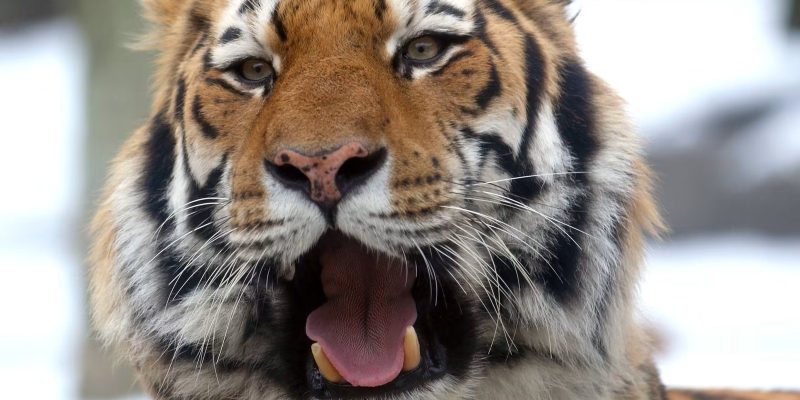
Utah’s Hogle Zoo has a new Amur tiger. Maxim, or Max to his keepers, is a 14-year-old male who moved to Salt Lake City from the Saint Louis Zoo, and he is settling into Asian Highlands alongside the zoo’s seven-year-old female, Sasha.
A breeding recommendation, not a transfer of convenience
Max came west on a recommendation from the Association of Zoos and Aquariums Amur Tiger Species Survival Plan, the cooperative program that manages husbandry and breeding across accredited institutions so the population under human care stays genetically diverse. Pairing him with Sasha was a deliberate genetic decision made at the level of the whole North American population, not a single zoo.
Amur tigers are listed as Endangered on the IUCN Red List. They live in the forests and mountains of the Russian Far East and northeast China in populations isolated enough from one another that movement between them is difficult, which is the core of the problem, alongside poaching, habitat loss and fragmentation, declining prey and human-wildlife conflict. As top predators they regulate large-herbivore numbers, which shapes the health of the forests and grasslands around them. The central conservation action is protecting and restoring large, connected landscapes tigers can actually move through.
Hogle Zoo has been building out its big-cat side for a while; its Amur leopard cubs went outdoors in June.
What Max is like
“Max tends to be a very laid-back and good-natured tiger,” said Brittany Dowdell, supervisor of Asian Highlands. “He’s been enjoying time in the water, a good cardboard box (or any enrichment he can shred), and other enrichment toys like large tiger-sized boomer balls. He has been very willing to train with keepers, which helps us get to know him and builds trust. He is very vocal with keepers, chuffing and chatting when he sees them and loves to do the tiger long call.”
That willingness to train matters more than it sounds. Voluntary training is how keepers do everything from a body-condition check to a blood draw without anesthesia, and a tiger who chooses to participate is a tiger who gets better care.
How you introduce two tigers
Slowly. Tigers are solitary outside of breeding season, which typically runs from January into March or April, so the two of them cannot just be put in a yard together. The care team started with smell and habitat swapping, letting Sasha into the space Max has been using and then returning Max to it after she leaves, so each learns the other’s scent before ever seeing them.
From there the pair will meet through mesh in controlled settings, and eventually go through a structured introduction known as a howdy, where keepers watch for the specific behaviors that say both cats are comfortable. Every step is driven by what the tigers themselves do; nothing moves forward until their behavior says it should.
What visitors will notice
Noise, mostly. Max and Sasha are both vocal tigers, and roars, chuffs and long calls all play a part in communication and in sizing up a potential mate. They may not always be calling to each other, but Max’s arrival is likely to get Sasha talking more than usual. Anyone walking through Asian Highlands this season has a genuinely good chance of hearing an Amur tiger long call, which is not a sound anyone forgets.