
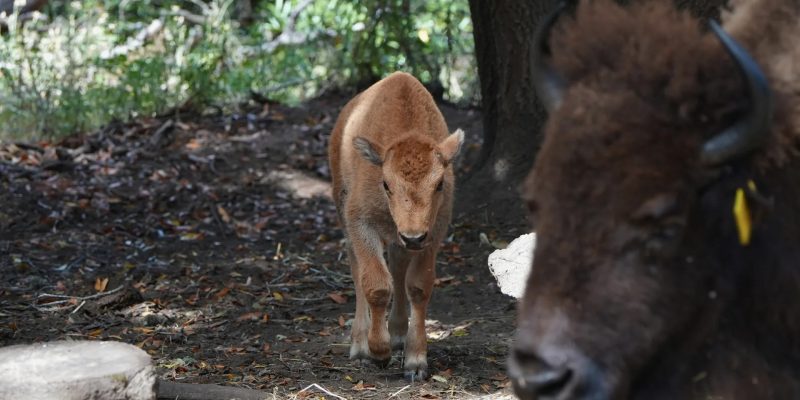
The fiftieth bison calf born under Oakland Zoo’s partnership with the Blackfeet Nation arrived this spring. The animals it descends from were taken off Blackfeet land in 1873.
Oakland Zoo announced the milestone on June 9, 2026. The calf is the fourth of the 2026 season and the fiftieth since the partnership began in 2016.
How the program works
This is an outbreeding program, which is a specific thing and not a general goodwill gesture. Bison come from the Blackfeet herd to the zoo’s California Trail habitat, breed with the zoo’s animals to introduce new genes, and the offspring go back to tribal land in Browning, Montana once they are old enough.
The most recent transfer was in early May 2026: five bison, three males and two females, driven 22 hours by trailer. More than 40 animals have gone back to Montana since the partnership started, across four releases.
“We provide the necessary care to ensure a healthy herd of bison until their release, but the Blackfeet care for their soul. We feel privileged and proud to have participated in this journey, with four successful releases. We consider it a great honor to have the trust of our Blackfeet partners. It is an opportunity to be involved in a program that restores a part of a culture that was once taken away.”
Angela Gibson, zoological manager, Oakland Zoo
Why genetics is the whole problem
The bison at Oakland trace to animals captured on Blackfeet land in 1873, which became the Pablo-Allard herd. That herd descends from a founder group of somewhere between four and seven individuals.
Read that again. A significant share of the plains bison alive today came through a genetic bottleneck of fewer than ten animals. The U.S. Fish and Wildlife Service puts it plainly: the loss of genetic diversity, combined with the loss of natural selection, threatens the ecological restoration of bison as wildlife.
That is why an outbreeding program exists at all. Fourteen female bison came to Oakland from the Blackfeet herd in April 2018. Two bulls from Yellowstone joined them that fall specifically to widen the gene pool. The calves going back to Montana carry genes the Montana herd did not have.
The numbers behind the collapse
The Department of the Interior puts the historical North American population at 60 million. By 1889, according to the Fish and Wildlife Service, only a few hundred wild plains bison remained, scattered across the Texas Panhandle, Colorado, Wyoming, Montana and the western Dakotas, plus a small number in captive herds.
Today there are roughly 20,500 plains bison in conservation herds and about 420,000 in commercial herds. Those are very different categories. A commercial bison is livestock. A conservation bison is an attempt at wildlife.
It is worth resisting the single-cause version of this history. The National Park Service account credits drought from 1846, competition from horses, the commercial robe trade and the 1840 intertribal peace alongside the Army campaigns of the 1860s. The collapse had more than one author.
Why does a California zoo breed bison for Montana?
Because the constraint is genetic, not numeric. There is no shortage of bison in North America. There is a shortage of bison carrying genes that were not funneled through a handful of survivors in the 1880s. A zoo has the facilities to hold, pair and monitor animals for a breeding purpose, and the Blackfeet herd has the land for them to be wildlife on. Neither party can do the other half.
Iinnii
Bison are iinnii in Blackfeet. The Iinnii Initiative grew out of conversations beginning in 2009, with a kickoff meeting in May 2011 attended by 85 tribal members, and its stated goals are an enduring conservation landscape, bison restored to it, and restoration connected to economic sustainability.
The 2016 agreement that started Oakland’s involvement moved 88 bison from Elk Island National Park in Canada to ancestral lands on the Two Medicine River. Oakland selected 11 for the breeding program.
“With the birth of its 50th calf, the Oakland Zoo is helping bring home far more than buffalo to the Blackfeet Nation. Together, we are restoring threads that were once severed, between people and place, culture and identity, memory and future, showing what becomes possible when restoration is rooted in relationship.”
Cristina Mormorunni, executive director, Indigenous LED
Ervin Carlson, president of the Intertribal Buffalo Council, put the point more directly when the first transfer happened in April 2018: for centuries the buffalo took care of us, and it is now our turn to take care of them.
“Witnessing the bison roam in their historical lands adds a profound beauty and significance that is difficult to capture without experiencing Montana firsthand.”
Nik Dehejia, CEO, Oakland Zoo
This is the model that shows up wherever restoration actually works: an institution supplying capacity, and a community supplying the reason. The same shape appears in the Punta San Juan penguin work in Peru, where the zoo builds and the local program decides.
Source: Oakland Zoo; U.S. Fish and Wildlife Service. Historical population figures from the Department of the Interior and the National Park Service.